Q.(a) Draw the pattern of waveforms of the first two harmonics in a closed pipe.
You're viewing a preview — the full solution, concept, methods & PYQ mapping are locked.
Start your 14-day free trial to unlock the full solution →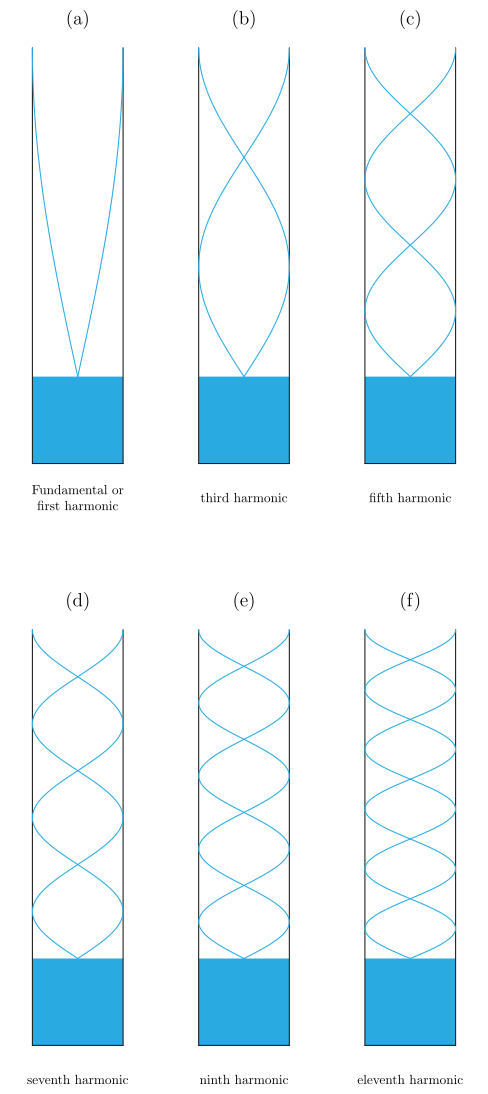
In a pipe closed at one end, the boundary conditions (node at the closed end, antinode at the open end) allow only odd harmonics. This answer describes the exact shape of the first two allowed standing-wave patterns in words — a diagram source was not supplied with this question, so the node/antinode positions below are given precisely enough for you to sketch them.
Boundary conditions
- The closed end cannot vibrate, so it is always a displacement node (N).
- The open end is free to vibrate maximally, so it is always a displacement antinode (A).
For a pipe of length L, the allowed standing-wave patterns satisfy
so only odd harmonics (1st, 3rd, 5th, …) are possible — even harmonics cannot satisfy a node-at-one-end/antinode-at-the-other boundary condition.
First harmonic (fundamental, n = 1)
Shape: starting at the closed end (x = 0, a node), the displacement rises smoothly to a maximum at the open end (x = L, an antinode) — a single quarter-wave arch, with exactly one node and one antinode and no node/antinode in between.
Second allowed harmonic (the 3rd harmonic, n = 2)
With a node fixed at x = 0, the standing-wave pattern (nodes every λ₂/2, antinodes every λ₂/2 starting at λ₂/4) works out to:
- Node at x = 0 (closed end) …
Unlock everything free for 14 days
- Full step-by-step solutions
- Concept-first explanations
- Methods, shortcuts & mistakes
- PYQ mapping + timed mock tests
Full access for 14 days. No credit card required.