Exercises · 5.4
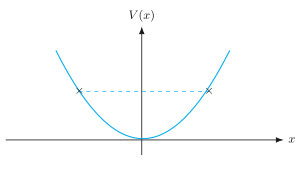
Q.The potential energy function for a particle executing linear simple harmonic motion is given by , where is the force constant of the oscillator. For , the graph of versus is shown in Fig. 5.12. Show that a particle of total energy moving under this potential must 'turn back' when it reaches .
Kerala DhseTextbookSubjective· 3mImportance★★★★★est
19% · 16/83 Questions
You're viewing a preview — the full solution, concept, methods & PYQ mapping are locked.
Start your 14-day free trial to unlock the full solution →For a particle in SHM, the turning points occur where kinetic energy becomes zero — i.e., where total energy equals potential energy. Setting gives , and with , solving yields .
The idea is simple: a particle moving under a conservative force has a fixed total energy , which is the sum of kinetic energy and potential energy . As the particle moves, energy sloshes between these two forms. At a turning point, the particle momentarily stops and reverses direction — so its kinetic energy is exactly zero. That means all the energy is potential.
So the condition for a turning point is:
Here, , with , and .
- Write the turning-point equation:
- Simplify the constant:
So:
- Solve for :
- Take the square root: …
Unlock everything free for 14 days
- Full step-by-step solutions
- Concept-first explanations
- Methods, shortcuts & mistakes
- PYQ mapping + timed mock tests
Full access for 14 days. No credit card required.