Botany · Ch 4 — Biotechnology: Principles and Processes
Obtaining the Foreign Gene Product
Obtaining the Foreign Gene Product
The ultimate goal of most recombinant DNA technology is not just to multiply a piece of alien DNA, but to produce a useful protein in large quantities. Once the foreign gene has been inserted into a vector and transferred into a host cell (bacterial, plant, or animal), the cell must be made to express that gene — that is, to actually manufacture the protein the gene codes for. This step is called expression of the foreign gene.
Getting a foreign gene to express properly in a host cell requires careful control of many technical details — the right promoters, regulatory sequences, and growth conditions. But even after you have successfully cloned the gene and optimised expression in a small culture, the real challenge is scaling up production. Why is large-scale production necessary? Because the protein is intended for practical use — as a medicine, an industrial enzyme, or a research tool — and the demand for such proteins can be enormous (for example, insulin or human growth hormone).
When a protein-encoding gene is expressed in a host that is not its natural source, the resulting protein is called a recombinant protein.
Small-scale and continuous culture
Initially, cells carrying the cloned gene can be grown on a small scale in the laboratory. The cultures are then harvested, and the desired protein is extracted and purified using various separation techniques (like chromatography or centrifugation).
For larger-scale production, cells can be multiplied in a continuous culture system. In this system, used (spent) medium is drained out from one side while fresh medium is added from the other. This keeps the cells in their physiologically most active state for longer periods, allowing continuous production of the protein.
Bioreactors
For truly large-scale production, cells are grown in specialised vessels called bioreactors or fermenters. A common design is the stirred-tank reactor.
A stirred-tank reactor is usually cylindrical or has a curved base. This shape helps in the efficient mixing of the reactor contents.
The key features of a stirred-tank bioreactor include:
- Agitator system (stirrer): Facilitates even mixing of the culture medium and ensures uniform availability of oxygen and nutrients to all cells.
- Oxygen delivery system: Either through the stirrer action or by bubbling air directly through the reactor. …
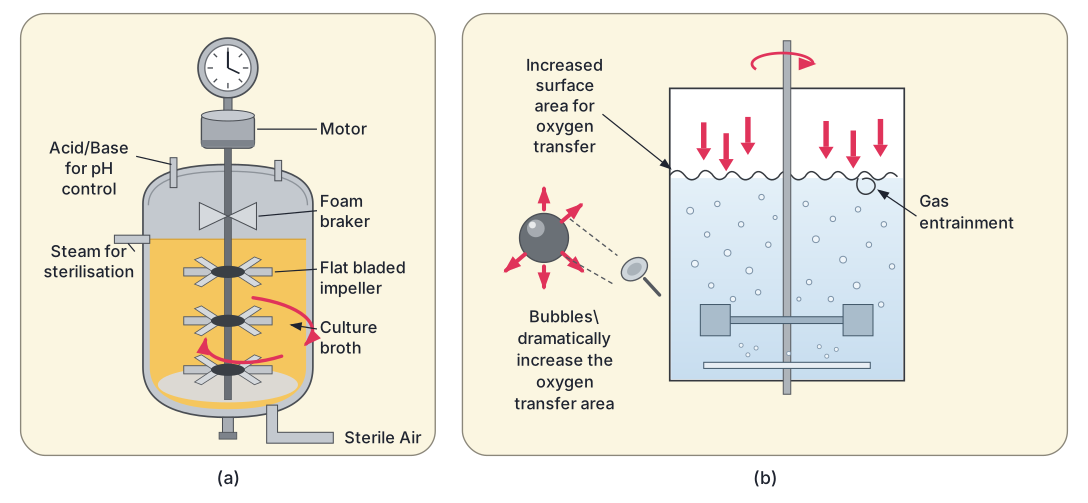
Drawn by us to help you understand the concept clearly, and verified to make sure it's accurate. For exams, practice from your textbook's own diagram.
Figure 9.7 shows two types of stirred-tank bioreactors side by side, labelled (a) and (b). Both are drawn as tall, cylindrical vessels with a curved base — the shape that helps the contents mix thoroughly. A central vertical shaft runs down into the tank, fitted with an agitator (stirrer) at the bottom. This stirrer is the key mechanical part: it rotates to keep the culture medium and cells evenly mixed, and to maintain uniform oxygen availability throughout the liquid.
Panel (a) is labelled “Simple stirred-tank bioreactor.” Around the main vessel, the diagram includes several control and monitoring systems drawn as attached boxes or ports. There is an oxygen delivery system (likely a pipe or inlet for supplying oxygen into the medium), a foam control system (to break up excess foam that can form during vigorous aeration), a temperature control system (often a jacket or coil around the tank), and a pH control system (for adding acid or base to keep the culture at the right pH). Small sampling ports are shown on the side of the vessel — these allow a small volume of culture to be withdrawn periodically without contaminating the rest.
Panel (b) is labelled “Sparged stirred-tank bioreactor through which sterile air bubbles are sparged.” It looks very similar to (a), but with one critical addition: a pipe or tube entering from the bottom of the tank, through which sterile air is bubbled (sparged) directly into the culture. The diagram shows these air bubbles rising up through the liquid. This sparging improves oxygen transfer and mixing beyond what the stirrer alone can achieve, because the rising bubbles create additional turbulence and increase the surface area for oxygen to dissolve into the medium. …