Q.Draw figure to show the splitting of d orbitals in an octahedral crystal field.
🔒You're viewing a preview — the full solution, concept, methods & PYQ mapping are locked.
🔒 Start your 14-day free trial to unlock the full solution →Concept understanding — Crystal Field Splitting
Crystal Field Splitting: From Intuition to Precision
Imagine you are a negatively charged electron sitting on a metal ion. All around you, the space is perfectly spherical — every direction feels the same. Your energy depends only on how far you are from the nucleus, not on which way you face.
Now imagine that six negative ions (or the negative ends of polar molecules) march in from the x, y, and z axes and stop close to you. Suddenly, the space around you is no longer uniform. If you try to move straight toward one of these approaching ions, you feel a strong repulsion — that path costs extra energy. If you move between the axes (say, along a diagonal), you feel less repulsion because you are farther from the incoming charges.
This is the core intuition: when ligands approach a metal ion, they break the spherical symmetry of the space around the metal. Different directions in space are no longer equivalent. Electrons in orbitals that point directly at the ligands get pushed up in energy; electrons in orbitals that point between the ligands stay lower.
The Precise Statement
Crystal Field Splitting is the splitting of degenerate d orbitals of a transition metal ion into two or more sets of different energies, caused by the electrostatic repulsion between the metal's d electrons and the negative charge (or dipole) of surrounding ligands.
For the most common geometry — octahedral — here is what happens:
- Six ligands sit at the corners of an octahedron, along the +x, −x, +y, −y, +z, −z axes.
- The dx2−y2 and dz2 orbitals point their lobes directly along these axes. These are the eg set. They feel maximum repulsion → higher energy.
- The dxy, dxz, and dyz orbitals point their lobes between the axes (into the octahedral faces). These are the t2g set. They feel less repulsion → lower energy.
The energy gap between these two sets is denoted by Δo (or 10Dq). The t2g set drops by 0.4Δo and the eg set rises by 0.6Δo, keeping the average energy unchanged (the "barycentre" rule).
The labels eg and t2g come from group theory — they describe how the orbitals transform under the symmetry operations of an octahedron. You do not need to memorise the derivation, but the notation is standard in every exam.
Why This Matters
Crystal field splitting explains three things you will see repeatedly:
- Colour — electrons can jump from t2g to eg by absorbing visible light. The gap Δo determines the colour you see.
- Magnetism — if Δo is large, electrons pair up in the lower t2g set (low spin). If Δo is small, electrons spread out (high spin). This changes the number of unpaired electrons. …
Why this formula?
Crystal Field Splitting: Why the Energy Splitting Occurs
Crystal Field Theory (CFT) explains how the d-orbitals of a transition metal ion split in energy when placed in an electrostatic field created by surrounding ligands (anions or polar molecules). The key result is that five degenerate d-orbitals split into two or more sets with different energies. Let's understand why this happens.
1. The Starting Point: Degenerate d-Orbitals
In a free transition metal ion (no ligands), all five d-orbitals have the same energy (degenerate). Their shapes are:
- dxy, dxz, dyz — lobes lie between the x, y, z axes (called t2g set in octahedral symmetry)
- dx2−y2, dz2 — lobes point directly along the x, y, z axes (called eg set)
Key idea: The spatial orientation of each orbital determines how it interacts with approaching ligands.
2. The Octahedral Case: Why eg Orbitals Are Higher in Energy
Imagine six ligands approaching along the +x, –x, +y, –y, +z, –z axes (octahedral geometry).
What happens to dx2−y2 and dz2?
- Their lobes point directly at the ligands.
- The negatively charged ligands repel the electron density in these orbitals.
- This repulsion raises the energy of these orbitals — they become less stable (higher energy).
What happens to dxy, dxz, dyz?
- Their lobes point between the axes (e.g., dxy lobes lie in the xy-plane but at 45° to x and y).
- They avoid the ligands — less repulsion.
- Their energy is lower than the eg set.
The Splitting Pattern
Δoct=E(eg)−E(t2g)
Where:
- E(eg) = energy of dx2−y2 and dz2 (higher)
- E(t2g) = energy of dxy, dxz, dyz (lower)
- Δoct is called the crystal field splitting energy (CFSE)
Why the name? The eg orbitals are "doubly degenerate" (2 orbitals), t2g are "triply degenerate" (3 orbitals). The letters come from group theory symmetry labels.
3. The Energy Conservation Rule
The total energy of all five d-orbitals must remain constant (no energy is created or destroyed). So:
- The center of gravity (average energy) of the split set equals the original degenerate energy.
- For octahedral splitting:
- 2 eg orbitals go up by +0.6Δoct each
- 3 t2g orbitals go down by −0.4Δoct each
Check:
2×(+0.6Δ)+3×(−0.4Δ)=1.2Δ−1.2Δ=0
This conservation of energy is a fundamental constraint — the splitting is not arbitrary.
4. The Tetrahedral Case: Why It's Opposite and Smaller
In a tetrahedral complex, four ligands approach from alternate corners of a cube. The axes are different:
- The dxy, dxz, dyz orbitals now point closer to the ligands (more repulsion).
- The dx2−y2 and dz2 orbitals point away from ligands (less repulsion).
Result:
- e set ( dx2−y2, dz2 ) — lower energy
- t2 set ( dxy, dxz, dyz ) — higher energy
The splitting is inverted compared to octahedral.
Magnitude:
Δtet≈94Δoct
Why smaller?
- Only 4 ligands (vs. 6) → less total repulsion.
- Ligands are not directly along axes → weaker interaction. …
Concept: Crystal Field Splitting – In an octahedral field, the five degenerate d orbitals split into two sets: the higher-energy eg (dx2−y2,dz2) and the lower-energy t2g (dxy,dyz,dzx).
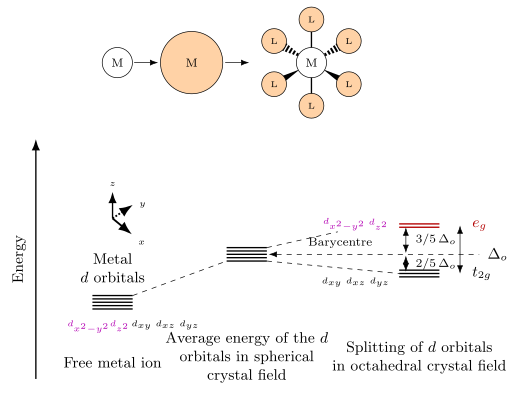
Reasoning:
- In an octahedral complex, six ligands approach along the x, y, and z axes.
- Orbitals with lobes pointing directly along these axes (eg) experience strong repulsion, raising their energy.
- Orbitals with lobes directed between the axes (t2g) experience less repulsion, so they remain lower in energy.
- The energy gap between the two sets is denoted Δo (or 10Dq).
Figure: …
In an octahedral crystal field, the five degenerate d‑orbitals split into two sets: the lower‑energy t2g set (dxy,dyz,dzx) and the higher‑energy eg set (dz2,dx2−y2). The splitting arises because the eg orbitals point directly at the ligands and experience greater repulsion.
The core idea: why does splitting happen?
Imagine placing a central metal ion inside an octahedron of six negative charges (ligands). The d‑orbitals are not all shaped the same — some lobes point directly toward the ligands, others point between them. An electron in an orbital that points straight at a ligand feels a strong electrostatic repulsion, raising its energy. An electron in an orbital that points between ligands feels less repulsion, so its energy stays lower.
This difference in repulsion is the entire origin of crystal field splitting. The five originally equal‑energy d‑orbitals break into two groups.
Step‑by‑step reasoning
-
Identify the orbital shapes relative to the axes
In an octahedral complex, the ligands lie along the +x, −x, +y, −y, +z, and −z axes.
- dz2 has a lobe along the z‑axis (plus a doughnut in the xy‑plane).
- dx2−y2 has lobes along the x and y axes.
- dxy, dyz, dzx have lobes that lie between the axes — in the planes at 45∘ to the axes.
-
Which orbitals point directly at the ligands?
The dz2 and dx2−y2 orbitals have their lobes aimed straight at the ligands on the axes. These are the eg set (two orbitals).
The dxy, dyz, dzx orbitals point between the axes, so they avoid the ligands. These are the t2g set (three orbitals).
-
Energy consequence
Because the eg orbitals experience direct repulsion from the ligand charges, their energy rises. The t2g orbitals, pointing into empty space between ligands, stay at a lower energy. The energy gap between the two sets is called Δo (or 10Dq).
-
The splitting diagram
On the left, the five d-orbitals of the free ion sit together at one (degenerate) energy level. On the right, in the octahedral field, they split into two groups: the eg pair (dz2,dx2−y2) raised above that level, and the t2g trio (dxy,dyz,dzx) lowered below it, separated by the gap Δo.
In its simplest form:
     e_g (higher energy)
     ↑
     |  Δ_o
     ↓
     t_{2g} (lower energy)
``` …
Crystal Field Splitting in an Octahedral Field
Method: Crystal Field Theory (CFT) — Electrostatic Repulsion Model
Core Concept
In an octahedral complex, the five d orbitals are not degenerate (equal in energy) because they experience different electrostatic repulsion from the six ligands placed along the x, y, and z axes.
Steps to Draw the Splitting Diagram
Step 1: Draw the energy axis
- Draw a vertical line (energy increasing upward).
- Mark a horizontal line labeled "Barycenter" or "Average energy of d orbitals in spherical field" — this is the energy the d orbitals would have if the field were spherically symmetric.
Step 2: Place the two groups of orbitals
- Above the barycenter, draw two degenerate (same energy) orbitals: dx2−y2 and dz2 — these are the eg set.
- Below the barycenter, draw three degenerate orbitals: dxy, dxz, dyz — these are the t2g set.
Step 3: Label the energy gap
- Draw a double-headed arrow between the t2g and eg sets.
- Label this gap as Δo (or 10Dq).
Step 4: Add orbital shapes (optional but helpful)
- Beside each orbital label, sketch the shape:
- dx2−y2: four lobes along x and y axes
- dz2: two lobes along z + a donut in xy plane
- dxy, dxz, dyz: four lobes between the axes
Why This Splitting Occurs
| Orbital Set | Orientation | Repulsion from ligands | Energy |
|---|---|---|---|
| eg (dx2−y2, dz2) | Point directly at ligands along axes | Maximum repulsion | Higher (+0.6Δo each) |
Common Mistakes in Drawing Octahedral Crystal Field Splitting
Mistake 1: Wrong Orbital Labels or Orientation
The error: Students often mislabel the dx2−y2 and dz2 orbitals, or draw them with incorrect spatial orientation.
How to avoid:
- Remember: dx2−y2 has lobes along the x and y axes (pointing directly at ligands in octahedral geometry)
- dz2 has a unique "doughnut" shape — a lobe along z-axis with a ring in xy-plane
- The three t2g orbitals (dxy,dxz,dyz) point between the axes
Key insight: In an octahedral field, ligands approach along x, y, and z axes. Orbitals pointing at axes (eg) experience more repulsion than those pointing between axes (t2g).
Mistake 2: Incorrect Energy Order
The error: Drawing t2g above eg, or placing them at the same energy level.
How to avoid:
- eg orbitals (dx2−y2,dz2) are higher in energy — they point directly at ligands
- t2g orbitals (dxy,dxz,dyz) are lower in energy — they point between ligands
- The energy gap is denoted as Δo (or 10Dq)
The eg set (dx2−y2,dz2) sits at the higher energy level, separated by the gap Δo from the t2g set (dxy,dxz,dyz) at the lower energy level.
Mistake 3: Forgetting the Barycenter
The error: Drawing the split levels without showing the average energy (barycenter) or misplacing it.
How to avoid:
- The barycenter (average energy of all five d-orbitals) must remain constant
- In octahedral field: eg orbitals go up by +0.6Δo, t2g go down by −0.4Δo
- Check: 2(+0.6)+3(−0.4)=1.2−1.2=0 ✓
Mistake 4: Unequal Spacing or Wrong Gap Size
The error: Drawing the eg and t2g levels with unequal spacing from the barycenter.
How to avoid:
- The eg level is farther from barycenter than t2g level
- Ratio: eg shift : t2g shift = 3:2 (because 2 orbitals × 3 parts = 3 orbitals × 2 parts)
- Draw the gap from t2g to barycenter as 2 units, and from barycenter to eg as 3 units
--- …
Showing the 12 most recent of 17 on this concept.
- KEAM 2026Set eng-2026-04184 marksMCQQ.Which of the following complex ion absorbs yellow colour in the visible region? (A) [Co(NH3)6]+3 (B) [Co(CN)6]3− (C) [Cu(H2O)4]+2 (D) [Co(NH3)5(H2O)]+3 (E) [CoCl(NH3)5]+2
›Reveal solutionSolution
A complex absorbs the colour complementary to the one it appears; the violet/purple [CoCl(NH3)5]2+ absorbs yellow.
Observed colour is complementary to the absorbed colour. A species that absorbs yellow light appears violet/purple. …
- KEAM 2026Set eng-2026-04204 marksMCQQ.The order of field strength of the following ligands in the spectrochemical series is (A) NCS−<CN−<SCN−<S2−<OH− (B) NCS−<OH−<S2−<NCS−<CN− (C) CN−<S2−<OH−<NCS−<SCN− (D) SCN−<S2−<OH−<NCS−<CN− (E) SCN−<S2−<CN−<NCS−<OH−
›Reveal solutionSolution
Field strength increases: SCN−<S2−<OH−<NCS−<CN−. …
- KEAM 2026Set eng-2026-04214 marksMCQQ.The correct increasing order of wavelength of absorption of the following complexes is(i) [CoCl(NH3)5]2+(ii) [Co(NH3)5(H2O)]3+(iii) [Co(NH3)6]3+(iv) [Co(CN)6]3− (A)(i) <(ii) <(iii) <(iv) (B)(i) <(ii) <(iv) <(iii) (C)(ii) <(i) <(iv) <(iii) (D)(iv) <(iii) <(ii) <(i) (E)(iv) <(i) <(ii) < (iii)
›Reveal solutionSolution
Wavelength is inverse to Δo; increasing λ: (iv)<(iii)<(ii)<(i). …
- KEAM 2026Set pha-2026-0420F4 marksMCQQ.Which one of the statements is not the limitation of valence bond theory of complexes? (A) It does not give a quantitative interpretation of the thermodynamic stabilities. (B) It does not give quantitative interpretation of magnetic properties.. (C) It explains the colour exhibited by coordination compounds. (D) It does not distinguish between weak and strong ligands. (E) It does not make exact predictions regarding the tetrahedral structures of 4-coordinated complexes.
›Reveal solutionSolution
A recognised limitation of VBT is that it fails to explain colour; the statement that it explains colour (C) is therefore not a limitation.
Valence bond theory has several well-known limitations: it gives no quantitative account of thermodynamic stabilities (A), no quantitative account of magnetic properties (B), does not distinguish strong from weak ligands (D), and makes no exact prediction of tetrahedral geometries (E) — all genuine shortcomings. …
- KEAM 2025Set eng-2025-04294 marksMCQQ.The complex ions [NiCl4]2− and [Ni(CN)4]2− differ by(i) Magnetic moment(ii) Geometry(iii) Hybridisation of central metal ion(iv) Oxidation state of nickel (A) (i),(ii) and(iv) (B) (i),(ii) and(iii) (C) (ii),(iii) and(iv) (D)(ii) and(iii) (E) (i), (ii),(iii) and (iv)
›Reveal solutionSolution
Both have Ni in the +2 state, so (iv) does not differ. They differ in magnetic moment (i), geometry (ii) and hybridisation (iii) — option (B).
Both complexes have Ni2+ (d8), so the oxidation state (iv) is the same in both — it cannot be a point of difference.
- [NiCl4]2−: Cl− is a weak-field ligand, so no pairing occurs. Configuration d8 with 2 unpaired electrons → sp3 hybridisation → tetrahedral, paramagnetic. …
- KEAM 2025Set eng-2025-04294 marksMCQQ.Four complex ions are given in Column I and the colours of light absorbed are given in Column II. Match the correct answer from the codes given below. Complex:(a) [Ti(H2O)6]3+;(b) [Cu(H2O)4]2+;(c) [CoCl(NH3)5]2+;(d) [Co(NH3)6]3+ Colour of light absorbed:(i) Blue;(ii) Yellow;(iii) Blue green;(iv) Red (A) (a)-(iii), (b)-(iv), (c)-(ii), (d)-(i) (B) (a)-(ii), (b)-(iv), (c)-(iii), (d)-(i) (C) (a)-(iii), (b)-(ii), (c)-(iv), (d)-(i) (D) (a)-(i), (b)-(iv), (c)-(ii), (d)-(iii) (E) (a)-(iii), (b)-(iv), (c)-(i), (d)-(ii)
›Reveal solutionSolution
[!TLDR]
Using crystal-field strength to rank the d-d absorption energies, [Ti(H2O)6]3+ absorbs blue-green, [Cu(H2O)4]2+ red, [CoCl(NH3)5]2+ yellow and [Co(NH3)6]3+ blue — option (A).
Concept
In a transition-metal complex, d-electrons are excited across the crystal-field gap Δ. The complex absorbs the wavelength matching Δ; a stronger ligand field means a larger Δ and absorption of higher-energy (shorter-wavelength, toward blue/violet) light. This CFT reasoning is standard in the NCERT/CBSE coordination-chemistry chapter that the KEAM syllabus draws from.
Solution
- (b) [Cu(H2O)4]2+: aqua ligands give a small Δ; the deep-blue solution absorbs low-energy red light ⇒ (iv).
- (a) [Ti(H2O)6]3+: a single d-d band near 500nm absorbs blue-green light (complex looks purple) ⇒ (iii). …
- KEAM 2025Set pha-2025-0424F4 marksMCQQ.Which of the following is a spin free complex? (A) [Ni(CO)4] (B) [Co(NH3)6]3+ (C) [Ni(CN)4]2− (D) [CoF6]3− (E) [Mn(CN)6]3−
›Reveal solutionSolution
"Spin free" = high spin. Only [CoF6]3−, with the weak-field F− ligand, keeps its d-electrons unpaired (high spin).
A spin-free (high-spin) complex forms with weak-field ligands, where the crystal-field splitting is too small to force pairing.
- [Ni(CO)4]: CO strong field, Ni(0) d10 — diamagnetic, not relevant as "spin-free."
- [Co(NH3)6]3+: NH3 strong-ish field, Co3+ d6 — low spin.
- [Ni(CN)4]2−: CN− strong field — low-spin, square planar, diamagnetic. …
- KEAM 2025Set pha-2025-0424A4 marksMCQQ.Which of the following complex ion is diamagnetic? (A) [MnCl6]3− (B) [Fe(CN)6]3− (C) [Co(C2O4)3]3− (D) [FeF6]3− (E) [CoF6]3−
›Reveal solutionSolution
[Co(C2O4)3]3− is diamagnetic.
Check the unpaired electrons in each ion:
- [MnCl6]3−: Mn3+ d4, weak-field Cl− ⇒ 4 unpaired — paramagnetic.
- [Fe(CN)6]3−: Fe3+ d5 low spin t2g5 ⇒ 1 unpaired — paramagnetic.
- [Co(C2O4)3]3−: Co3+ d6; oxalate is a fairly strong field ligand giving low spin t2g6eg0 ⇒ 0 unpaired — diamagnetic. …
- KEAM 2025Set pha-2025-0429F4 marksMCQQ.Which of the following is an outer orbital complex? (A) [Co(NH3)6]3+ (B) [Mn(CN)6]3− (C) [Co(C2O4)3]3− (D) [MnCl6]3− (E) [Fe(CN)6]3−
›Reveal solutionSolution
Outer-orbital (high-spin) complexes form with weak-field ligands that use the outer d orbitals (sp3d2). Among the options only [MnCl6]3− has a weak-field ligand (Cl−); the rest have strong-field ligands (CN−, NH3, C2O42−) giving inner-orbital (d2sp3) complexes.
Reasoning
Whether a complex is inner- or outer-orbital depends on the ligand field strength:
- [Co(NH3)6]3+ — NH3 strong field, d2sp3, inner orbital.
- [Mn(CN)6]3− — CN− strong field, inner orbital.
- [Co(C2O4)3]3− — Co(III) with oxalate, low-spin inner orbital. …
- KEAM 2024Set eng-2024-06094 marksMCQQ.The type of d-d transition of the electron occurs in [Ti(H2O)6]3+ is (A) t2g2eg1→t2g1eg2 (B) t2g1eg0→t2g1eg0 (C) t2g1eg0→t2g0eg1 (D) t2g0eg1→t2g1eg0 (E) t2g2eg0→t2g1eg1
›Reveal solutionSolution
Ti3+ is a d1 ion; the single electron jumps t2g→eg.
In [Ti(H2O)6]3+, titanium is in the +3 state: Ti is [Ar]3d24s2, so Ti3+ is [Ar]3d1 — a single d electron. In an octahedral field it occupies the lower t2g set: t2g1eg0. Absorption of light (giving the violet col …
- KEAM 2024Set eng-2024-06094 marksMCQQ.The increasing order of field strength of ligands in the spectrochemical series is (A) CO<H2O<Cl−<I− (B) Cl−<H2O<CO<I− (C) H2O<CO<I−<Cl− (D) H2O<I−<Cl−<CO (E) I−<Cl−<H2O<CO
›Reveal solutionSolution
Increasing field strength: I−<Cl−<H2O<CO.
In the spectrochemical series the ligands are arranged by increasing crystal-field splitting power. The relevant fragment is
I−<Br−<Cl−<F−<H2O<NH3<en<CN−≈CO.
Hence for the given ligands the increasing field strength is …
- KEAM 2024Set eng-2024-06094 marksMCQQ.The number of unpaired electrons in [CoF6]3− is (A) one (B) four (C) zero (D) two (E) three
›Reveal solutionSolution
[CoF6]3− is a high-spin d6 complex (weak-field F−) with 4 unpaired electrons.
Cobalt in [CoF6]3− is Co3+: [Ar]3d6. Fluoride is a weak-field ligand, so the splitting Δo is small and the complex is high spin. The six d electrons fill as
t2g4eg2, …
🎓Unlock everything free for 14 days
- ✓Full step-by-step solutions
- ✓Concept-first explanations
- ✓Methods, shortcuts & mistakes
- ✓PYQ mapping + timed mock tests
Full access for 14 days. No credit card required.