Q.A point charge +10μC is a distance 5cm directly above the centre of a square of side 10cm, as shown in Fig. 1.31. What is the magnitude of the electric flux through the square? (Hint: Think of the square as one face of a cube with edge 10cm.)
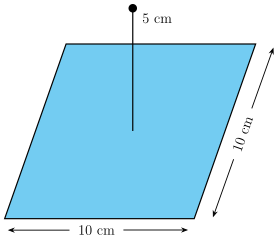
🔒You're viewing a preview — the full solution, concept, methods & PYQ mapping are locked.
🔒 Start your 14-day free trial to unlock the full solution →Concept understanding — Gauss Law
Gauss's Law is a shortcut. Instead of adding up the Coulomb contribution of every charge — a nightmare of vectors and integrals — it lets you read the field straight off the symmetry of a problem. The whole idea rests on one quantity: electric flux.
Flux — field-lines counted through a surface. For a uniform field E crossing a flat area A, the flux is Φ = E·A = EA cosθ, where θ is the angle between the field and the normal to the surface. Picture the field as a bundle of lines; flux is how many pierce the surface. When E is edge-on (θ = 90°) nothing passes through and Φ = 0; when E is ⊥ to the surface (θ = 0) the count is maximal. For a closed surface, Φ is the net number of lines leaving it — lines that enter and exit cancel.
The law itself. Gauss's law states that the net flux out of any closed surface depends only on the charge trapped inside:
Φ = q_enclosed / ε₀.
Two consequences do most of the work. First, only enclosed charge counts — a charge outside sends as many lines in as out, so its net contribution is exactly zero. Second, the surface's shape is irrelevant; move the charge around inside or deform the surface, and Φ never changes.
Why symmetry makes it powerful. By itself Φ = q/ε₀ has E buried in an integral. It becomes a tool only when you pick a Gaussian surface matched to the symmetry — one where E is constant and everywhere either ⊥ to the surface (so Φ = EA) or ∥ to it (contributing nothing). Then E slides out and you solve in one line. This works for exactly three geometries:
1 — Infinite line charge (linear density λ). Use a coaxial cylinder: E = λ / 2πε₀r, falling off as ∝ 1/r.
2 — Infinite sheet (surface density σ). Use a pillbox pierced through the sheet: E = σ / 2ε₀ — uniform and completely independent of distance. The field near a large charged plane simply doesn't weaken as you step back. …
Why this formula?
Gauss's Law: Why It Holds
Gauss's Law is one of the four Maxwell's equations and a cornerstone of electromagnetism. Let's build the understanding from the ground up — not just the formula, but the why.
1. The Core Idea: Flux as "Flow" of Field
Imagine an electric field E passing through a small patch of area dA. The electric flux through that patch is:
dΦE=E⋅dA=EdAcosθ
where θ is the angle between E and the outward normal to the surface.
Why this definition?
- If E is perpendicular to the surface (θ=0), maximum field "flows through".
- If E is parallel (θ=90∘), no flux — the field just slides along the surface.
Total flux through a closed surface S is:
ΦE=∮SE⋅dA
2. The Key Insight: Flux Depends Only on Enclosed Charge
Consider a single point charge +q at the centre of a spherical surface of radius r.
- By Coulomb's law, at every point on the sphere: E=4πε01r2q, radially outward.
- The area vector dA is also radially outward.
- So E⋅dA=EdA everywhere.
The total flux:
ΦE=∮EdA=E∮dA=(4πε01r2q)(4πr2)=ε0q
Notice: The r2 cancels! The flux is independent of the radius.
3. Why Shape Doesn't Matter
Now, what if the surface is not spherical but any closed shape enclosing the charge?
- Draw a small cone from the charge to the surface.
- The flux through a patch dA at distance r is dΦ=4πε01r2qcosθdA.
- But r2cosθdA is exactly the solid angle dΩ subtended by dA at the charge.
So dΦ=4πε0qdΩ.
Integrating over the entire closed surface: ∮dΩ=4π (total solid angle around a point).
Hence:
ΦE=4πε0q⋅4π=ε0q
Result: For any closed surface enclosing q, the flux is ε0q.
4. Multiple Charges: Superposition
If there are many charges q1,q2,…,qn inside the surface, the total electric field is the vector sum of individual fields:
E=E1+E2+⋯+En
Flux is linear: …
By the hint, treat the square as one face of a cube of edge 10cm. Because the charge is 5cm (half an edge) above the square's centre, it lies exactly at the cube's centre.
Gauss's law gives the total flux through the closed cube:
Φtotal=ε0q.
By symmetry the six faces share this equally, so the flux through one face is …
Completing the square into a cube of edge 10cm places the charge at the cube's centre; Gauss's law gives total flux q/ε0, and by symmetry each of the six faces carries q/6ε0=1.88×105N⋅m2/C.
A single square is an open surface, so Gauss's law cannot be applied to it directly. The hint tells us to complete it into a closed surface.
Step 1 — Build the cube. The charge sits 5cm above the centre of the 10cm square. Imagine a cube of edge 10cm having this square as one face. The centre of such a cube is 5cm from each face — exactly where the charge is. So the charge is at the centre of the cube, and the given square is one of its six faces.
Step 2 — Total flux through the cube. The cube is now a closed surface enclosing q=+10μC. Gauss's law gives
Φtotal=ε0q,ε0=8.854×10⁻¹²C2/N⋅m2.
Step 3 — Use symmetry. With the charge at the centre, the six faces are equivalent, so each receives one‑sixth of the total flux: …
Method: Gauss's Law with Symmetry (Cube Construction)
Why This Method Works
The hint suggests a powerful symmetry trick. A point charge above the centre of a square has no simple symmetry by itself — but if we imagine the square as one face of a cube with the charge at its centre, the full cube has perfect symmetry.
Steps
Step 1: Construct an imaginary cube
Place the +10μC charge at the exact centre of a cube of side 10cm. The given square becomes the top face of this cube.
Step 2: Apply Gauss's Law to the entire cube
Gauss's Law states:
Φcube=ε0Qenclosed
Here, Qenclosed=+10μC=10×10−6C.
So:
Φcube=8.85×10−1210×10−6≈1.13×10⁶N⋅m2/C
Step 3: Use symmetry to find flux through one face
The charge is at the cube's centre. By symmetry, the total flux is divided equally among all 6 faces of the cube.
Therefore: …
Common Mistakes Students Make with This Gauss Law Problem
Mistake 1: Trying to integrate directly over the square
What students do wrong:
They attempt to compute Φ=∫E⋅dA directly, setting up a double integral over the square's surface. This is messy because the electric field from a point charge varies in both magnitude and direction across the square.
Why it's wrong:
The integration is unnecessarily complex. The electric field is not uniform over the square — its magnitude changes with distance from the charge, and its direction changes relative to the surface normal. This leads to a difficult integral that most students cannot evaluate correctly.
How to avoid:
Use the hint in the problem. Place the square as one face of a cube of side 10cm, with the charge at the cube's centre. By Gauss's law, the total flux through the entire cube is:
Φcube=ε0qenc
Since the charge is at the centre, the flux is equally distributed through all 6 faces. Therefore:
Φsquare=61⋅ε0q
Mistake 2: Forgetting that the charge is not at the centre of the square
What students do wrong:
They assume the charge is at the centre of the square and use symmetry arguments incorrectly — for example, claiming the flux through the square is 4ε0q (as if the square were one face of a tetrahedron).
Why it's wrong:
The charge is 5 cm above the centre, not at the centre of the square itself. The square is only one face of an imaginary cube. The symmetry that works is the cubic symmetry — the charge is at the cube's centre, so all 6 faces are equivalent.
How to avoid:
Visualise the cube clearly. The square is the top face of a cube of side 10cm, and the charge is at the cube's centre (5 cm below the top face). This makes all 6 faces symmetric with respect to the charge.
Mistake 3: Using the wrong value of q or units
What students do wrong:
They forget to convert 10μC to SI units (10×10−6C) or use 10cm as 10m instead of 0.1m.
Why it's wrong:
Gauss's law in SI form requires charge in coulombs and distances in metres. Using wrong units gives a numerically incorrect answer.
How to avoid:
Always convert to SI before plugging into formulas:
- q=10μC=10×10−6C=1.0×10⁻⁵C
- Side of square = 10cm=0.1m
Mistake 4: Forgetting ε0 or using the wrong value
What students do wrong:
They either omit ε0 entirely or use ε0=8.85×10⁻¹² incorrectly (e.g., forgetting units).
Why it's wrong: …
- KEAM 2026Set eng-2026-04194 marksMCQQ.If a spherical conductor of 10 cm radius contains 5×10⁶ electrons, then the electric field on its surface (in NC−1) is (A) 0.86 (B) 0.36 (C) 0.45 (D) 1.44 (E) 0.72
›Reveal solutionSolution
Find the surface charge, then use E=kQ/r2 at the sphere's surface.
Total charge:
Q=ne=(5×10⁶)(1.6×10⁻¹⁹)=8×10⁻¹³ C.
Field at the surface of a conducting sphere of radius r=0.1 m: …
- KEAM 2026Set eng-2026-04214 marksMCQQ.If an infinitely long uniformly charged wire produces an electric field of intensity E at a distance of d from it, then the linear charge density λ of the wire is (A) πϵ0Ed (B) 2πϵ0Ed (C) 21ϵ0Ed (D) 2πϵ0Ed (E) ϵ0Ed
›Reveal solutionSolution
Invert E=2πϵ0dλ to get λ=2πϵ0Ed.
For an infinite line charge, Gauss's law gives E=2πϵ0dλ at perpendicular distance d. …
- KEAM 2026Set eng-2026-04224 marksMCQQ.A uniformly charged cube of side one cm having surface charge density of 8.85 μC cm−2 is placed inside a hollow metal sphere. The total flux emerging out of the sphere in Nm2C−1 is (ε0=8.85×10⁻¹² C2N−1m−2) (A) 8.85×10⁶ (B) 12×106 (C) 19.7×10⁶ (D) 3×10⁶ (E) 6×10⁶
›Reveal solutionSolution
By Gauss's law the flux out of the enclosing sphere is the total charge divided by ε0.
The cube (side 1 cm) has 6 faces of 1cm2 each, total area 6cm2.
Total charge Q=σA=8.85μC cm−2×6cm2=53.1μC=53.1×10⁻⁶C. …
- KEAM 2026Set pha-2026-0420F4 marksMCQQ.Electric-flux through a closed surface depends on the (A) shape of the surface (B) area of the surface (C) volume of the surface (D) electric field outside the surface (E) charge enclosed by the surface
›Reveal solutionSolution
Gauss's law: Φ=qenc/ε0 — only the enclosed charge matters.
Gauss's law states
ΦE=∮E⋅dA=ε0qenclosed. …
- KEAM 2025Set eng-2025-04234 marksMCQQ.The inward and outward electric flux from a closed surface are 6×10⁴ NM2C−1 and 3×10⁴ NM2C−1. Then the net charge (in coulomb) inside the closed surface is (A) −6×10⁴ε0 (B) 6×10⁴ε0 (C) 3×10⁴ε0 (D) 9×10⁴ε0 (E) [AMBIGUOUS]
›Reveal solutionSolution
[!TLDR]
Using Gauss's law with net flux =ϕout−ϕin=−3×10⁴ gives an enclosed charge of −3×10⁴ε0 C, which matches option (E).
Concept
Gauss's law states that the net electric flux through a closed surface equals the enclosed charge divided by the permittivity of free space: ϕnet=ε0qenc. Outward flux is taken positive and inward flux negative — the standard NCERT/CBSE electrostatics convention the KEAM syllabus is aligned with.
Solution
The net flux through the surface is the outward flux minus the inward flux:
ϕnet=ϕout−ϕin=3×10⁴−6×104=−3×10⁴ Nm2C−1.
By Gauss's law the enclosed charge is
qenc=ε0ϕnet=−3×10⁴ε0 C. …
- KEAM 2025Set eng-2025-04274 marksMCQQ.The electric field inside a uniformly charged spherical shell of radius R is: (A) directly proportional to the charge within the shell (B) inversely proportional to R2 (C) same as that outside the shell (D) zero (E) maximum at the centre
›Reveal solutionSolution
A Gaussian surface inside a uniformly charged spherical shell encloses no charge, so E=0 everywhere inside.
For a uniformly charged spherical shell, apply Gauss's law to a concentric spherical surface of radius r<R. It encloses zero net charge, so …
- KEAM 2024Set eng-2024-06094 marksMCQQ.The electric field due to a an infinitely long thin wire with linear charge density λ at a radial distance r is proportional to (A) rλ2 (B) rλ (C) r2λ (D) rλ (E) rλ
›Reveal solutionSolution
By Gauss's law the field of an infinite line charge is E=2πε0rλ, i.e. proportional to λ/r.
Using a cylindrical Gaussian surface of radius r: …
- KEAM 2023Set eng-2023-P1-A14 marksMCQQ.A hollow sphere of radius 'r' encloses an electric dipole composed of two charges +q and −q. The net flux of electric field through the surface of the sphere due to the enclosed dipole is: (A) ε02q (B) ε02q⋅4πr2 (C) infinite (D) zero (E) ε0q
›Reveal solutionSolution
The net electric flux through the sphere is zero.
Concept and Intuition
By Gauss's law the flux depends only on the enclosed net charge. A dipole encloses +q and −q, whose sum is zero.
Step-by-Step Solution
- Enclosed charge =+q+(−q)=0.
- Gauss's law: Φ=ε0Qenc=ε00.
- Φ=0.
Common Mistakes …
🎓Unlock everything free for 14 days
- ✓Full step-by-step solutions
- ✓Concept-first explanations
- ✓Methods, shortcuts & mistakes
- ✓PYQ mapping + timed mock tests
Full access for 14 days. No credit card required.