Question of 96
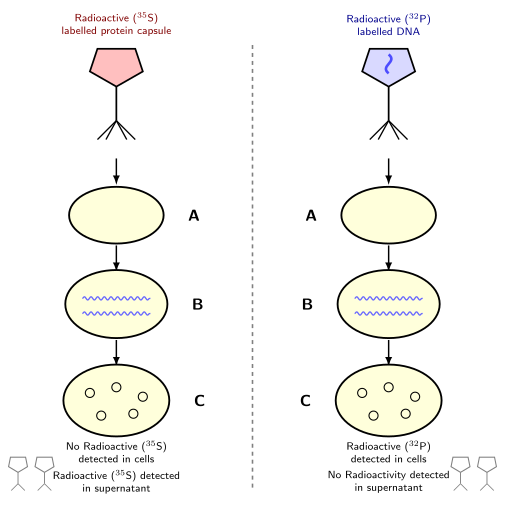
Q.(a) Identify and write the name of the experiment shown in figure.
(b) What was the aim of this experiment ?
(c) Name the processes marked as 'A', 'B' and 'C'/(3 steps).
Kerala DhseKerala DHSE Plus Two Board 2025Subjective· 3mImportance★★★★★
0% · 0/96 Questions
You're viewing a preview — the full solution, concept, methods & PYQ mapping are locked.
Start your 14-day free trial to unlock the full solution →Hershey and Chase (1952) infected bacteria with bacteriophages whose protein coat and DNA were separately radiolabelled, and found only the labelled DNA (not the protein) entered the bacterium and appeared in the progeny phages, proving that DNA — not protein — is the genetic material.
- Name of the experiment: This is the Hershey and Chase experiment (also called the Blender experiment), performed in 1952 using the bacteriophage that infects E. coli.
- Aim: At the time, it was still debated whether protein or DNA was the genetic material, since bacteriophages are made up of only these two components (a protein coat and a DNA core). The aim of the experiment was to determine which of the two — protein or DNA — is the actual genetic material that carries hereditary information from a parent bacteriophage into its progeny.
- The three processes A, B, C: The bacteriophages were grown in two separate batches — one with radioactive sulphur (35S), which labelled only the protein coat (since sulphur is present in proteins but not DNA), and another with radioactive phosphorus (32P), which labelled only the DNA (since phosphorus is present in DNA but not protein).
- A — Infection (adsorption and injection): the radiolabelled phages were allowed to attach to (adsorb onto) the surface of bacterial cells and inject their genetic material into the bacterium.
- B — Replication/biosynthesis: inside the infected bacterium, the injected phage genetic material takes over the host's machinery to replicate itself and direct synthesis of new phage components.
- C — Progeny formation (maturation and lysis): new progeny phage particles are assembled and eventually released by lysis of the bacterial cell. …
Unlock everything free for 14 days
- Full step-by-step solutions
- Concept-first explanations
- Methods, shortcuts & mistakes
- PYQ mapping + timed mock tests
Full access for 14 days. No credit card required.