Mathematics · Ch 9 — Straight Lines
Slope-intercept Form
Slope-intercept Form
Slope-Intercept Form
When a line's slope is known and we also know where it cuts one of the coordinate axes, we can write its equation directly. The intercept — the signed distance from the origin to the point where the line meets an axis — gives us a fixed point on the line, and the slope gives us the direction. Together, these two pieces of information determine the line uniquely.
Case I: Line with given slope and y-intercept
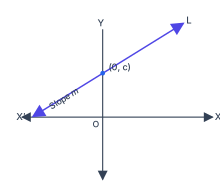
Suppose a line has slope and cuts the -axis at a distance from the origin. This distance is called the -intercept of the line. The point where the line meets the -axis has coordinates .
Since the line has slope and passes through the fixed point , we can use the point-slope form. The point-slope equation of a line through with slope is . Substituting and :
This simplifies to:
Thus, a point lies on the line with slope and -intercept if and only if
The value of is positive when the intercept is on the positive side of the -axis (above the origin) and negative when the intercept is on the negative side (below the origin).
Do not confuse the -intercept with the -coordinate of a general point on the line. The intercept is a fixed number — the -coordinate of the specific point where the line crosses the -axis. Every other point on the line has a different -coordinate.
Case II: Line with given slope and x-intercept
Now suppose a line has slope and makes an -intercept . This means the line cuts the -axis at the point . The distance is called the -intercept of the line.
Using the same method as in Case I, we apply the point-slope form with the fixed point :
This gives:
You can derive this equation yourself by exactly the same reasoning as in Case I — just replace the fixed point with . The structure is identical: slope times .
Worked Example
Example 7. Write the equation of the lines for which , where is the inclination of the line, and:
(i) -intercept is
(ii) -intercept is
Solution.
(i) Here, the slope of the line is , and the -intercept is .
Using the slope-intercept form :
Multiplying through by 6 to clear denominators:
Rearranging to standard form:
This is the required equation.
(ii) Here, and the -intercept is . …
Drawn by us to help you understand the concept clearly, and verified to make sure it's accurate. For exams, practice from your NCERT textbook's own diagram.
Fig. 9.12 is a simple coordinate-plane sketch that shows the geometric meaning of the slope-intercept form of a straight line. The axes are the usual -axis (horizontal) and -axis (vertical). A single straight line, labelled , is drawn sloping upward from left to right — its slope is , and the value is written along the line itself, tilted to follow its direction. The line crosses the -axis at a single marked point with coordinates . That crossing point is the -intercept; the distance is measured from the origin along the -axis, and can be positive (above the origin) or negative (below it). No other curves, points, or labels appear in the figure — it is deliberately minimal, focusing attention on just two pieces of information: the slope and the -intercept.
The physical idea is this: if you know how steep a line is (its slope ) and exactly where it meets the -axis (the intercept ), then you can write its equation immediately — you don’t need any other point. The figure makes that relationship visual: the line is completely determined by those two numbers.
From this diagram, the textbook derives the central formula of the section. Since the line has slope and passes through the fixed point , the point-slope form gives:
which simplifies to:
Here, is the slope of the line, and is the -intercept — the -coordinate of the point where the line meets the -axis. Every point on the line satisfies this equation, and conversely any point satisfying it lies on the line. The sign of tells you whether the intercept lies on the positive or negative side of the -axis.
Do not confuse the -intercept with the -intercept. The -intercept is the value of when ; the -intercept is the value of when . The figure shows only the -intercept case. The textbook separately treats the -intercept case (Case II), which gives , where is the -intercept. …