Q.Show inflationary gap using a well labelled diagram. Suggest any two fiscal measures to correct the situation of inflationary gap.
You're viewing a preview — the full solution, concept, methods & PYQ mapping are locked.
Start your 14-day free trial to unlock the full solution →An inflationary gap occurs when aggregate demand exceeds the economy's full employment output, leading to price increases without real output growth; it can be corrected by fiscal measures like increasing taxes or decreasing government expenditure.
The concept of an inflationary gap helps us understand a situation where an economy is "overheating." It describes a scenario where the total demand for goods and services in an economy (Aggregate Demand, AD) is greater than what the economy can produce when all its resources are fully employed (Aggregate Supply at full employment).
Think of it this way: if everyone suddenly has a lot more money and wants to buy more things, but factories are already running at their maximum capacity and there are no unemployed workers to hire, what happens? The increased demand can't be met by increased production. Instead, producers will simply raise prices for the existing goods, leading to inflation. The inflationary gap is precisely this excess of aggregate demand over the full employment level of output.
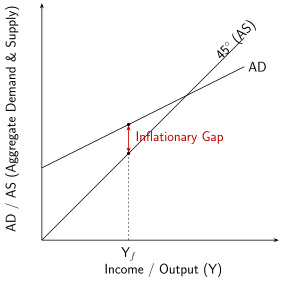
Showing the Inflationary Gap with a Diagram
-
The Axes and Aggregate Supply:
We use a standard Keynesian cross diagram. The horizontal axis represents Real GDP or National Income (), and the vertical axis represents Aggregate Demand (). The Aggregate Supply (AS) curve is represented by a 45-degree line from the origin. This line signifies that at every point on it, Aggregate Demand equals Aggregate Supply (), which is the equilibrium condition.
-
Full Employment Output:
We introduce a vertical line, , representing the full employment level of output. This is the maximum sustainable output an economy can produce when all its available resources (labour, capital, land) are fully utilised without generating inflationary pressures.
-
Equilibrium at Full Employment:
Let's assume an initial Aggregate Demand curve, . If intersects the 45-degree AS line exactly at the full employment output , then the economy is in equilibrium at full employment. This is the ideal situation where demand matches the economy's productive capacity.
-
The Inflationary Gap:
Now, imagine that Aggregate Demand increases to . This new AD curve intersects the 45-degree line at a point corresponding to an output level , which is greater than . However, the economy cannot actually produce because it is already at full employment (). The actual output remains at . At this full employment level of output (), the new Aggregate Demand () is higher than the Aggregate Demand required for full employment (). The vertical distance between and at the full employment level of output () is the inflationary gap.
This gap signifies the amount by which aggregate demand needs to be reduced to bring the economy back to full employment equilibrium without inflation.
*   The 45-degree line represents $AD = Y$ (Aggregate Supply).
*   $Y_f$ is the full employment level of output.
*   $AD_1$ is the aggregate demand curve that achieves full employment equilibrium at $E_1$.
*   $AD_2$ is the new, higher aggregate demand curve.
*   The vertical distance between $AD_2$ and $AD_1$ at $Y_f$ (from $E_1$ up to $AD_2$ at $Y_f$) is the **Inflationary Gap**.
Fiscal Measures to Correct an Inflationary Gap
To correct an inflationary gap, the government needs to reduce the aggregate demand in the economy. Fiscal policy involves the government's decisions regarding its spending and taxation. Here are two fiscal measures:
- Increase Taxes:
- Reasoning: When the government increases various taxes (like income tax, corporate tax, or GST), it reduces the disposable income available to households and firms. …
Unlock everything free for 14 days
- Full step-by-step solutions
- Concept-first explanations
- Methods, shortcuts & mistakes
- PYQ mapping + timed mock tests
Full access for 14 days. No credit card required.