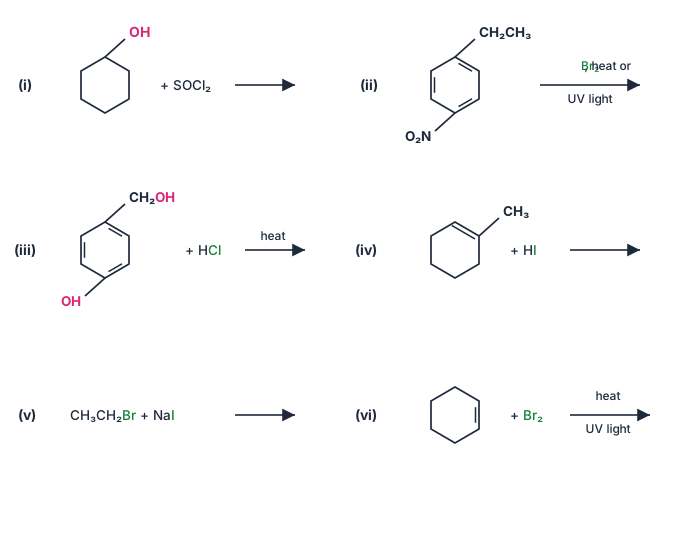
Q.Draw the structures of major monohalo products in each of the following reactions:
You're viewing a preview — the full solution, concept, methods & PYQ mapping are locked.
Start your 14-day free trial to unlock the full solution →Identify the reactive site in each substrate and apply the correct mechanism (SNi/SN2, free-radical substitution, Markovnikov addition, or halogen exchange) to predict the major monohalo product. Structures for the ring-containing products are drawn below.
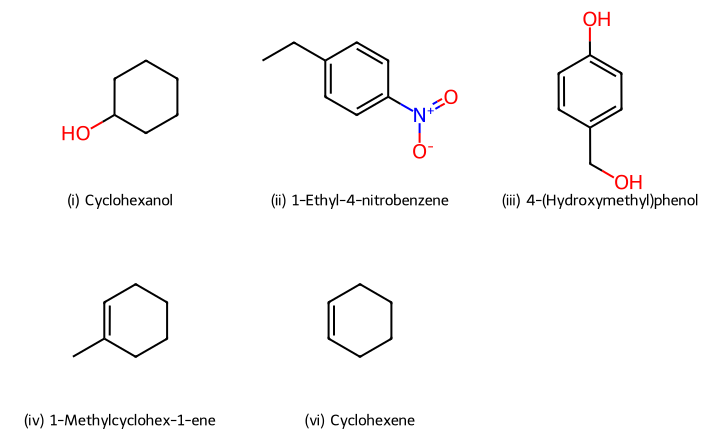
(i) Cyclohexanol
Thionyl chloride converts an alcohol's into a chloride. With no pyridine present (as here), the reaction proceeds through the (internal nucleophilic substitution) pathway: the alcohol first forms a chlorosulfite ester, and the chloride ion that is released stays associated with the same face of the carbon it left from, delivering the chlorine back to that same face — giving retention of configuration. (With pyridine added, the freed chloride ion instead attacks from the opposite face for a clean -style inversion.) Since cyclohexanol's C1 is not a stereocentre, retention or inversion makes no visible difference to the product here — either way the product is chlorocyclohexane.
(ii) 1-Ethyl-4-nitrobenzene (-)
Heat/UV light homolyses into bromine radicals, favouring free-radical substitution at the most stabilised C–H bond. The benzylic C–H (on the ethyl group's carbon directly attached to the ring) gives a radical stabilised by resonance into the ring, so bromination occurs there rather than anywhere else on the chain. The nitro group's directing effect governs electrophilic aromatic substitution, not this radical pathway, so it plays no role in where the Br ends up. Major product: 1-(1-bromoethyl)-4-nitrobenzene.
(iii) 4-(Hydroxymethyl)phenol (-)
Two groups are present: a phenolic directly on the ring, and a benzylic on the side chain. The phenolic C–O bond has partial double-bond character from resonance with the ring and resists substitution under these mild conditions. The benzylic alcohol, by contrast, readily protonates and loses water to form a benzylic carbocation (stabilised by the ring), which chloride then attacks. Major product: 4-(chloromethyl)phenol — the phenolic is untouched.
(iv) 1-Methylcyclohex-1-ene …
Unlock everything free for 14 days
- Full step-by-step solutions
- Concept-first explanations
- Methods, shortcuts & mistakes
- PYQ mapping + timed mock tests
Full access for 14 days. No credit card required.