Biology · Ch 7 — Structural Organisation in Animals
Morphology
Morphology
The skin of a frog is smooth and slippery because of the presence of mucus, and it is always kept in a moist condition. On the dorsal side the colour is generally olive green with dark irregular spots, while on the ventral side it is uniformly pale yellow. Interestingly, the frog never drinks water; instead it absorbs water directly through its skin.
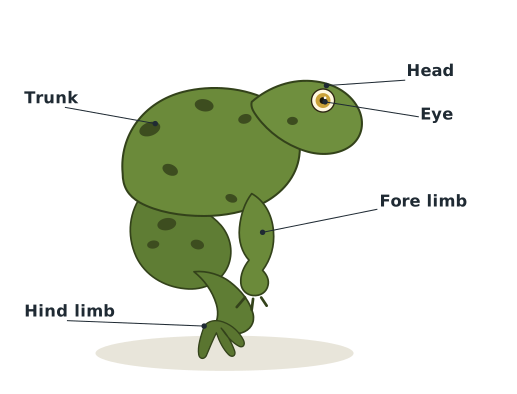
The body of a frog is divisible into two parts, the head and the trunk — a neck and a tail are absent. Above the mouth lies a pair of nostrils. The eyes are bulged and are each covered by a nictitating membrane, a protective fold that shields the eye while the frog is in water. On either side of the eyes is a membranous tympanum, or ear, which receives sound signals.
The forelimbs and hind limbs assist the frog in swimming, walking, leaping and burrowing. The hind limbs are larger and more muscular than the forelimbs; they end in five digits, whereas the forelimbs end in four digits. The digits of the feet are webbed, which helps in swimming. …
Drawn by us to help you understand the concept clearly, and verified to make sure it's accurate. For exams, practice from your NCERT textbook's own diagram.
This diagram shows the whole-body external form of Rana tigrina in its typical resting posture, seen from the side and slightly above. It labels the two divisions of the body — the head at the front and the broad trunk behind it — and makes clear that a neck and a tail are absent. On the head, the bulged eye is marked; in life this eye is protected by a nictitating membrane. Near the front of the body the forelimb is shown ending in four digits, while the larger, more muscular hind limb is shown folded and ending in five webbed digits used for swimming and leaping. The dorsal surface is drawn olive green with dark irregular spots, illustrating the ca …