Chemistry · Ch 4 — Chemical Bonding and Molecular Structure
Hybridisation of Elements involving d Orbitals
Hybridisation of Elements involving d Orbitals
Why d Orbitals Enter Hybridisation
Atoms of elements in the third period (like phosphorus, sulphur, and chlorine) possess d orbitals in addition to s and p orbitals. For these atoms, the energy of the 3d orbitals is comparable to that of the 3s and 3p orbitals. More surprisingly, the 3d orbitals are also close in energy to the 4s and 4p orbitals. This energy match makes hybridisation involving d orbitals possible.
Two combinations are energetically feasible:
- Mixing of 3s, 3p, and 3d orbitals.
- Mixing of 3d, 4s, and 4p orbitals.
However, one combination is ruled out: the energy gap between 3p and 4s orbitals is too large, so hybridisation involving 3p, 3d, and 4s orbitals does not occur.
The key condition for hybridisation is that the participating orbitals must have comparable energies. For third-period elements, the 3d, 4s, and 4p orbitals satisfy this condition, but 3p and 4s do not.
Hybridisation Schemes Involving d Orbitals
The textbook presents several important hybridisation types that involve d orbitals. Each scheme produces a specific molecular geometry.
| Hybridisation Type | Atomic Orbitals Used | Examples | Geometry |
|---|---|---|---|
| , | Square planar | ||
| , | Trigonal bipyramidal | ||
| Square pyramidal | |||
| , | Octahedral | ||
| Octahedral |
Notice that both and produce octahedral geometry. The difference lies in which orbitals are used: uses outer d orbitals (3d), while uses inner d orbitals (e.g., 3d for a 4th-period metal like cobalt). The geometry is the same.
Case Study 1: Formation of PCl₅ ( Hybridisation)
Phosphorus (atomic number 15) has the ground state electronic configuration: . The outer electrons are in the third shell.
Step 1: Promotion to an excited state. One electron from the 3s orbital is promoted to an empty 3d orbital. This requires energy, but it is compensated by the formation of five strong bonds.
- Ground state:
- Excited state:
Now, five orbitals (one 3s, three 3p, and one 3d) are each singly occupied.
Step 2: Hybridisation. These five orbitals mix to form five equivalent hybrid orbitals.
Step 3: Geometry. The five hybrid orbitals are directed towards the five corners of a trigonal bipyramid.
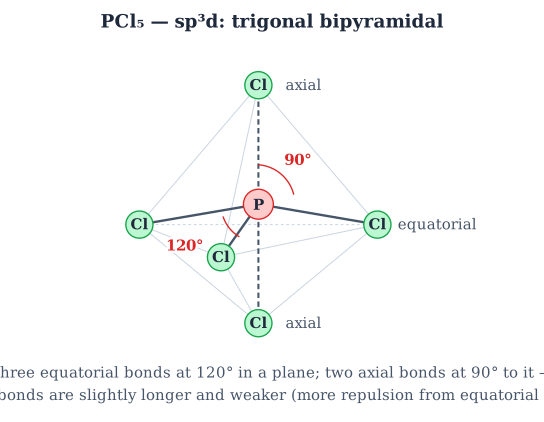
In a trigonal bipyramid, all bond angles are not equal. Three orbitals lie in a plane (the equatorial plane) and are separated by . The remaining two orbitals point above and below this plane (the axial positions) and are at to the equatorial plane.
Step 4: Bond formation. Each hybrid orbital of phosphorus overlaps with a singly occupied 3p orbital of a chlorine atom, forming five P–Cl sigma bonds.
Properties of the bonds:
- Equatorial bonds: The three P–Cl bonds lying in the equatorial plane. They make angles with each other.
- Axial bonds: The two P–Cl bonds lying above and below the equatorial plane. They make angles with the equatorial plane.
The axial bonds are longer and weaker than the equatorial bonds. Why? The axial bond pairs experience greater repulsive interaction from the two equatorial bond pairs that are at to them. This repulsion pushes the axial bonds further away from the central atom, making them longer and thus weaker. This is why PCl₅ is a reactive molecule — the axial bonds break more easily.
Drawn by us to help you understand the concept clearly, and verified to make sure it's accurate. For exams, practice from your NCERT textbook's own diagram.
The figure is a structural diagram of the PCl₅ molecule, showing its trigonal bipyramidal geometry. It does not have axes or curves — it is a ball-and-stick or space-filling model that labels the spatial arrangement of atoms and bonds. The central phosphorus atom sits at the centre of the figure. Five chlorine atoms are placed at the five corners of a trigonal bipyramid: three of them lie in a flat plane (the equatorial plane) and are spaced 120° apart; the remaining two are positioned directly above and below this plane, along an axis perpendicular to it, making 90° angles with the equatorial plane.
The figure distinguishes the two types of P–Cl bonds. The three equatorial bonds are drawn in the plane, and the two axial bonds are shown extending out of the plane (often with a different shading or dashed lines to indicate depth). The caption or labels in the figure typically note that the axial bonds are slightly longer than the equatorial ones — a key physical detail that the textbook explains arises from greater repulsion experienced by the axial bond pairs.
The physical idea the figure teaches is that when a central atom uses hybridisation, the five hybrid orbitals point to the corners of a trigonal bipyramid. This geometry is not symmetric: the bond angles are not all equal. The equatorial bonds are at 120° to each other, while the axial bonds are at 90° to the equatorial plane. The unequal bond lengths (axial longer) and unequal bond strengths (axial weaker) make PCl₅ more reactive than a molecule with all equivalent bonds.
The central result the textbook develops with this figure is the hybridisation scheme for phosphorus in PCl₅. The ground-state electron configuration of phosphorus is . In the excited state, one electron is promoted to a orbital, giving five singly occupied orbitals: one , three , and one . These five orbitals hybridise to form five equivalent hybrid orbitals.
The key formula is the description of the hybridisation itself:
Each symbol means:
- : one orbital
- : three orbitals (, , )
- : one orbital (typically , which has the right shape to point along the axial direction)
- : the set of five hybrid orbitals formed
The figure also implicitly teaches the bond angle relationships:
- Equatorial–equatorial bond angle:
- Axial–equatorial bond angle: …
Case Study 2: Formation of SF₆ ( Hybridisation)
Sulphur (atomic number 16) has the ground state outer electronic configuration: .
Step 1: Promotion to an excited state. Two electrons are promoted: one from the 3s orbital and one from a 3p orbital, moving to two empty 3d orbitals.
- Ground state:
- Excited state: …
Drawn by us to help you understand the concept clearly, and verified to make sure it's accurate. For exams, practice from your NCERT textbook's own diagram.
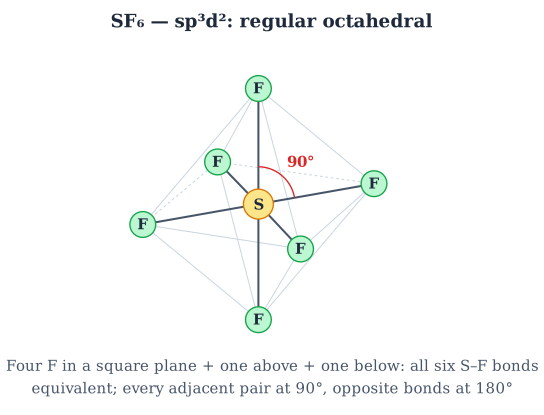
Fig. 4.18 is a structural diagram — not a plot with axes — that shows the three‑dimensional arrangement of atoms in the sulphur hexafluoride (SF₆) molecule. The central sulphur atom sits at the centre of a regular octahedron, and six fluorine atoms occupy the six corners. All S–F bonds are equivalent in length and strength. The bond angles between any two adjacent S–F bonds are exactly 90°, and the angle between opposite bonds is 180°. The figure makes the octahedral symmetry immediately visible: four fluorine atoms lie in a square plane around the sulphur, one fluorine is directly above that plane, and one directly below.
The physical idea the figure teaches is that when a central atom uses six equivalent hybrid orbitals, those orbitals must point to the vertices of a regular octahedron to minimise repulsion. This is the geometry that gives maximum separation between six electron pairs. In SF₆, the sulphur atom undergoes hybridisation: one 3s orbital, three 3p orbitals, and two 3d orbitals mix to form six identical hybrid orbitals. Each hybrid orbital overlaps with a fluorine 2p orbital to form a sigma bond.
The central result the textbook develops with this figure is that hybridisation produces a regular octahedral geometry with six equivalent bonds at 90° angles. This is the only hybridisation scheme that gives a perfect octahedron.
The key formula that emerges from this discussion is the description of the hybridisation itself:
Here, refers to the 3s orbital of sulphur, to the three 3p orbitals (), and to two of the five 3d orbitals (typically and ). The six hybrid orbitals are equivalent in energy and shape, each having 1/6 s‑character, 1/2 p‑character, and 1/3 d‑character.
A common mistake is to think that and are the same. They are not: uses outer d‑orbitals (e.g., 3d in SF₆) and gives an octahedron, while uses inner d‑orbitals (e.g., 3d in [Co(NH₃)₆]³⁺) and also gives an octahedron. The textbook lists both under "Octahedral" but notes they involve different sets of atomic orbitals. …