Chemistry · Ch 9 — Hydrocarbons
Aromatic Hydrocarbons
Aromatic Hydrocarbons
Aromatic Hydrocarbons – The Arenes
The word "aromatic" comes from the Greek aroma, meaning pleasant smell. Early chemists gave this name because many of these compounds — benzene, toluene, naphthalene — had distinctive, often sweet odours. But the name stuck for a deeper reason: these compounds share a special kind of chemical stability that is fundamentally different from the behaviour of ordinary unsaturated hydrocarbons like alkenes or alkynes.
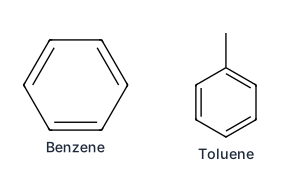
Aromatic hydrocarbons are also called arenes. The simplest and most important arene is benzene, . If you count the hydrogen atoms, benzene looks highly unsaturated — it has the same hydrogen-to-carbon ratio as a compound with three double bonds. Yet benzene does not undergo the typical addition reactions of alkenes. It resists addition and instead undergoes substitution reactions, keeping its ring of unsaturation intact. This resistance to addition is the hallmark of aromatic character.
Most aromatic compounds contain a benzene ring. Those that do are called benzenoids. But there are also aromatic compounds that lack a benzene ring and instead contain other highly unsaturated ring systems; these are non-benzenoid aromatics. The textbook gives four examples of arenes:
| Compound | Structure (simplified) | Type |
|---|---|---|
| Benzene | (six-membered ring with alternating double bonds) | Benzenoid |
| Toluene | (methylbenzene) | Benzenoid |
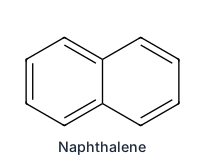
| Naphthalene | (two fused benzene rings) | Benzenoid |
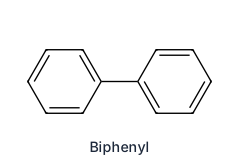
| Biphenyl | (two benzene rings joined by a single bond) | Benzenoid |
All four are benzenoid. The textbook mentions non-benzenoid aromatics only in passing — they exist, but the entire treatment of aromatic hydrocarbons in this section focuses on benzenoid compounds, and on benzene in particular.
Drawn by us to help you understand the concept clearly, and verified to make sure it's accurate. For exams, practice from your NCERT textbook's own diagram.
The first two example arenes the textbook lists: benzene, the parent aromatic hydrocarbon drawn as a plain Kekulé hexagon, and toluene (methylbenzene), the same ring carry …
Drawn by us to help you understand the concept clearly, and verified to make sure it's accurate. For exams, practice from your NCERT textbook's own diagram.
Naphthalene, the textbook's third example arene: two benzene rings fused along a shared edge (sharing two adjacent carbon atoms), molecular formula — the small …
Drawn by us to help you understand the concept clearly, and verified to make sure it's accurate. For exams, practice from your NCERT textbook's own diagram.
Biphenyl, the textbook's fourth example arene: two separate benzene rings joined by a single C–C sigma bond (not fused — no edge is shared), molecu …
…