Q.Which is the correct increasing order of boiling points of the following compounds?
1-Iodobutane, 1-Bromobutane, 1-Chlorobutane, Butane
You're viewing a preview — the full solution, concept, methods & PYQ mapping are locked.
Start your 14-day free trial to unlock the full solution →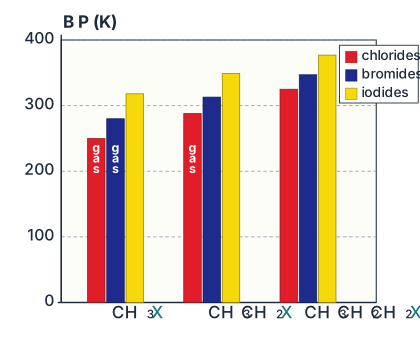
Boiling point depends on molecular mass and intermolecular forces. For haloalkanes, as the halogen size increases, boiling point increases due to stronger London dispersion forces. Butane, being nonpolar, has the lowest boiling point. The correct order is: Butane < 1-Chlorobutane < 1-Bromobutane < 1-Iodobutane, which matches option (i).
Boiling point trends in organic compounds are governed by two main factors: the strength of intermolecular forces and the molecular mass. For a series of similar compounds, like the 1-halobutanes, the key force is London dispersion (van der Waals) forces. These forces increase with molecular size and surface area — larger, heavier molecules have more electrons and a larger electron cloud, making them more polarizable. Stronger dispersion forces mean more energy is needed to separate molecules, hence a higher boiling point.
Butane is a simple alkane with no polar C–X bond. It experiences only weak London forces. The haloalkanes, on the other hand, have a polar C–X bond, which adds dipole-dipole interactions. However, for the 1-halobutane series, the difference in dipole moments is small — the dominant effect is the increasing size and polarizability of the halogen as we go from Cl to Br to I.
Let’s work through the reasoning step by step.
-
Identify the compounds and their molecular masses.
- Butane ():
- 1-Chlorobutane ():
- 1-Bromobutane ():
- 1-Iodobutane ():
Mass increases steadily from butane to 1-iodobutane.
-
Consider the intermolecular forces at play.
All four molecules experience London dispersion forces. The haloalkanes also have dipole-dipole interactions because the C–X bond is polar. But the dipole moment of C–Cl is about 1.9 D, C–Br about 1.8 D, and C–I about 1.6 D — these are quite similar. The real difference comes from polarizability: iodine is much larger and more polarizable than chlorine, so the dispersion forces in 1-iodobutane are significantly stronger than in 1-chlorobutane.
-
Rank the boiling points.
- Butane has the lowest mass and no dipole — it will have the lowest boiling point ().
- 1-Chlorobutane boils at about .
- 1-Bromobutane boils at about .
- 1-Iodobutane boils at about .
So the order is: Butane < 1-Chlorobutane < 1-Bromobutane < 1-Iodobutane. …
Unlock everything free for 14 days
- Full step-by-step solutions
- Concept-first explanations
- Methods, shortcuts & mistakes
- PYQ mapping + timed mock tests
Full access for 14 days. No credit card required.