Q.If length of three sides of a trapezium other than base are equal to cm, then find the area of the trapezium when it is maximum.
You're viewing a preview — the full solution, concept, methods & PYQ mapping are locked.
Start your 14-day free trial to unlock the full solution →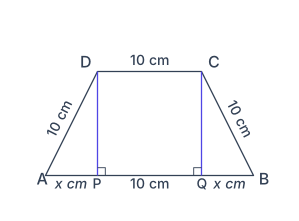
The maximum area of an isosceles trapezium with three equal sides of 10 cm occurs when the base is 20 cm and the height is cm, giving an area of cm².
The problem gives us a trapezium where three sides — the top and both slant sides — are each 10 cm. Only the longer base is free to vary. The figure shows an isosceles trapezium, so the two slant sides are equal and the feet of the perpendiculars from the top corners split the base into three segments: two equal overhangs of length on each side, and a middle segment of 10 cm (same as the top). The height comes from the right triangle formed by the slant side, the overhang , and the height itself.
The key insight: as increases, the base gets longer (good for area) but the height shrinks (bad for area). Somewhere in between, the product of base and height reaches a maximum. This is a classic optimisation problem — express area as a function of , differentiate, set to zero, and verify it's a maximum.
Let's work through it.
- Set up the geometry. Let the two equal overhangs be cm. The top cm, so the bottom base cm. In right triangle , the slant side cm and the horizontal leg cm. By Pythagoras:
The height is defined only when (if , the trapezium becomes a rectangle; if , the height becomes zero and the figure collapses).
- Write the area function. Area of a trapezium = . Here:
Simplify:
- Differentiate to find critical points. Use the product rule. Let and . , . So:
Put over a common denominator:
- Set . The denominator is positive for , so we only need the numerator to be zero:
Divide by 2:
Solve:
…
Unlock everything free for 14 days
- Full step-by-step solutions
- Concept-first explanations
- Methods, shortcuts & mistakes
- PYQ mapping + timed mock tests
Full access for 14 days. No credit card required.