Mathematics and Statistics · Ch 7 — Applications of Definite Integration
Area Under a Curve
Area Under a Curve
In the previous chapter, a definite integral was evaluated as a single number using the Fundamental Theorem of Integral Calculus, . This Std XII Commerce Mathematics and Statistics chapter gives that number its most important geometric meaning: it measures area. The same definite-integration principles used here are the standard treatment of area found in commerce- and general-mathematics curricula across India.
The area formula
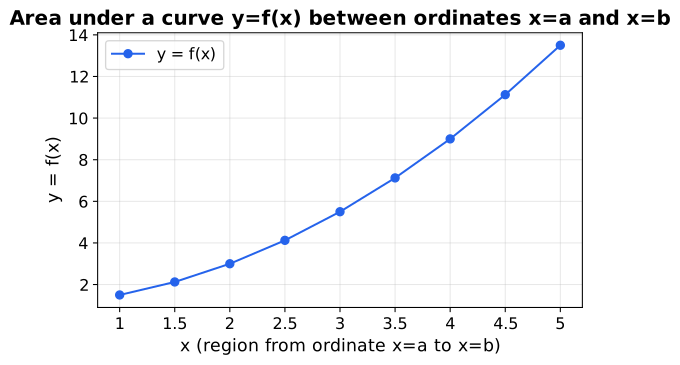
Let be a continuous function that is non-negative (its curve lies on or above the x-axis) on the interval . Then the area of the region bounded by:
- the curve (above),
- the x-axis (below),
- the ordinate (vertical line) (on the left), and
- the ordinate (on the right)
is given by
Why the integral gives the area — the idea of accumulation
Imagine slicing the shaded region into a large number of very thin vertical strips, each of width . A single strip standing at position has height and width , so its area is approximately (the area of a thin rectangle). Adding up the areas of all such strips from to — which is exactly what the integral sign does — gives the total area of the region. The integral is a limit of this sum as the strips become infinitely thin, so the approximation becomes exact.
The three-step method
- Set up the integral with the correct function and limits: .
- Integrate to get an antiderivative — no constant of integration is needed for a definite integral.
- Substitute the limits and subtract: . Since this is an area, the result must be reported as a positive quantity in square units.
Area is never negative
For a curve lying above the x-axis, the definite integral comes out positive automatically. The formula measures a geometric area, so the final answer is always stated as a positive number of square units — the sign of the integral only becomes an issue when part or all of the region lies BELOW the x-axis, which is handled in Section 3.
For a continuous, non-negative function , the area bounded by the curve, the x-axis, and the ordinates and is , where is any antiderivative of .
A vertical line that bounds a region on its left or right side. In an area problem, the two ordinates and supply the lower and upper limits of the definite integral.