Botany · Ch 1 — Biological Classification
Protozoans
Protozoans
All protozoans are heterotrophs and live as predators or parasites. They are believed to be primitive relatives of animals. There are four major groups of protozoans:
- Amoeboid protozoans: These organisms live in fresh water, sea water or moist soil. They move and capture their prey by putting out pseudopodia (false feet), as in Amoeba. Marine forms have silica shells on their surface. Some, such as Entamoeba, are parasites.
- Flagellated protozoans: The members of this group are either free-living or parasitic, and they have flagella. The parasitic forms cause diseases such as sleeping sickness. Example: Trypanosoma.
- Ciliated protozoans: These are aquatic, actively moving organisms because of the presence of thousands of cilia. They have a cavity (gullet) that opens to the outside of the cell surface. The coordinated movement of rows of cilia causes water laden with food to be steered into the gullet. Example: Paramoecium. …
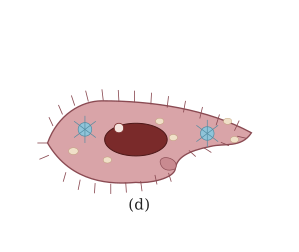
Drawn by us to help you understand the concept clearly, and verified to make sure it's accurate. For exams, practice from your textbook's own diagram.
This composite figure shows four representative members of the Kingdom Protista. In (a) a dinoflagellate is drawn with its stiff cellulose plates on the cell surface and a furrow housing its flagella; these are mostly marine, photosynthetic forms. In (b) Euglena is shown as a spindle-shaped cell with a long flagellum and a flexible pellicle instead of a cell wall, able to switch between photosynthesis and a heterotrophic mode. In (c) a slime mould appears as an irregular, lobed mass that creeps over decaying material engulfing organic matter. In (d) Paramoecium is a slipper-sha …