Botany · Ch 11 — Plant Growth and Development
Phases of Growth
Phases of Growth
The period of growth is generally divided into three phases: the meristematic, the elongation and the maturation phase. These are easiest to understand by looking at a root tip, where the three phases lie one behind the other.
- Meristematic phase — The constantly dividing cells at the root apex (and likewise at the shoot apex) represent this phase. The cells here are rich in protoplasm and possess large, conspicuous nuclei. Their cell walls are primary in nature, thin and cellulosic, with abundant plasmodesmatal connections between them.
- Phase of elongation — The cells lying proximal (just next, away from the tip) to the meristematic zone make up this phase. Its cells are marked by increased vacuolation, cell enlargement and new cell wall deposition. …
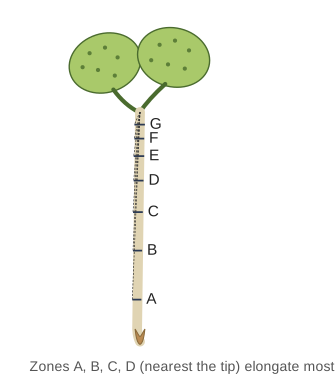
Drawn by us to help you understand the concept clearly, and verified to make sure it's accurate. For exams, practice from your textbook's own diagram.
This figure illustrates a simple experiment used to locate the region of a root where most elongation occurs. Fine parallel ink lines are drawn at equal spacing along a young root, from the tip backwards, marking zones labelled A, B, C, D and beyond. The root is then allowed to grow for a period, after which the spacing between the lines is examined again. The lines in the zones immediately behind the apex — A, B, C and D — are found to have moved much farther apart, showing that these zones have elongated the most, while the marks nearer the very tip and those far back have separated little. This demonstrates that growth in length is not spread evenly along the root but is concentrated in the elongation zone, lying just proximal to the di …