Chemistry · Ch 12 — Organic Chemistry – Some Basic Principles and Techniques
Carbon and Hydrogen
Carbon and Hydrogen
Estimation of Carbon and Hydrogen
Both carbon and hydrogen are determined in a single experiment. A known mass of the organic compound is burnt in excess oxygen in the presence of copper(II) oxide. The copper(II) oxide ensures complete combustion. Carbon and hydrogen in the compound are oxidised to carbon dioxide and water respectively.
The combustion reaction for a hydrocarbon is:
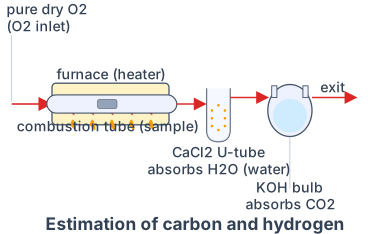
The mixture of gases produced is passed through a weighed U-tube containing anhydrous calcium chloride. Water vapour is absorbed by the calcium chloride. The carbon dioxide then passes into another U-tube containing a concentrated solution of potassium hydroxide, which absorbs it. These tubes are connected in series, as shown in the figure.
The increase in mass of the calcium chloride tube gives the mass of water produced. The increase in mass of the potassium hydroxide tube gives the mass of carbon dioxide produced. From these masses, the percentages of carbon and hydrogen in the original compound are calculated.
Drawn by us to help you understand the concept clearly, and verified to make sure it's accurate. For exams, practice from your textbook's own diagram.
Figure 8.14 is a schematic of a combustion train — the classic apparatus used to determine the percentages of carbon and hydrogen in an organic compound. The figure does not show a graph or plot; it is a flow diagram of a sequence of connected tubes and furnaces. The key idea is that burning a known mass of the compound in pure oxygen converts all its carbon to CO₂ and all its hydrogen to H₂O. By trapping each product separately and measuring the increase in mass of the absorbents, you can calculate the original masses of carbon and hydrogen.
The diagram shows a horizontal combustion tube made of hard glass, placed inside a furnace. A small porcelain boat containing the weighed organic sample sits inside this tube. A steady stream of pure, dry oxygen enters from one end. The tube is heated strongly, and the compound burns completely. The hot exit gases — a mixture of CO₂, H₂O vapour, and excess O₂ — then pass through a U-tube packed with anhydrous calcium chloride (CaCl₂). This absorbs all the water vapour. The remaining gases then bubble through a second U-tube or set of bulbs containing a concentrated solution of potassium hydroxide (KOH), which absorbs carbon dioxide. The oxygen that is not absorbed simply escapes.
Both absorption units are weighed before and after the experiment. The increase in mass of the CaCl₂ tube gives the mass of water produced; the increase in mass of the KOH tube gives the mass of carbon dioxide produced.
A common mistake is to think the KOH tube absorbs only CO₂. In fact, KOH solution also absorbs water vapour from the gas stream. That is why the CaCl₂ tube must come first — to remove water before the gas reaches the KOH. If the order were reversed, the KOH gain would include both CO₂ and H₂O, ruining the calculation.
From these two measured masses, the textbook derives the percentage composition. Let the mass of the organic compound taken be grams. Let the increase in mass of the CaCl₂ tube be grams, and the increase in mass of the KOH tube be grams.
The mass of hydrogen in the water is found from the ratio of atomic masses. In one mole of water (18 g), there are 2 g of hydrogen. So:
Similarly, in one mole of CO₂ (44 g), the mass of carbon is 12 g:
The percentage of each element in the original compound is then:
…
A common mistake is to forget that the masses measured are the increases in mass of the absorption tubes, not the masses of the tubes themselves. The increase in mass of the CaCl tube is the mass of water absorbed; the increase in mass of the KOH tube is the mass of CO absorbed.
Calculation of Percentage of Carbon
Let the mass of the organic compound taken be grams. Let the mass of carbon dioxide produced be grams.
From the molecular formula of carbon dioxide, , the molar mass is g mol. The mass of carbon in one mole of is g.
Therefore, the mass of carbon that produced grams of is:
The percentage of carbon in the compound is then:
Substituting the expression for the mass of carbon:
Calculation of Percentage of Hydrogen
Let the mass of water produced be grams.
From the molecular formula of water, , the molar mass is g mol. The mass of hydrogen in one mole of water is g.
Therefore, the mass of hydrogen that produced grams of water is:
The percentage of hydrogen in the compound is then: …