Zoology · Ch 4 — Biomolecules
Polysaccharides
Polysaccharides
Polysaccharides are the carbohydrate macromolecules of the acid-insoluble pellet, and like proteins they are long polymeric chains — but here the building blocks are sugars.
Long chains of sugars
A polysaccharide is a long chain of sugars, much like a cotton thread made by stringing together many small units. The building blocks are monosaccharides, and different polysaccharides use different monosaccharides. Some familiar examples:
- Cellulose — a polymer built from just one type of monosaccharide, glucose. Because it uses only one kind of monomer, cellulose is a homopolymer.
- Starch — a variant that plants use as a storehouse of energy.
- Glycogen — the corresponding energy-storage variant found in animals.
- Inulin — a polymer of fructose.
Ends and branches
In a polysaccharide chain such as glycogen, the two ends are not equivalent. The right end is called the reducing end and the left end is called the non-reducing end. Glycogen is also a branched molecule, with side chains coming off the main chain.
Secondary structure and the iodine test
Starch can coil into helical secondary structures. This helix can trap iodine molecules (I2) within its coils, and the resulting starch–iodine complex is blue — the basis of the well-known iodine test for starch. Cellulose, by contrast, does not form these complex helices, so it cannot hold iodine and gives no such blue colour.
Where these polysaccharides are found
Cellulose is the material of plant cell walls; paper made from plant pulp and cotton fibre is essentially cellulose.
Complex polysaccharides …
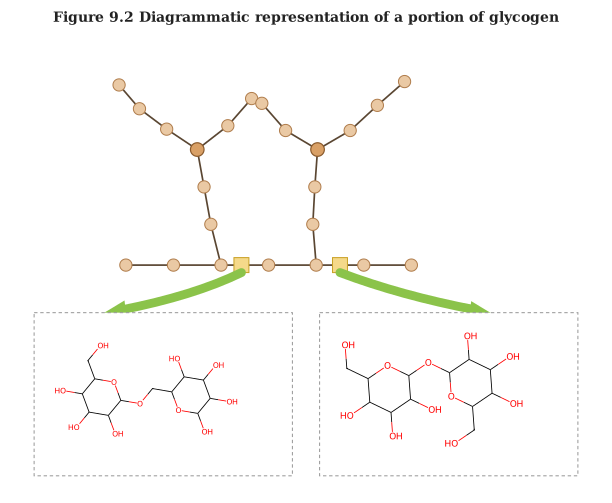
Drawn by us to help you understand the concept clearly, and verified to make sure it's accurate. For exams, practice from your textbook's own diagram.
This diagram represents a portion of a glycogen molecule as a schematic of its branched shape. Each circle stands for a glucose unit, and the units are joined end to end into a main chain, with side branches coming off at intervals from branch-point residues. This heavy branching, together with the right-handed helical main chain, gives glycogen a compact, bushy form with many exposed ends — which is exactly what suits it to its role as the main storage carbohydrate of animal cells, since gluc …