Q.Reaction of with aqueous sodium hydroxide follows ____________.
You're viewing a preview — the full solution, concept, methods & PYQ mapping are locked.
Start your 14-day free trial to unlock the full solution →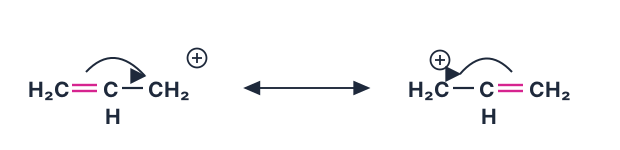
Benzyl bromide () reacts with aqueous NaOH via an mechanism because the benzylic carbocation intermediate is highly stabilized by resonance with the aromatic ring, making the unimolecular pathway much faster than the bimolecular one.
The key to predicting the mechanism here lies in the stability of the carbocation intermediate. In nucleophilic substitution, the pathway depends entirely on how easily the leaving group can depart to form a carbocation — and how stable that carbocation is once formed.
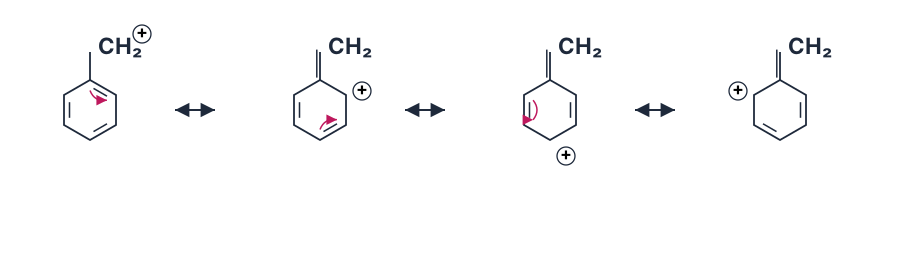
Benzyl bromide is special. The bromine is attached to a carbon that is directly bonded to a benzene ring. When that carbon loses , it becomes a benzylic carbocation. This cation is not just any ordinary primary carbocation — it is dramatically stabilized because the positive charge can be delocalized into the aromatic ring through resonance. The ring effectively "shares" the charge across several carbon atoms, lowering the energy of the intermediate enormously.
Compare this to a simple primary alkyl halide like : its primary carbocation is so unstable that is essentially impossible. But the benzylic carbocation is about as stable as a tertiary carbocation — sometimes even more so, depending on substituents. That stability makes the pathway viable even though the carbon is formally primary.
Now, let's walk through the reasoning step by step.
-
Identify the substrate type.
is a primary alkyl halide at the benzylic position. Normally, primary halides favor because the carbon is sterically unhindered. But the benzylic position is an exception — the aromatic ring provides unique electronic stabilization.
-
Consider the leaving group.
Bromide is an excellent leaving group. In aqueous NaOH, the solvent is polar protic (water), which strongly solvates the departing bromide ion and also stabilizes the carbocation through ion-dipole interactions. Polar protic solvents favor over because they stabilize the transition state leading to the carbocation.
-
Analyze the nucleophile.
Aqueous NaOH provides as the nucleophile. Hydroxide is a strong nucleophile, which might suggest . However, the rate-determining step of does not involve the nucleophile — it only involves the substrate. So even a strong nucleophile does not force if the carbocation pathway is overwhelmingly faster.
-
The decisive factor: carbocation stability.
The benzylic carbocation is resonance-stabilized:
This delocalization lowers the activation energy for dramatically. In fact, the rate for benzylic halides is comparable to that of tertiary halides.
- Experimental evidence. …
Unlock everything free for 14 days
- Full step-by-step solutions
- Concept-first explanations
- Methods, shortcuts & mistakes
- PYQ mapping + timed mock tests
Full access for 14 days. No credit card required.