Q.What are concurrent forces ? Prove that under the action of three concurrent forces F1, F2 and F3, a body will be in equilibrium when F1 + F2 + F3 = 0. (1+4=5)
OR
What is centripetal force ? Derive the expression for maximum speed of circular motion of a car on a level road. (1+4=5)
Imagine a book lying flat on a table. It doesn't move. A lamp hanging from the ceiling — still. A bridge holding up cars — motionless. What do all these have in common? They are in static equilibrium.
The word "static" means unchanging or stationary. "Equilibrium" comes from Latin aequilibrium — "equal balance." Put them together: a state where an object is completely at rest, with no tendency to start moving or rotating.
But here's the key insight: being at rest doesn't mean nothing is happening. Forces are still acting on that book — gravity pulls it down, the table pushes it up. The lamp feels tension from the ceiling pulling up and gravity pulling down. These forces are cancelling each other out perfectly.
Note
Static equilibrium is dynamic balance — forces are present, but their net effect is zero. The object "chooses" to stay still because all pushes and pulls are perfectly matched.
The Two Conditions for Static Equilibrium
For an object to be truly static (not moving or rotating), two separate things must be true simultaneously.
Condition 1: No Net Force (Translational Equilibrium)
The sum of all forces acting on the object must be zero. In vector form:
∑F=0
This means:
All upward forces equal all downward forces
All leftward forces equal all rightward forces
All forward forces equal all backward forces
If you break it into components (the standard exam approach):
∑Fx=0,∑Fy=0,∑Fz=0
Why this alone isn't enough: Imagine pushing a door at its handle — it rotates open. The forces might balance (you push, the hinges push back), but the door still moves. That's why we need the second condition.
Condition 2: No Net Torque (Rotational Equilibrium)
The sum of all torques (twisting effects) about any point must be zero:
∑τ=0
Torque depends on three things: the force applied, the distance from the pivot point, and the angle at which you push. For a force F applied at distance r from the pivot, at angle θ:
τ=rFsinθ
Watch out
A common mistake: thinking torque only matters if the object is actually rotating. Torque can be present even when nothing moves — it's just balanced by other torques. A seesaw with two kids of equal weight at equal distances is a perfect example.
Putting It All Together
For an object to be in static equilibrium:
∑F=0and∑τ=0
Both conditions must hold simultaneously. If either fails, the object will either accelerate (move in a straight line) or start rotating (or both).
A Simple Example: The Book on the Table
Consider a 2 kg book on a horizontal table. Gravity pulls down with force Fg=mg=2×9.8=19.6 N.
This question (or its OR alternative on centripetal force and maximum car speed on a level road) asks for concurrent forces and the equilibrium condition under three of them; the primary version is proved here. …
Concurrent forces act through a common point; three such forces keep a body in equilibrium exactly when their vector sum is zero, which is proved from Newton's first law and shown geometrically as a closed triangle of vectors.
Concurrent forces are two or more forces acting on a body whose lines of action all pass through a single common point. (They need not be equal in magnitude or have any particular angle between them — the defining feature is only that they meet at one point.)
Proof that equilibrium under three concurrent forces requires F1+F2+F3=0:
By Newton's first law, a body remains in equilibrium (at rest, or moving with constant velocity) if and only if the net (resultant) external force acting on it is zero:
Fnet=0
If the body has exactly three concurrent forces F1, F2, F3 acting on it, and no other forces, then equilibrium requires:
Same / Similar Concept — real previous-year questions on the same or a closely similar concept, not this exact question.
CBSE 2026Set ANNUAL1 markMCQ
Q.In a seesaw, where should a heavier person sit to balance with a lighter person on the other side?
(a) Closer to the pivot point
(b) Further from the pivot point
(c) It does not matter where they sit
(d) At the mid-point of the seesaw
›Reveal solutionSolution
For rotational equilibrium, the torques (moment = force x perpendicular distance from the pivot) on both sides of the seesaw must be equal; a bigger weight needs a smaller distance to produce the same torque as a smaller weight at a larger distance.
For a seesaw balanced about its pivot (fulcrum), the principle of moments requires:
Weight1 x distance1 = Weight2 x distance2
If person 1 (heavier) has a larger weight W1, and person 2 (lighter) has weight W2 < W1, sitting at distance d2 from the pivot, then to balance:
Q.A rectangular frame is to be suspended symmetrically by two strings of equal length on two supports as shown in Fig. It can be done in following three ways, the tension in the strings will be:
(a) The same in all cases
(b) Least in
(a)
(c) Least in
(b)
(d) Least in
(c)
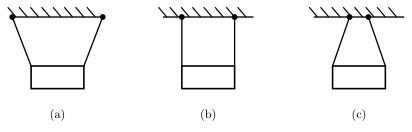
›Reveal solutionSolution
Tension is smallest when the strings are exactly vertical, because the whole tension then acts along the direction opposing gravity with no component 'wasted' sideways.
By symmetry, each string carries the same tension T and its two horizontal components cancel, so only the vertical components support the weight W of the frame:
2Tcosθ=W⇒T=2cosθW
where θ is the angle each string makes with the vertical.
In (a) the strings splay outward (diverge), so θ>0, hence cosθ<1 and T>W/2.
In (b) the strings are vertical, so θ=0, cosθ=1, giving the minimum possible tension T=W/2. …
Q.A cork of mass 10 gram is floating on water. The net force acting on the cork is
(1) 10 N
(2) 10^-3 N
(3) 10^-2 N
(4) zero
›Reveal solutionSolution
A floating object is in translational equilibrium: the upward buoyant force (from displaced water) exactly balances the downward weight, so the net force is zero -- consistent with it floating at a fixed depth rather than accelerating up or down.
A cork floating (at rest, at a constant level) on the surface of water is in mechanical equilibrium. Two forces act on it:
Its weight, mg, acting downward.
The buoyant (upthrust) force from the displaced water, acting upward, equal in magnitude to the weight of water displaced (Archimedes' principle).
Since the cork is floating steadily (not sinking or rising), these two forces must be equal and opposite, so the net force on it is: …
Q.A particle is said to be in equilibrium if the net external force on the particle is
(a) zero
(b) constant
(c) positive
(d) negative
›Reveal solutionSolution
A particle is in equilibrium only when the vector sum of every external force on it is zero.
A particle is said to be in (translational) equilibrium when it has no acceleration — it is either at rest or moving with constant velocity. From Newton's second law, Fnet=ma. If a=0, then Fnet must be 0. A 'constant' nonzero force, a 'positive' force, or a 'negative' force would each still produce a nonzero …