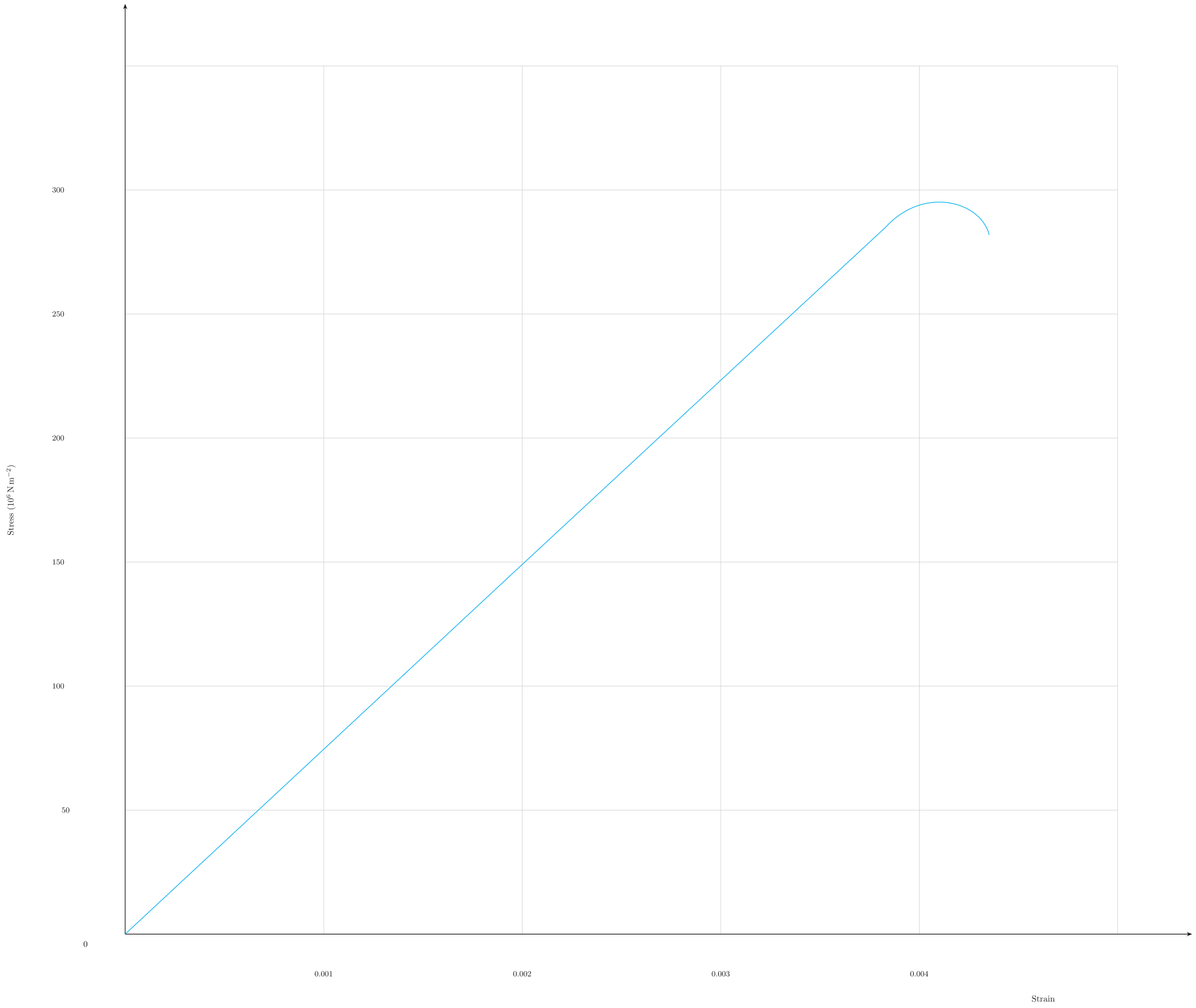
Q.Figure 8.9 shows the strain-stress curve for a given material. What are
Concept understanding — Youngs Modulus
Young’s Modulus: The Stretchiness of a Solid
When you pull on a rubber band, it stretches easily. When you pull on a steel rod of the same size, it barely moves. Both are elastic — they return to their original shape when you let go — but they resist stretching very differently. Young’s modulus is the number that tells you exactly how much a material resists being stretched or compressed lengthwise.
The Intuition: Stiffness per Unit Size
Think of a spring. A stiff spring requires a large force to stretch it a little. A soft spring stretches a lot with a small force. Young’s modulus is like the “stiffness” of a material, but it’s cleverly designed to be independent of the object’s shape and size.
If you take a thick steel rod and a thin steel wire of the same length, the rod is harder to stretch. That’s because you’re pulling on more material. Young’s modulus removes this size effect — it tells you the stiffness of the material itself, not the particular piece you’re holding.
The Precise Definition
Young’s modulus (E or Y) is defined as the ratio of tensile stress to tensile strain, as long as the material obeys Hooke’s law (the deformation is reversible and proportional to the force).
Y=Tensile StrainTensile Stress
Let’s break down the two parts.
Tensile Stress (σ) is the force per unit area. If you pull with a force F on a rod of cross-sectional area A, the stress is:
σ=AF
Stress has units of pressure — pascals (Pa) or N/m2. It tells you how “intense” the pulling is, regardless of the rod’s thickness.
Tensile Strain (ε) is the fractional change in length. If the original length is L0 and it stretches by ΔL, the strain is:
ε=L0ΔL
Strain is a pure number — it has no units. A strain of 0.01 means the rod stretched by 1% of its original length.
Putting it together:
Y=ΔL/L0F/A=AΔLFL0
What the Number Tells You
A high Young’s modulus means the material is very stiff — it takes a huge stress to produce even a tiny strain. Steel has Y≈200×109 Pa. A low Young’s modulus means the material is easily stretched. Rubber has Y≈0.01×10⁹ Pa — about 20,000 times smaller than steel.
Young’s modulus is only valid in the elastic region — where the material returns to its original shape after the force is removed. If you stretch too far (past the elastic limit), the material deforms permanently or breaks, and Young’s modulus no longer applies.
A Worked Example
A steel wire of length 2.0 m and cross-sectional area 1.0×10⁻⁶ m2 is pulled by a force of 100 N. How much does it stretch? (Young’s modulus of steel = 2.0×10¹¹ Pa)
From Y=AΔLFL0, rearrange:
ΔL=AYFL0=(1.0×10−6)×(2.0×1011)100×2.0=2.0×105200=1.0×10⁻³ m=1.0 mm
The wire stretches by just 1 mm. If you tried the same with a rubber band of the same dimensions (Y≈107 Pa), the stretch would be about 20,000 times larger — 20 metres! (Of course, a real rubber band would break long before that.)
Key Points for Exams
- Young’s modulus is a material property — it doesn’t depend on the object’s length or thickness.
- It applies only to axial (lengthwise) tension or compression, not to bending or twisting.
- The units are the same as pressure: pascals (Pa) or N/m2.
- For most materials, Young’s modulus is the same in tension and compression (within the elastic limit).
Do not confuse Young’s modulus with stiffness (k=F/ΔL). Stiffness depends on the object’s dimensions (k=YA/L0). Young’s modulus is the intrinsic material property; stiffness is the property of a particular object.
"Youngs Modulus important questions" is a common search among CBSE and competitive-exam aspirants alike, since Youngs Modulus sits squarely within the Mechanical Properties of Solids coverage of NCERT Class 11 Physics, so it is fair game for both CBSE board questions and competitive-exam numericals. Pairing this explanation with NCERT Physics textbook practice and previous years' questions is the surest way to lock the concept in before an exam.
The slope of the straight part of the stress-strain graph is Young's modulus, and the stress where the line bends over is the yield strength.
Using a point on the linear region, strain 0.002 with stress 150×106 N m−2: Y=0.002150×106=7.5×10¹⁰ N m−2. The curve stops being linear and levels off near a stress of 300×106 N m−2.
- Y≈7.5×10¹⁰ N m−2.
- Yield strength ≈3×10⁸ N m−2 (i.e. 300×106 N m−2).
Young's modulus is the slope of the straight (proportional) part of the stress-strain graph, and the yield strength is the stress at which the curve stops being linear and begins to level off. Reading the graph gives Y≈7.5×10¹⁰ N m−2 and a yield strength of about 3×10⁸ N m−2.
Concept
In the initial straight portion of a stress-strain curve, stress is proportional to strain (Hooke's law). The constant of proportionality is Young's modulus, Y=strainstress, which equals the slope of that straight line. The yield strength is the stress at the point where the curve departs from the straight line and the material begins to deform permanently.
(a) Young's modulus
Take a point on the straight region: at strain ε=0.002 the stress is σ=150×106 N m−2.
Y=εσ=0.002150×106=7.5×10¹⁰ N m−2.
Any other point on the line gives the same value, e.g. 225×106/0.003=7.5×1010.
(b) Yield strength
The curve stays straight up to a strain of about 0.003 and then bends over, flattening near a maximum stress of about 300×106 N m−2. The stress at which this non-linear (plastic) behaviour sets in is the yield strength:
σy≈300×106=3×10⁸ N m−2.
- Y≈7.5×10¹⁰ N m−2.
- Approximate yield strength ≈3×10⁸ N m−2 (300×106 N m−2).
Step 1: identify the linear (Hooke's law) portion. Step 2: Y=slope=(150e6)/0.002=7.5e10 N/m^2. Step 3: yield strength read at the point curve stops being straight, ~3e8 N/m^2.
- Council of Higher Secondary Education, Manipur (Higher Secondary 1st Year) 2026Set ANNUAL1 markMCQQ.The modulus of rigidity(shear modulus) of an ideal liquid is –(a) infinity(b) some finite small non zero constant value zero(c) unity(d) zero
›Reveal solutionSolution
The shear modulus (modulus of rigidity) of an ideal liquid is zero.
Shear modulus G is defined as G = shear stress / shear strain. A liquid (unlike a solid) has no fixed shape; when a tangential (shear) force is applied to a liquid layer, it does not develop a restoring elastic shear stress — it simply flows/deforms continuously. Since a liquid offers essentially zero resistance to shape-changing (shear) deformation while at rest, its shear modulus is taken as zero. This is why liquids (and gases) can only sustain longitudinal, not transverse, elastic waves.
✓Final answerThe correct option is (d) zero.
- Council of Higher Secondary Education, Manipur (Higher Secondary 1st Year) 2026Set ANNUAL1 markQ.Draw the Force–Displacement graph for a body obeying the relation (F = kx), where (k) is a constant and(x) is the displacement.
›Reveal solutionSolution
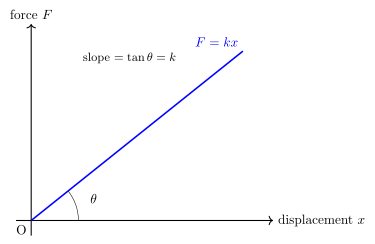
Figure — Force-Displacement graph for F=kx The Force–Displacement graph for F = kx is a straight line passing through the origin, with slope equal to k.
Given F = kx, F is directly proportional to x (k is a constant, e.g., a spring/elastic constant, as in Hooke's Law).
To draw the graph:
- Put displacement x on the horizontal axis and force F on the vertical axis.
- Since F = kx is a linear equation in x with zero intercept, the graph is a straight line that starts at the origin (0,0) and rises with a constant slope equal to k, i.e., for every unit increase in x, F increases by k.
- The line lies in the first quadrant for x > 0 (and third quadrant if x is negative, for a restoring-type force convention).
Description of the plot: a single straight line through the origin, inclined at an angle θ to the x-axis where tan θ = k. (The area under this line between 0 and x, equal to (1/2)kx², gives the work done in stretching/compressing by x.)
✓Final answerThe F–x graph is a straight line through the origin with slope k (F increases linearly with x).
- Council of Higher Secondary Education, Manipur (Higher Secondary 1st Year) 2023Set ANNUAL1 markQ.State Hooke's law.
›Reveal solutionSolution
Within the elastic limit, the stress produced in a body is directly proportional to the strain it undergoes.
When a deforming force is applied to an elastic body, it develops an internal restoring force per unit area called stress, and undergoes a fractional change in dimension called strain. Hooke's law states that as long as the deformation stays within the elastic limit of the material (i.e., the body can still fully recover its original shape when the force is removed), the stress developed is directly proportional to the strain produced:
Stress∝Strain⇒Stress=k×Strain
The proportionality constant k is called the modulus of elasticity of the material (Young's modulus for longitudinal stress-strain, bulk modulus for volume stress-strain, or shear modulus for shearing stress-strain, depending on the type of deformation). Beyond the elastic limit, the stress-strain relationship becomes non-linear and Hooke's law no longer holds.
✓Final answerHooke's law: within the elastic limit, Stress ∝ Strain, i.e., Stress = k × Strain, where k is the modulus of elasticity of the material.
- Council of Higher Secondary Education, Manipur (Higher Secondary 1st Year) 2022Set ANNUAL1 markQ.How are we able to break a wire by repeated bending ?
›Reveal solutionSolution
Bending a wire repeatedly at the same point strains it beyond its elastic limit again and again, causing progressive internal damage (elastic fatigue) until it fractures, even though one such bend alone would not break it.
When a wire is bent, the material on the outer side of the bend is stretched (tensile strain) while the material on the inner side is compressed. If the bend is sharp, the strain at that point can exceed the elastic limit of the material, so the material does not fully return to its original state when straightened — some permanent (plastic) deformation and internal microscopic damage remains.
When this bending is repeated again and again at the same point, each cycle adds a little more damage: microscopic cracks form and grow within the material, and the local heating produced by the repeated internal friction/deformation further reduces the wire's elastic strength at that spot. This cumulative loss of strength through repeated stress cycles is called elastic fatigue.
Eventually, after enough repetitions, the wire's elastic strength at the bend point is reduced so much that it can no longer withstand even the ordinary bending stress, and it breaks — which is why a wire can be broken by hand through repeated bending even though a person could not simply snap it in one motion.
✓Final answerRepeated bending is possible because each bend strains the wire beyond its elastic limit at the same spot; this cumulative damage — elastic fatigue, aided by local heating — progressively weakens the wire until it finally breaks.
- Council of Higher Secondary Education, Manipur (Higher Secondary 1st Year) 2021Set ANNUAL1 markQ.How are we able to break a wire by repeated bending ?
›Reveal solutionSolution
Bending a wire back and forth repeatedly causes elastic fatigue — the metal at the bend loses its elasticity and develops cracks, so it eventually breaks even without a large single force.
When a wire is bent, the layer on the outside of the bend is stretched (put under tensile stress) and the layer on the inside is compressed. If the bend is sharp enough, the local stress at the fold can exceed the material's elastic limit even though the wire as a whole isn't under much load.
Each time we bend the wire back and forth, the material at that point undergoes this stress reversal again. Every cycle produces tiny, permanent internal deformations (dislocations) that the material cannot fully recover from — this cumulative loss of elastic strength with repeated stress cycles is called elastic fatigue. Over many cycles, microscopic cracks form at the bend and grow with each further flex, until the cross-section remaining is too weak to bear even the wire's own handling force, and it snaps.
This is why we can break a paperclip or a piece of wire by bending it back and forth a number of times at the same spot, even though we could never break it by simply pulling on it once with our hands.
✓Final answerRepeated bending stresses the wire beyond its elastic limit at the bend again and again; the material progressively loses its elastic strength (elastic fatigue), micro-cracks develop at the bend, and the wire finally snaps even though each individual bend applies only a modest force.
🎓Unlock everything free for 14 days
- ✓Full step-by-step solutions
- ✓Concept-first explanations
- ✓Methods, shortcuts & mistakes
- ✓PYQ mapping + timed mock tests
Full access for 14 days. No credit card required.