Q.A cord of negligible mass is wound round the rim of a fly wheel of mass 20 kg and radius 20 cm. A steady pull of 25 N is applied on the cord as shown in Fig. 6.31. The flywheel is mounted on a horizontal axle with frictionless bearings.
You're viewing a preview — the full solution, concept, methods & PYQ mapping are locked.
Start your 14-day free trial to unlock the full solution →Treating the flywheel as a uniform disc, . A steady pull of 25 N at the rim gives angular acceleration . Unwinding 2 m of cord does 50 J of work, and the wheel's kinetic energy after that is also 50 J — confirming the work-energy theorem exactly.
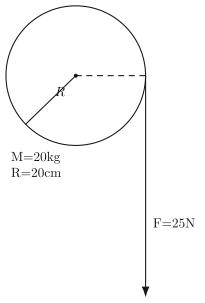
The figure shows a flywheel — a heavy wheel of mass and radius — mounted on a fixed axle through its centre. A cord is wound around the rim of the wheel. One end of the cord is attached to the rim; the other end hangs vertically downward, and a steady force pulls on it. The cord leaves the rim tangentially, so the force is always perpendicular to the radius at the point of contact.
The physical idea is straightforward: the pull of the cord exerts a torque about the axle, causing the flywheel to rotate. Because the force is constant and always tangential, the torque is constant, and the wheel undergoes uniform angular acceleration. The figure is used to work out the angular acceleration, the tension in the cord (if the cord were massless and the pull were applied directly, the tension equals the applied force), and the resulting motion.
The key relation is the rotational analogue of Newton’s second law:
Here is the net torque about the axis, is the moment of inertia of the flywheel about that axis, and is the angular acceleration.
For a solid disc or cylinder of mass and radius , the moment of inertia about its central axis is
The torque from the tangential force is
because the lever arm is exactly (the force is perpendicular to the radius). There is no other torque acting about the axle (we ignore friction in this idealised problem). So
Cancelling one factor of gives
and solving for :
Plugging in the numbers — , , — yields
A common mistake is to forget that the moment of inertia of a solid disc is , not . Using (as for a point mass at the rim) would give half the correct angular acceleration.
The figure also sets up the idea that the cord unwinds without slipping. The linear acceleration of a point on the rim — and therefore the acceleration of the cord as it is pulled — is . So
This connects the rotational dynamics to the linear motion of the cord, a link that appears repeatedly in problems involving pulleys, yo-yos, and rolling objects.
The steady force produces a constant torque, hence constant angular acceleration. The flywheel does not translate — its centre of mass is fixed — so only rotational motion matters. The cord is assumed massless and inextensible, and the pull is applied directly at its free end, so the tension in the cord equals everywhere.
In short, the figure is a clean, minimal illustration of how a tangential force causes rotational acceleration, and it provides the numbers for a concrete calculation that reinforces the formula . …
Unlock everything free for 14 days
- Full step-by-step solutions
- Concept-first explanations
- Methods, shortcuts & mistakes
- PYQ mapping + timed mock tests
Full access for 14 days. No credit card required.