Q.Show that moment of a couple does not depend on the point about which you take the moments.
You're viewing a preview — the full solution, concept, methods & PYQ mapping are locked.
Start your 14-day free trial to unlock the full solution →The moment of a couple is the same about any point because the equal and opposite forces produce torques that always add to , where is the vector between the two forces — independent of the reference point.
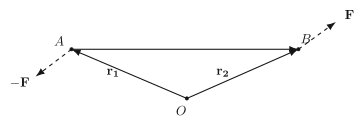
The figure shows two points A and B, with a point O placed below them. A force acts at B, and an equal and opposite force acts at A. The lines of action of these two forces are drawn as dashed lines, making it clear they are parallel but not collinear — they are separated by a perpendicular distance. Two position vectors are drawn from O: goes from O to A, and goes from O to B.
This is the classic picture of a couple: a pair of equal, opposite, and parallel forces whose lines of action do not coincide. A couple produces pure rotation, with no net translational force. The figure is designed to show that the moment (torque) of a couple is the same regardless of which point O you choose to calculate it about.
The physical idea is subtle but important. For a single force, the torque depends on the point you take as the reference — move the reference point and the torque changes. But for a couple, the total torque is independent of the reference point. That is what the figure demonstrates geometrically.
The textbook uses this figure to derive the formula for the torque of a couple. The torque about O due to the force at B is , and due to the force at A is . The net torque about O is therefore:
The vector is simply the vector from A to B, which we can call . So:
Here is the position of B relative to A, and is the force at B (or equivalently, the negative of the force at A). The key point: this expression contains no reference to O at all. The torque of the couple depends only on the vector joining the two points of application and the force — not on where you place the reference point.
The moment of a couple is the same about any point. It is a free vector, meaning it can be moved anywhere in the plane of the forces without changing its effect on the rigid body.
The perpendicular distance between the two lines of action is called the arm of the couple. If is that perpendicular distance, the magnitude of the torque is simply , where . This is the familiar result: torque of a couple = force × perpendicular distance between the forces.
Do not confuse the arm of the couple with the distance between the points A and B. The arm is the perpendicular distance between the two parallel lines of action, which is generally smaller than the distance between A and B unless the forces are applied perpendicular to the line joining A and B.
The figure thus grounds a crucial result for equilibrium of rigid bodies: a couple cannot be balanced by a single force — it requires another couple of equal and opposite moment. This becomes important when analysing forces on a rigid body in static equilibrium, where the net torque must vanish about any point.
The key idea is that a couple consists of two forces that are equal in magnitude, opposite in direction, and separated by some perpendicular distance. When you compute the total torque (moment) about any arbitrary point, the contributions from the two forces combine in a way that cancels out the dependence on that point. This is a beautiful consequence of the forces being a pure couple — no net force, only a net torque.
Let’s walk through it step by step.
-
Define the couple and the reference point.
Consider two forces and acting at points A and B respectively. Let the position vectors of A and B relative to some origin O be and . Now choose an arbitrary point P about which we want to compute the moment. Let the position vectors of A and B relative to P be and .
-
Write the moment about P.
The total moment (torque) about P is the sum of the moments due to each force:
…
Unlock everything free for 14 days
- Full step-by-step solutions
- Concept-first explanations
- Methods, shortcuts & mistakes
- PYQ mapping + timed mock tests
Full access for 14 days. No credit card required.