Business Studies · Ch 11 — Consumer Protection
Ways and Means of Consumer Protection
Ways and Means of Consumer Protection
Consumer protection does not rest on consumer awareness alone. While a well-informed consumer is a powerful force, the textbook identifies four other pillars that together create a complete safety net. Each of these ways works differently, but they all aim at the same goal: shielding consumers from exploitation and ensuring fair treatment.
1. Self-regulation by Business
Socially responsible businesses do not wait for the law to force them to behave. They voluntarily adopt ethical standards and practices because they recognise that serving customers well is in their own long-term interest. A firm that cheats a customer today loses that customer forever, and likely many others through word of mouth.
Many companies have set up their own customer service and grievance cells. These are internal departments where a consumer can directly lodge a complaint — about a defective product, poor service, or a billing error — and get it resolved without going to court. This is the fastest route to redress, but it depends entirely on the goodwill of the business.
2. Business Associations
Trade and industry bodies also step in to protect consumers. Organisations like the Federation of Indian Chambers of Commerce and Industry (FICCI) and the Confederation of Indian Industry (CII) have laid down codes of conduct for their member businesses. These codes are voluntary guidelines that tell members how they should deal with customers — what is acceptable behaviour and what is not.
By agreeing to follow such a code, a business signals that it is committed to fair practices. If a member firm violates the code, the association can take disciplinary action, which acts as a deterrent against exploitation.
3. Consumer Awareness
This is the foundation. A consumer who knows their rights — and the reliefs available when those rights are violated — can raise their voice effectively against unfair trade practices or unscrupulous exploitation. Equally important is knowing one's responsibilities (e.g., checking for quality marks, asking for a bill, not falling for misleading ads). An aware consumer is the best defence against fraud.
The Government of India runs a major awareness campaign called Jago Grahak Jago through the Department of Consumer Affairs. This campaign uses advertisements, hoardings, and digital media to educate citizens about their rights and the steps they can take if cheated.
4. Consumer Organisations
Independent consumer organisations play a crucial role in educating consumers and providing them protection. These organisations work as watchdogs. They can:
- Publish information about defective products and unfair practices.
- File complaints on behalf of consumers.
- Lobby the government for stronger laws.
- Force business firms to avoid malpractices through public pressure and legal action.
Their strength lies in being independent of both business and government, so they can act purely in the consumer's interest.
5. Government
The government protects consumers through two main instruments: legislation and direct support mechanisms.
Legislation: The most important law is the Consumer Protection Act, 2019. This Act:
- Establishes a Central Consumer Protection Authority (CCPA) to regulate matters relating to violation of consumer rights, unfair trade practices, and false or misleading advertisements that are prejudicial to consumers' interests.
- Provides a three-tier machinery for redressal of consumer grievances at the district, state, and national levels. This means a consumer can file a complaint at the level closest to them, and if unsatisfied, appeal to a higher authority.
Direct Support: The government has also set up a toll-free national consumer helpline — the number is 1800-11-4000 — where consumers can get guidance and assistance. …
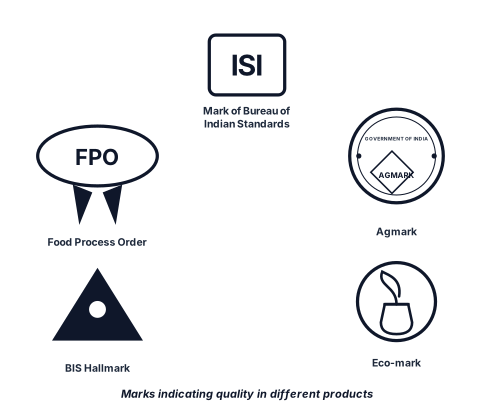
Drawn by us to help you understand the concept clearly, and verified to make sure it's accurate. For exams, practice from your textbook's own diagram.
Our own rendering of the five official quality-certification marks the real page shows: the ISI mark of the Bureau of Indian Standards, the Food Process Order (FPO) mark, Agmark, the BIS Hallmark, and the Eco-mark. …