Q.Write the structures of the following organic halogen compounds.
The key idea is to translate each IUPAC name into a structural formula by identifying the parent chain, locating substituents with locants, and drawing the correct connectivity — including stereochemistry where implied. The final structures are given below.
Why this approach works
Drawing organic structures from IUPAC names is like following a set of building instructions. The name tells you three things: the parent chain (the longest carbon skeleton), the functional groups or substituents attached to it, and their positions (locants). The trick is to work systematically — start with the backbone, number it correctly, then attach each substituent at the right carbon. For cyclic compounds, the ring is the parent. For aromatic compounds, the benzene ring is the parent, and substituents are numbered to give the lowest locants.
Let’s go through each one.
-
2-Chloro-3-methylpentane
Parent chain: pentane (5 carbons).
Number from the end nearest the first substituent. Here, chloro is at C-2 and methyl at C-3.
Draw a 5-carbon straight chain:
Attach Cl at C-2 and a methyl group () at C-3.
The structure:
-
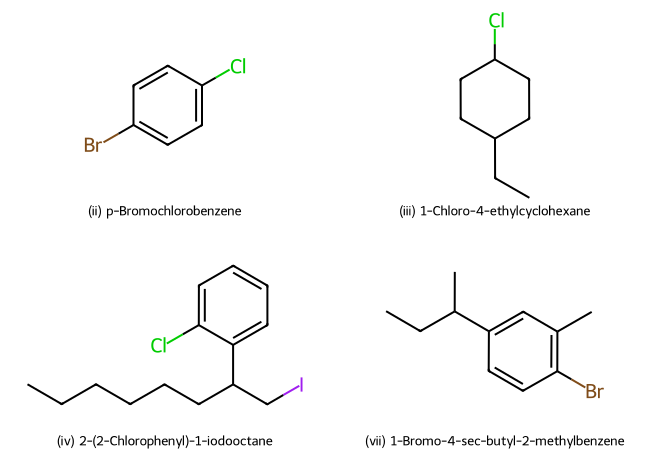
p-Bromochlorobenzene
“p-” means para — the two substituents are opposite each other on the benzene ring.
Benzene ring with Br at position 1 and Cl at position 4 (or vice versa — it’s the same compound).
Draw a hexagon with alternating double bonds. Attach Br to one carbon and Cl to the carbon directly opposite.
-
1-Chloro-4-ethylcyclohexane
Parent: cyclohexane (6-carbon ring).
Number the ring carbons so that the substituents get the lowest locants. Chloro at C-1, ethyl at C-4.
Draw a hexagon. At one carbon, attach Cl. At the carbon three steps away (counting around), attach an ethyl group ().
NoteIn cyclohexane, the ring is usually drawn as a regular hexagon. The exact stereochemistry (cis/trans) is not specified here, so just show the connectivity.
-
2-(2-Chlorophenyl)-1-iodooctane
Parent chain: octane (8 carbons).
Substituents: an iodine at C-1, and a 2-chlorophenyl group at C-2.
“2-Chlorophenyl” means a benzene ring with a chlorine at the 2-position (ortho to the point of attachment).
Draw an 8-carbon chain:
Attach I at C-1. At C-2, attach a benzene ring that has a Cl at the ortho position relative to the bond to C-2.
So the benzene ring is drawn with the attachment point at C-1 of the ring, and Cl at C-2 of the ring.
-
2-Bromobutane
Parent: butane (4 carbons).
Bromine at C-2.
-
4-tert-Butyl-3-iodoheptane
Parent: heptane (7 carbons).
Substituents: iodine at C-3, and a tert-butyl group at C-4.
“tert-Butyl” is .
Draw a 7-carbon chain:
Attach I at C-3. At C-4, attach a carbon that has three methyl groups:
The full structure:
-
1-Bromo-4-sec-butyl-2-methylbenzene
Parent: benzene.
Substituents: Br at C-1, methyl at C-2, and a sec-butyl group at C-4.
“sec-Butyl” is .
Number the benzene ring so that the substituents get the lowest locants. Here, 1,2,4-trisubstituted.
Draw the benzene ring. At position 1, attach Br. At position 2 (adjacent), attach a methyl group. At position 4 (directly opposite C-1), attach the sec-butyl group:
-
1,4-Dibromobut-2-ene
Parent: but-2-ene (4-carbon chain with a double bond between C-2 and C-3).
Bromines at C-1 and C-4.
The double bond is between C-2 and C-3.
Structure:
Watch outA common mistake is to put the double bond at the end. The name “but-2-ene” explicitly places the double bond between carbons 2 and 3. Also, the bromines are on the terminal carbons.
The structural formulas are: (i) (ii) A benzene ring with Br and Cl para to each other (iii) A cyclohexane ring with Cl at C-1 and ethyl at C-4 (iv) (v) (vi) (vii) A benzene ring with Br at C-1, methyl at C-2, and sec-butyl at C-4 (viii)
Unlock everything free for 14 days
- Full step-by-step solutions
- Concept-first explanations
- Methods, shortcuts & mistakes
- PYQ mapping + timed mock tests
Full access for 14 days. No credit card required.