Chemistry · Ch 4 — The d- and f-Block Elements
Atomic and Ionic Sizes
Atomic and Ionic Sizes
The Lanthanoid Contraction
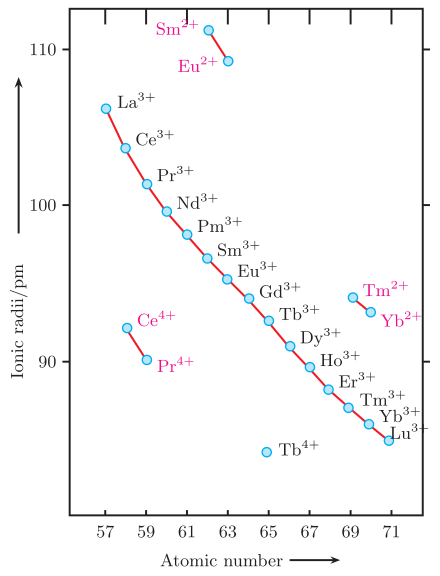
Moving across the series from lanthanum to lutetium, both the atomic radii and the ionic radii fall steadily. This overall shrinkage is called the lanthanoid contraction, and it is one of the defining features of lanthanoid chemistry — its effects reach well beyond the lanthanoids themselves and shape the chemistry of the third transition series too (see below).
Drawn by us to help you understand the concept clearly, and verified to make sure it's accurate. For exams, practice from your textbook's own diagram.
What the Figure Shows
The plot has atomic number (from 57, La, to 71, Lu) on the x‑axis and ionic radius (in picometres, roughly 90–110 pm) on the y‑axis. The main feature is a smooth, downward‑sloping line connecting the points for the tripositive ions . This line falls steadily from (largest radius) to (smallest radius). Above this line, unconnected labelled points represent a few divalent ions (, , , ) — these have larger radii. Below the line, unconnected labelled points show a few tetravalent ions (, , ) — these have smaller radii.
The Physical Idea: Lanthanoid Contraction
As we move from La to Lu, the nuclear charge increases by 14 protons. The added electrons enter the 4f subshell, which is poorly shielding. Each new 4f electron does not effectively screen the outer electrons from the increased nuclear pull. Consequently, the entire electron cloud contracts slightly with each step. This regular decrease in ionic radius for ions is called the lanthanoid contraction. The contraction is cumulative: the total shrinkage from to is about 15–20 pm.
The figure also shows that oxidation states other than +3 produce ions with different radii. Removing more electrons (forming ) leaves a smaller ion; removing fewer electrons (forming ) leaves a larger ion. The +2 and +4 states occur only for certain elements where the resulting electron configuration is especially stable (e.g., has a half‑filled 4f⁷, has a filled 4f¹⁴, has a noble‑gas core).
Key Formula Developed from This Figure
The textbook uses the figure to illustrate the regular trend in ionic radii for ions. The radius of a tripositive lanthanoid ion can be approximated by a linear decrease with atomic number :
where:
- is the ionic radius of (≈ 106 pm), …
The decrease is not equally tidy in both cases. The fall in atomic radii, measured from the structures of the metals themselves, is somewhat irregular, whereas the fall in the radii of the ions is quite regular and steady across the series (this is the trend plotted in Fig. 4.6 — the ionic radii fall in an almost straight line as atomic number increases).
Why It Happens
The cause is the same effect responsible for the analogous contraction seen across an ordinary -block transition series: imperfect shielding. As you move along the series, each additional electron goes into the same subshell as the ones before it, and one electron is comparatively poor at shielding another electron from the nucleus. Because the shielding within the subshell is weaker than the shielding one electron provides another, the effective nuclear charge felt by the outer electrons keeps climbing steadily as protons are added — and the atom (or ion) shrinks in a correspondingly steady way.
Why It Matters — Consequences for the Third Transition Series
The cumulative effect of this steady shrinkage across all fourteen lanthanoids is large enough that it carries over into the elements that come right after the lanthanoid series in the periodic table — the third row of the -block. As a result, the radii of the third-row transition elements end up remarkably close to the radii of their second-row counterparts directly above them, even though the third-row elements are far heavier. …