Q.If ∮SE⋅dS=0 over a surface, then
🔒You're viewing a preview — the full solution, concept, methods & PYQ mapping are locked.
🔒 Start your 10-day free trial to unlock the full solution →Concept understanding — Gauss Law
Gauss's Law is a shortcut. Instead of adding up the Coulomb contribution of every charge — a nightmare of vectors and integrals — it lets you read the field straight off the symmetry of a problem. The whole idea rests on one quantity: electric flux.
Flux — field-lines counted through a surface. For a uniform field E crossing a flat area A, the flux is Φ = E·A = EA cosθ, where θ is the angle between the field and the normal to the surface. Picture the field as a bundle of lines; flux is how many pierce the surface. When E is edge-on (θ = 90°) nothing passes through and Φ = 0; when E is ⊥ to the surface (θ = 0) the count is maximal. For a closed surface, Φ is the net number of lines leaving it — lines that enter and exit cancel.
The law itself. Gauss's law states that the net flux out of any closed surface depends only on the charge trapped inside:
Φ = q_enclosed / ε₀.
Two consequences do most of the work. First, only enclosed charge counts — a charge outside sends as many lines in as out, so its net contribution is exactly zero. Second, the surface's shape is irrelevant; move the charge around inside or deform the surface, and Φ never changes.
Why symmetry makes it powerful. By itself Φ = q/ε₀ has E buried in an integral. It becomes a tool only when you pick a Gaussian surface matched to the symmetry — one where E is constant and everywhere either ⊥ to the surface (so Φ = EA) or ∥ to it (contributing nothing). Then E slides out and you solve in one line. This works for exactly three geometries:
1 — Infinite line charge (linear density λ). Use a coaxial cylinder: E = λ / 2πε₀r, falling off as ∝ 1/r.
2 — Infinite sheet (surface density σ). Use a pillbox pierced through the sheet: E = σ / 2ε₀ — uniform and completely independent of distance. The field near a large charged plane simply doesn't weaken as you step back. …
Why this formula?
Gauss's Law: Why It Holds
Gauss's Law is one of the four Maxwell's equations and a cornerstone of electromagnetism. Let's build the understanding from the ground up — not just the formula, but the why.
1. The Core Idea: Flux as "Flow" of Field
Imagine an electric field E passing through a small patch of area dA. The electric flux through that patch is:
dΦE=E⋅dA=EdAcosθ
where θ is the angle between E and the outward normal to the surface.
Why this definition?
- If E is perpendicular to the surface (θ=0), maximum field "flows through".
- If E is parallel (θ=90∘), no flux — the field just slides along the surface.
Total flux through a closed surface S is:
ΦE=∮SE⋅dA
2. The Key Insight: Flux Depends Only on Enclosed Charge
Consider a single point charge +q at the centre of a spherical surface of radius r.
- By Coulomb's law, at every point on the sphere: E=4πε01r2q, radially outward.
- The area vector dA is also radially outward.
- So E⋅dA=EdA everywhere.
The total flux:
ΦE=∮EdA=E∮dA=(4πε01r2q)(4πr2)=ε0q
Notice: The r2 cancels! The flux is independent of the radius.
3. Why Shape Doesn't Matter
Now, what if the surface is not spherical but any closed shape enclosing the charge?
- Draw a small cone from the charge to the surface.
- The flux through a patch dA at distance r is dΦ=4πε01r2qcosθdA.
- But r2cosθdA is exactly the solid angle dΩ subtended by dA at the charge.
So dΦ=4πε0qdΩ.
Integrating over the entire closed surface: ∮dΩ=4π (total solid angle around a point).
Hence:
ΦE=4πε0q⋅4π=ε0q
Result: For any closed surface enclosing q, the flux is ε0q.
4. Multiple Charges: Superposition
If there are many charges q1,q2,…,qn inside the surface, the total electric field is the vector sum of individual fields:
E=E1+E2+⋯+En
Flux is linear: …
Gauss's law: ∮SE⋅dS=qenc/ε0. Given the flux is zero, qenc=0 — which in the field-line picture means exactly as many flux lines enter S as leave it (option c). It does not mean E=0 on/inside S (a), nor that E is uniform (b), nor that all charge sits outside S (d): a dipole (equal +q,−q) placed inside S gives zero net charge and zer …
Zero net flux through a closed surface means, by Gauss's law, that the net charge enclosed is zero — and "net flux equals zero" is exactly the statement that as many field lines enter the surface as leave it. Among the four options, that is option (c).
Working from Gauss's law
Gauss's law for any closed surface S states
∮SE⋅dS=ε0qenc.
Here we are told ∮SE⋅dS=0, so directly qenc=0 — the total charge enclosed is zero (equal amounts of positive and negative charge inside, or none at all).
Checking each option against this
- "the electric field inside the surface and on it is zero." False. A zero-charge enclosure does not force E=0. Example: place a dipole (+q and −q) inside S. The enclosed charge is zero, so the flux is zero — but E is clearly non-zero at most points on and inside S (it points strongly near each charge).
- "the electric field inside the surface is necessarily uniform." False, for the same dipole example: the field near +q points outward, near −q it points inward — nowhere close to uniform. …
Concept: Gauss's Law in Electrostatics
Gauss's law states that the net electric flux through any closed surface is proportional to the net charge enclosed:
∮SE⋅dS=ε0Qenc
Where:
- E = electric field
- dS = area vector (outward normal)
- Qenc = total charge inside the surface
- ε0 = permittivity of free space
Method: Direct Application of Gauss's Law
Step 1 — Write Gauss's law
∮SE⋅dS=ε0Qenc
Step 2 — Substitute the given condition
We are told:
∮SE⋅dS=0
Therefore:
ε0Qenc=0
Step 3 — Solve for enclosed charge
Since ε0=0, we get:
Qenc=0
Interpretation …
Here are the common mistakes students make when interpreting ∮SE⋅dS=0, along with how to avoid each.
Mistake 1: Assuming the Electric Field is Zero Everywhere on the Surface
The error:
Students conclude that if the flux is zero, then E=0 at every point on S.
Why it’s wrong:
Flux is the net sum of E⋅dS. Field lines can enter on one side and leave on another, giving zero net flux even though E is non-zero everywhere.
How to avoid:
Remember:
Zero flux = zero field.
Think of a uniform field passing through a closed cylinder — flux in one end equals flux out the other, so net flux is zero, but E is constant and non-zero.
Mistake 2: Concluding No Charge Exists Anywhere
The error:
Students apply Gauss’s law and say Qenc=0, then assume there is no charge at all in the universe.
Why it’s wrong:
Gauss’s law only tells you about the net charge enclosed inside S. Charges outside S contribute to E on the surface but not to Qenc.
How to avoid:
Always write:
∮SE⋅dS=ε0Qenc
So ∮=0 means Qenc=0 — not that no charges exist anywhere.
Mistake 3: Forgetting the Surface Must Be Closed
The error:
Students apply the reasoning to an open surface (like a disk or a square).
Why it’s wrong:
The symbol ∮ means a closed surface. Gauss’s law only holds for closed surfaces. An open surface can have zero flux without any special condition on enclosed charge.
How to avoid:
Check the integral symbol:
- ∮ = closed surface (Gauss’s law applies)
- ∫ = open surface (no such law)
Mistake 4: Thinking the Field is Zero Inside the Volume
The error:
Students conclude E=0 everywhere inside the volume bounded by S.
Why it’s wrong:
Zero net flux does not imply zero field inside. For example, a dipole inside a closed surface gives zero net flux but a non-zero field inside.
How to avoid:
Use Gauss’s law only for flux, not for the field at interior points. To find E inside, you need symmetry or other methods (like superposition).
Mistake 5: Ignoring the Sign of dS
The error: …
Showing the 12 most recent of 36 on this concept.
- JEE Main 2026Set 2026-01-23-s14 marksMCQQ.Two point charges 2q and q are placed at vertex A and centre of face CDEF of the cube as shown in figure. The electric flux passing through the cube is:
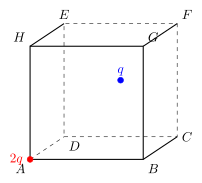 (A) 3q/ε₀
(B) 3q/(4ε₀)
(C) 3q/(2ε₀)
(D) q/ε₀
›Reveal solutionSolution
Split each charge's flux by the symmetry of how many identical cubes share that charge's location - vertex: 1/8, face-centre: 1/2 - then add.
Cube with charge 2q at vertex A and charge q at the centre of face CDEF Gauss's law: Φ=Qenc/ε0. For a charge shared equally by n identical surrounding solids, each solid captures 1/n of its total flux by symmetry.
- Figure: charge 2q sits at vertex A of the cube; charge q sits at the centre of face CDEF. …
- JEE Main 2026Set 2026-01-24-s14 marksMCQQ.The electrostatic potential in a charged spherical region of radius r varies as V = ar³ + b, where a and b are constants. The total charge in the sphere of unit radius is α × πaε₀. The value of α is _____. (permittivity of vacuum is ε₀) (A) -9 (B) -6 (C) -12 (D) -8
›Reveal solutionSolution
Differentiate the given potential to get the field, then feed that field into Gauss's law for a sphere — the enclosed charge comes out to −12πaε0, so α=−12.
A potential that depends only on r inside a spherical region is really just a compact way of encoding a continuous, spherically symmetric charge distribution. Once V(r) is known, the radial field drops straight out of E=−drdV, and once the field is known, Gauss's law hands over the enclosed charge at any radius without ever needing the actual charge density ρ(r) explicitly.
- Start from the given potential, V(r)=ar3+b, valid throughout the charged spherical region. The radial electric field is
E(r)=−drdV=−3ar2.
The field grows as r2 and points inward for positive a, since E(r) is negative.
- Apply Gauss's law on a spherical surface of radius r concentric with the charge distribution. By the symmetry of the problem, E(r) is uniform in magnitude over this surface and purely radial, so
E(r)⋅4πr2=ε0Qenc(r).
Qenc(r)=4πε0r2E(r)
- Substituting E(r)=−3ar2: …
- JEE Main 2025Set 2025-01-22-s14 marksMCQQ.A line charge of length a/2 is kept at the center of an edge BC of a cube ABCDEFGH having edge length 'a' as shown in the figure. If the density of line charge is λC per unit length, then the total electric flux through all the faces of the cube will be __________ . (Take, ε0 as the free space permittivity) (A) λa / (2ε0) (B) λa / (8ε0) (C) λa / (4ε0) (D) λa / (16ε0)
›Reveal solutionSolution
A charge sitting exactly on an edge of a cube is shared by 4 cubes that would tile around that edge, so Gauss's law gives 1/4 of the enclosed charge's total flux through any one such cube.
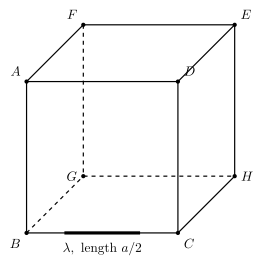
Cube ABCDEFGH of edge length a with a line charge of length a/2 centred on edge BC Intuition. This is the edge-version of the familiar "charge at a corner → 1/8 of Q/ε0" trick (corner shared by 8 cubes) and "charge on a face → 1/2" (face shared by 2 cubes). An edge of a cube, if the cube were tiled in 3D space, is shared by exactly 4 cubes arranged symmetrically (90° wedges) around the line — so by symmetry each cube intercepts exactly one quarter of the flux that would emerge from a closed surface fully surrounding the charge.
1. Check the charge lies strictly on the edge, inside the cube's extent. The line has length a/2, centred at the midpoint of edge BC (which has length a). Its two ends are each a/4 from the midpoint — well short of reaching corners B or C — so the entire charge coincides with a portion of the cube's own edge, not sticking out beyond it.
2. Total charge on the segment.
Q=λ⋅2a
3. Total flux if this charge were fully enclosed by any closed surface (Gauss's law).
Φtotal=ε0Q=2ε0λa …
- JEE Main 2025Set 2025-01-23-s14 marksMCQQ.The electric flux is φ = ασ + βλ where λ and σ are linear and surface charge density, respectively. (α/β) represents (A) displacement (B) charge (C) electric field (D) area
›Reveal solutionSolution
Since ασ and βλ must each carry the dimensions of flux, dividing α by β leaves only a ratio of (charge/length) to (charge/area), which is a length — i.e. a displacement.
The trick in this kind of question is to never worry about what α and β 'physically' are — just force both terms to have the dimensions of ϕ and see what's left when you divide.
- Electric flux ϕ=E⋅A has dimensions [field]×[area].
- From ϕ=ασ: [α]=[σ][ϕ], where [σ]= charge/area.
- From ϕ=βλ: [β]=[λ][ϕ], where [λ]= charge/length.
- Therefore …
- JEE Main 2025Set 2025-01-24-s14 marksQ.A square loop of sides a = 1 m is held normally in front of a point charge q = 1C at a distance a/2. The flux of the electric field through the shaded region is (5/p) × (1/ε₀) Nm²/C, where the value of p is ________ .
›Reveal solutionSolution
The charge-at-centre-of-a-cube trick gives the whole square a flux of q/(6ε0); the shaded triangles cover 5/8 of the square's area, so the shaded flux is 5q/(48ε0) and p=48.
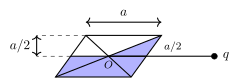
Square loop tilted in perspective, subdivided by diagonals and midline into six triangles with the shaded region marked, and point charge q at distance a/2 Whenever a point charge sits at perpendicular distance a/2 from the centre of a square of side a, with the square's plane perpendicular to the line joining its centre to the charge, you can mentally complete five more identical squares around the charge to form a closed cube of edge a with the charge exactly at its centre. By symmetry, each of the six faces intercepts an equal share of the total flux leaving the charge.
- By Gauss's law, the total flux from the point charge through any closed surface enclosing it is q/ε0.
- The given square is one face of a cube of edge a centred on q (the perpendicular distance from the charge to the face is a/2, exactly half the edge). By symmetry all 6 faces receive equal flux, so Φsquare=61⋅ε0q=6ε0q. …
- JEE Main 2025Set 2025-01-29-s24 marksMCQQ.A point charge causes an electric flux of −2×10^4 N·m²·C^-1 to pass through a spherical Gaussian surface of 8.0 cm radius, centred on the charge. The value of the point charge is : (Given ε0 = 8.85×10^-12 C² N^-1 m^-2) (A) 17.7×10^-8 C (B) −17.7×10^-8 C (C) 15.7×10^-8 C (D) −15.7×10^-8 C
›Reveal solutionSolution
Gauss's law relates flux directly to enclosed charge — the sign of the flux is the sign of the charge, and the Gaussian surface's radius is irrelevant once flux is given.
- Gauss's law: Φ=ε0q ⇒ q=Φε0.
- q=(−2×10⁴ N⋅m2C−1)×(8.85×10−12 C2N−1m−2)=−17.7×10⁻⁸ C. …
- JEE Main 2025Set 2025-04-08-s24 marksMCQQ.An infinitely long wire has uniform linear charge density λ = 2 nC/m. The net flux through a Gaussian cube of side length √3 cm, if the wire passes through any two corners of the cube, that are maximally displaced from each other, would be x Nm^2C^-1, where x is: [Neglect any edge effects and use 1/(4πε₀) = 9 × 10^9 SI units] (A) 6.48π (B) 0.72π (C) 1.44π (D) 2.16π
›Reveal solutionSolution
Only the portion of the line charge actually enclosed inside the Gaussian cube contributes to the flux (Gauss's law cares about enclosed charge, not the charge outside); the two "maximally displaced" corners of a cube are the endpoints of its space diagonal.
1. Length of wire inside the cube
The two corners that are maximally displaced from each other in a cube are the ends of the space diagonal, of length a3 for a cube of side a.
a=3 cm⇒Lenc=a3=3×3=3 cm=0.03 m
2. Charge enclosed
Qenc=λLenc=(2×10⁻⁹)(0.03)=6×10⁻¹¹ C
3. Apply Gauss's law
Φ=ε0Qenc
Using 4πε01=9×10⁹⇒ε01=4π×9×109=36π×109: …
- JEE Main 2024Set 2024-01-29-s14 marksMCQQ.Two charges of 5Q and -2Q are situated at the points (3a, 0) and (-5a, 0) respectively. The electric flux through a sphere of radius '4a' having its centre at the origin is: (A) ε03Q (B) ε05Q (C) ε07Q (D) ε02Q
›Reveal solutionSolution
Gauss's law: flux through a closed surface depends only on enclosed charge. The sphere of radius 4a encloses 5Q but not −2Q, so flux =5Q/ε0.
Current i=8 A entering node A, splitting between a galvanometer G (top) and shunt resistor S (bottom) in parallel, exiting at B. By Gauss's law, the electric flux through a closed surface is ε0Qenc, where Qenc is the total charge inside.
- Sphere centre at origin, radius 4a. …
- JEE Main 2024Set 2024-02-01-s24 marksMCQQ.C1 and C2 are two hollow concentric cubes enclosing charges 2Q and 3Q respectively as shown in figure. [FIGURE] The ratio of electric flux passing through C1 and C2 is: (A) 3 : 2 (B) 5 : 2 (C) 2 : 5 (D) 2 : 3
›Reveal solutionSolution
Use Gauss's law: flux through a closed surface equals qenclosed/ε0. Find the charge enclosed by each cube and take the ratio.
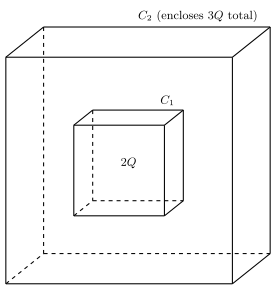
A smaller cube C1 (enclosing charge 2Q, labelled inside) drawn nested inside a larger cube C2 (enclosing total charge 3Q, i.e. an additio... Gauss's law states that the total electric flux through any closed surface depends only on the net charge enclosed, independent of the surface's shape or size.
- For the inner cube C1, the enclosed charge is q1=2Q, so Φ1=ε02Q. …
- JEE Main 2024Set 2024-04-09-s24 marksMCQQ.Five charges +q, +5q, –2q, +3q and –4q are situated as shown in the figure. The electric flux due to this configuration through the surface S is :[FIGURE] (A) ϵ05q (B) ϵ04q (C) ϵ03q (D) ϵ0q
›Reveal solutionSolution
Apply Gauss's law: flux =qenclosed/ϵ0, counting only charges inside the surface.
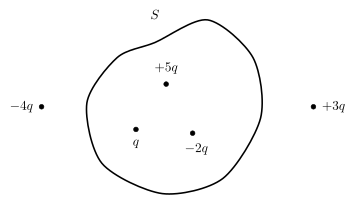
A closed, irregularly-shaped (amoeba-like) Gaussian surface labelled S is drawn. Inside the surface are three point charges: +5q, q, and ... - Charges inside S: +5q, +q, −2q. …
- JEE Main 2024Set 2024-01-29-s14 marksQ.An electron is moving under the influence of the electric field of a uniformly charged infinite plane sheet S having surface charge density +σ. The electron at t=0 is at a distance of 1 m from S and has a speed of 1 m/s (moving toward S). The maximum value of σ if the electron strikes S at t=1 s is α[emε0]m2C, the value of α is __________.
›Reveal solutionSolution
The infinite sheet produces a uniform attractive acceleration on the electron; solving the kinematics for the given strike time gives the field strength.
- An infinite sheet of surface charge +σ produces a uniform field of magnitude 2ε0σ, independent of distance, directed away from the sheet. The resulting attractive force on the electron (charge −e) has constant magnitude F=2ε0eσ, giving constant acceleration a=2ε0meσ toward the sheet.
- With the electron 1 m from the sheet and an initial 1 m/s component, the net displacement toward the sheet after time t, measured as remaining distance from the sheet, is x(t)=1+t−21at2 (the uniform pull steadily curves the electron's path back toward the sheet). …
- JEE Main 2024Set 2024-04-04-s14 marksQ.An infinite plane sheet of charge having uniform surface charge density +σs C/m² is placed on the x-y plane. Another infinitely long line charge having uniform linear charge density +λe C/m is placed at z = 4m plane and parallel to y-axis. If the magnitude values ∣σs∣=2∣λe∣ then at point (0, 0, 2), the ratio of magnitudes of electric field values due to sheet charge to that of line charge is πn:1. The value of n is_________.
›Reveal solutionSolution
Compute Es=2ε0σs and Eℓ=2πε0rλe with r=2 m, then use σs=2λe.
- Field of infinite sheet at z=2: Es=2ε0σs.
- Field of infinite line charge at perpendicular distance r=2 m: Eℓ=2πε0⋅2λe=4πε0λe.
- Ratio: …
🎓Unlock everything free for 10 days
- ✓Full step-by-step solutions
- ✓Concept-first explanations
- ✓Methods, shortcuts & mistakes
- ✓PYQ mapping + timed mock tests
Full access for 10 days. No credit card required.