Imagine you're walking home from school. You take a shortcut through a park, then stop to buy a snack, then realise you forgot something and run back a bit, then finally walk home. By the time you reach your front door, you've walked a total of 2 km — but your house is only 500 metres from school in a straight line.
That difference — between the total ground you covered and how far you actually ended up from where you started — is the entire point of speed vs velocity.
The Precise Definitions
Average speed is a measure of how fast something is moving overall. It cares only about the total distance travelled, not the direction.
Average speed=Total time takenTotal distance travelled
Average velocity is a measure of how fast and in what direction something is moving overall. It cares about the net displacement — the straight-line distance from start to finish, with a direction.
Average velocity=Total time takenDisplacement
Note
Displacement is the straight-line distance from the starting point to the ending point, with a direction. Distance is the total length of the actual path travelled, with no direction.
The Key Difference in One Sentence
Speed is a scalar (just a number, like 5 km/h). Velocity is a vector (a number and a direction, like 5 km/h north).
That one word — direction — changes everything.
A Concrete Example
You walk 3 km east, then 4 km north. The whole trip takes 1 hour.
Total distance travelled = 3 + 4 = 7 km
Displacement = straight line from start to finish = 32+42=5 km, northeast
Now compute:
Average speed=1 h7 km=7 km/h
Average velocity=1 h5 km, northeast=5 km/h, northeast
Watch out
A common mistake: students think average velocity is just "speed with direction". It's not. It's displacement divided by time, not distance divided by time. If you walk in a circle and return to your starting point, your displacement is zero — so your average velocity is zero, even though your average speed is positive.
When Are They Equal?
Only when the motion is in a straight line without changing direction. If you walk 2 km east in a straight line, then distance = displacement, so average speed = magnitude of average velocity.
But the moment you turn, or stop, or go backwards — they diverge.
Why This Matters for Exams
In Indian board exams (CBSE, ICSE, state boards), you will be asked to:
Distinguish between speed and velocity (scalar vs vector)
Calculate average speed and average velocity from given data …
Average velocity is displacement over time, and for motion along a semicircle from A to B the displacement is the straight-line diameter joining A and B, not the curved path length. …
Average velocity uses displacement (straight-line distance A to B = diameter), giving 2.0 m/s, not the arc length (which would give average SPEED = 3.14 m/s).
The particle moves along a semicircular arc of radius r = 1.0 m from A to B in time t = 1.0 s.
Displacement (straight line from A to B) = diameter = 2r = 2 x 1.0 = 2.0 m.
Average velocity = displacement / time = 2.0 m / 1.0 s = 2.0 m/s.
Same / Similar Concept — real previous-year questions on the same or a closely similar concept, not this exact question.
CBSE 2025Set ANNUAL1 markMCQ
Q.A cyclist moving on a circular track of radius 40 m completes half a revolution in 40 s. Its average velocity is
(a) zero
(b) 2 m s^-1
(c) 4 pi m s^-1
(d) 8 pi m s^-1
›Reveal solutionSolution
Average velocity uses DISPLACEMENT, not distance travelled; half a revolution displaces the cyclist by one diameter (2r), giving 2 m/s.
Radius r = 40 m, so diameter = 2r = 80 m.
In half a revolution, the cyclist moves from one end of a diameter to the exact opposite end of the circle. The straight-line displacement between these two points equals the diameter, 80 m (NOT the arc length, which is used for average SPEED, not average velocity).
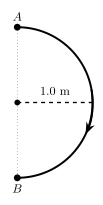
Q.In 1.0 second, a particle goes from point A to point B moving in a semi-circle of radius 1.0m as shown in fig. The magnitude of average velocity is
(a) 3.14 m/s
(b) 2.0 m/s
(c) 1.0 m/s
(d) Zero
›Reveal solutionSolution
Average velocity uses displacement (straight-line distance A to B = diameter), giving 2.0 m/s, not the arc length (which would give average SPEED = 3.14 m/s).
The particle moves along a semicircular arc of radius r = 1.0 m from A to B in time t = 1.0 s.
Displacement (straight line from A to B) = diameter = 2r = 2 x 1.0 = 2.0 m.
Average velocity = displacement / time = 2.0 m / 1.0 s = 2.0 m/s.