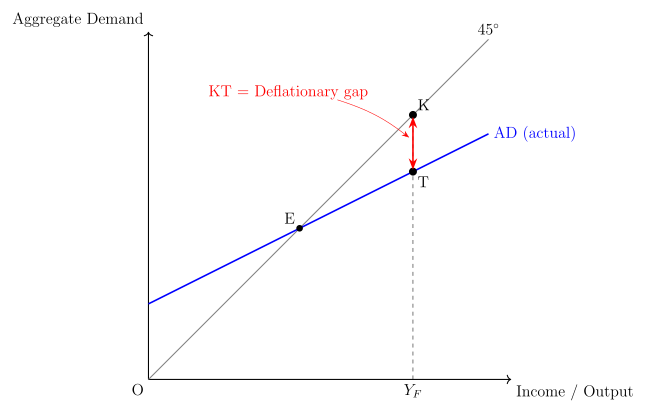
Q.In the given figure, what does the gap ‘KT’ represent ? State and discuss any two fiscal measures to correct the situation. For Visually Impaired Candidates : What is meant by deflationary gap ? State and discuss any two fiscal measures to correct the situation of deflationary gap.
You're viewing a preview — the full solution, concept, methods & PYQ mapping are locked.
Start your 14-day free trial to unlock the full solution →The gap 'KT' represents a deflationary gap, which is the shortfall in aggregate demand required to achieve full employment; this situation can be corrected by increasing government expenditure or decreasing taxes.
Concept and Intuition
In macroeconomics, the economy is considered to be in equilibrium when aggregate demand (AD) equals aggregate supply (AS). However, this equilibrium might not always coincide with full employment of resources. A deflationary gap arises when the actual aggregate demand in the economy is less than the aggregate demand required to achieve full employment.
Imagine an economy capable of producing goods and services using all its available labour and capital (full employment output). If people and businesses aren't spending enough to buy all that could be produced at full employment, then some resources (like labour) will remain idle. This shortfall in spending is the deflationary gap. It signals a situation of underutilization of resources, leading to unemployment and a general slowdown in economic activity. The goal of economic policy in such a situation is to boost aggregate demand to the level required for full employment.
Step-by-Step Solution
-
Understanding the Gap 'KT'
For visually impaired candidates, the question clarifies that 'KT' refers to the deflationary gap.
A deflationary gap (also known as a recessionary gap) occurs when the aggregate demand (AD) in the economy falls short of the aggregate supply (AS) at the full employment level of output.
In simpler terms, it is the amount by which actual aggregate demand falls below the level of aggregate demand required to achieve full employment equilibrium.
This situation leads to:
- Unemployment: As firms produce less due to insufficient demand, they lay off workers.
- Underutilization of resources: Productive capacity remains idle.
- Downward pressure on prices: Though not always leading to outright deflation, it indicates a lack of inflationary pressure and potential for price falls.
Deflationary Gap = Aggregate Demand at Full Employment Actual Aggregate Demand
-
Fiscal Measures to Correct a Deflationary Gap
Fiscal policy refers to the government's use of spending and taxation to influence the economy. To correct a deflationary gap, the government aims to increase aggregate demand. This is achieved through an expansionary fiscal policy.
ImportantThe primary objective of fiscal measures to correct a deflationary gap is to stimulate aggregate demand to reach the full employment level.
Here are two key fiscal measures:
- Measure 1: Increase in Government Expenditure ()
When the government increases its spending on goods and services (e.g., infrastructure projects, defence, public services), it directly injects money into the economy. This direct injection immediately boosts aggregate demand.
The impact is amplified by the multiplier effect:
- The initial government spending becomes income for those who receive it (e.g., construction workers, suppliers).
- These individuals then spend a portion of their increased income, which becomes income for others.
- This process continues, leading to a total increase in aggregate demand and national income that is several times the initial increase in government spending. …
- Measure 1: Increase in Government Expenditure ()
When the government increases its spending on goods and services (e.g., infrastructure projects, defence, public services), it directly injects money into the economy. This direct injection immediately boosts aggregate demand.
The impact is amplified by the multiplier effect:
Unlock everything free for 14 days
- Full step-by-step solutions
- Concept-first explanations
- Methods, shortcuts & mistakes
- PYQ mapping + timed mock tests
Full access for 14 days. No credit card required.