Q.(a) Write the IUPAC name of the following complex: [Cr(NH3)3(H2O)3]Cl3 (1 mark)
🔒You're viewing a preview — the full solution, concept, methods & PYQ mapping are locked.
🔒 Start your 14-day free trial to unlock the full solution →Concept understanding — Coordination Compound Nomenclature
Coordination Compound Nomenclature: From Intuition to Precision
Imagine you're naming a person. You'd say "Ravi Sharma" — family name first, then given name. Coordination compounds have a similar logic, but the "family name" is the metal, and the "given names" are the groups attached to it. The rules are just a systematic way of writing that name so any chemist anywhere can draw the exact structure from it.
The Core Idea
A coordination compound has a central metal ion surrounded by molecules or ions called ligands. Think of the metal as the nucleus and ligands as planets orbiting it. The entire assembly (metal + ligands) is called the coordination sphere, and it's written inside square brackets: [Co(NH₃)₆]Cl₃.
The nomenclature rules tell you:
- What order to list things
- How to name each ligand
- How to indicate the metal's oxidation state
- How to handle the counter-ions outside the brackets
The Rules, Step by Step
1. Cation before anion (just like NaCl is sodium chloride)
If the complex ion is positive, it's named first. If it's negative, it's named last. Simple.
2. Within the coordination sphere: ligands first, then metal
This is the big rule. Ligands are named before the metal, in alphabetical order (ignoring prefixes like di-, tri-).
Alphabetical order is based on the ligand's name, not its formula. So NH₃ (ammine) comes before H₂O (aqua), even though N comes after H in the alphabet.
3. Naming ligands
| Ligand type | Name | Example |
|---|---|---|
| Neutral molecule (NH₃) | ammine | [Co(NH₃)₆]³⁺ → hexaamminecobalt(III) |
| Neutral molecule (H₂O) | aqua | [Cu(H₂O)₄]²⁺ → tetraaquacopper(II) |
| Neutral molecule (CO) | carbonyl | [Ni(CO)₄] → tetracarbonylnickel(0) |
| Negative ion (Cl⁻) | chloro | [PtCl₆]²⁻ → hexachloroplatinate(IV) |
| Negative ion (CN⁻) | cyano | [Fe(CN)₆]⁴⁻ → hexacyanoferrate(II) |
| Negative ion (OH⁻) | hydroxo | [Al(OH)₄]⁻ → tetrahydroxoaluminate(III) |
ammine (with two m's) is for NH₃ as a ligand. amine (one m) is for organic compounds like ethylamine. Don't mix them up — exam setters love this trap.
4. Prefixes for multiple ligands
Use Greek prefixes: di-, tri-, tetra-, penta-, hexa-, hepta-, octa-.
If the ligand name already contains a number (like ethylenediamine), use bis-, tris-, tetrakis- instead.
[Co(en)₃]³⁺ is tris(ethylenediamine)cobalt(III), not triethylenediaminecobalt(III). The parentheses around the ligand name are mandatory when using bis/tris/tetrakis.
5. Oxidation state of the metal
Write it in Roman numerals in parentheses right after the metal name. No space.
[Fe(CN)₆]³⁻ → hexacyanoferrate(III) (iron is in +3 state)
6. If the complex is an anion, change the metal's ending
| Metal | Anionic form |
|---|---|
| Cobalt | cobaltate |
| Copper | cuprate |
| Iron | ferrate |
| Nickel | nickelate |
| Platinum | platinate |
| Zinc | zincate |
General pattern:
[M(L)ₙ]Xₘ → cation name = [prefix-ligands]metal(oxidation state)
anion name = [prefix-ligands]metalate(oxidation state)
Worked Examples
Example 1: K₃[Fe(CN)₆]
- Cation: potassium (K⁺)
- Complex anion:
[Fe(CN)₆]³⁻ - Ligands: 6 cyano → hexacyano
- Metal: iron → ferrate (because it's an anion)
- Oxidation state: Fe is +3 (since 6 CN⁻ = -6, total charge -3, so Fe must be +3)
- Answer: Potassium hexacyanoferrate(III)
Example 2: [Co(NH₃)₅Cl]Cl₂
- Cation:
[Co(NH₃)₅Cl]²⁺ - Ligands: 5 ammine + 1 chloro → alphabetical: ammine before chloro → pentaamminechloro
- Metal: cobalt
- Oxidation state: Co is +3 (5 NH₃ neutral, 1 Cl⁻ = -1, total +2, so Co = +3) …
Why this formula?
Coordination Compound Nomenclature: Why the Rules Work
Coordination compound nomenclature isn't about a single formula — it's a system of rules built on a few core principles. Let's understand the why behind each major rule, so you never have to memorise blindly.
1. The Central Idea: Ligands as "Guests" Around a Metal "Host"
A coordination compound has a central metal atom/ion surrounded by ligands (molecules or ions that donate electron pairs). The naming reflects this relationship:
- Cation first, then anion (like normal ionic compounds)
- Ligands named before the metal (because they modify the metal's identity)
Why?
In chemistry, we name the more electropositive part first (cation). The metal-ligand complex is treated as a single unit — the ligands are "attached" to the metal, so they come first in the complex name.
2. Key Rule: Ligand Order — Alphabetical, Not by Charge
Rule: Ligands are named in alphabetical order (ignoring prefixes like di-, tri-).
Why?
- If we ordered by charge or size, the name would change every time a ligand is replaced.
- Alphabetical order is universal and unambiguous — it doesn't depend on the metal or oxidation state.
- Example:
[Co(NH₃)₄Cl₂]⁺is tetraamminedichlorocobalt(III) — "ammine" (a) before "chloro" (c).
3. Oxidation State: Why Roman Numerals?
Rule: The metal's oxidation state is written in Roman numerals in parentheses after the metal name.
Why?
- The oxidation state tells you the charge on the metal after accounting for ligand charges.
- Roman numerals avoid confusion with Arabic numbers (which are used for ligand counts).
- Example:
[Fe(CN)₆]³⁻→ hexacyanoferrate(III) — the iron is Fe³⁺, not Fe²⁺.
Derivation of oxidation state:
Let the complex charge = Q, ligand charges = sum of ligand charges L, number of ligands = n.
Then:
Metal oxidation state=Q−L
For [Fe(CN)₆]³⁻: CN⁻ has charge -1, so L=6×(−1)=−6, Q=−3.
Fe oxidation state=−3−(−6)=+3
4. Anionic Ligands: The "-o" Ending
Rule: Anionic ligands (negative ions) end in -o (e.g., Cl⁻ → chloro, CN⁻ → cyano, OH⁻ → hydroxo).
Why?
- This distinguishes them from neutral ligands (e.g., NH₃ → ammine, H₂O → aqua).
- The suffix -o signals "this ligand came from an anion" — crucial for charge balance.
Common examples:
| Anion | Ligand name |
|---|---|
| Cl⁻ | chloro |
| CN⁻ | cyano |
| OH⁻ | hydroxo |
| SO₄²⁻ | sulfato |
5. Neutral Ligands: Special Names
Rule: Neutral ligands keep their molecular name, except for a few with special names:
- NH₃ → ammine (not "ammonia")
- H₂O → aqua
- CO → carbonyl
- NO → nitrosyl
Why?
- "Ammine" avoids confusion with ammonia (NH₃) as a free molecule.
- These special names are historical but standardised — you must memorise them for exams.
6. Prefixes: di-, tri-, tetra-, etc.
Rule: Use Greek prefixes to indicate the number of each ligand:
- 2 → di, 3 → tri, 4 → tetra, 5 → penta, 6 → hexa
Why?
- Without prefixes,
[Co(NH₃)₆]³⁺would be "hexaamminecobalt(III)" — the "hexa" tells you there are six ammines. - For ligands with complex names (e.g., ethylenediamine), use bis-, tris-, tetrakis- to avoid confusion.
Example:
[Co(en)₃]³⁺ → tris(ethylenediamine)cobalt(III) — "tris" because "triethylenediamine" would sound like three ethylenediamine molecules (which is correct, but "tris" is clearer).
7. Anionic Complexes: The "-ate" Suffix …
- [Cr(NH3)3(H2O)3]Cl3 is named triamminetriaquachromium(III) chloride (ligands cited alphabetically: ammine before aqua).
- A chelating ligand is a polydentate ligand that binds to the same metal ion through two or more donor atoms, forming a ring (e.g. ethylenediamine).
- In a tetrahedral complex all four positions are equivalent and adjacent (bond angle ≈109.5°), so there is no cis/trans distinction possible. Or: (d) [Ti(H2O)6]3+ (d1) shows a t2g→eg d-d transition on absorbing visible light, hence coloured; [Ti(H2O)6]4+ (d0) has no d-electron to promote, hence colourless. (e) [Co(NH3)4Cl2]+ has cis (Cl atoms at 90°) and trans (Cl atoms at 180°) geometrical isomers. …
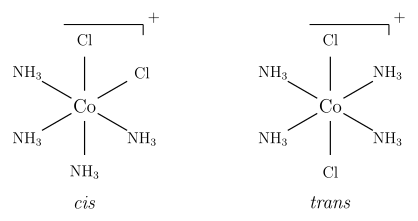
This question tests IUPAC nomenclature of coordination compounds, the meaning of chelation, and why tetrahedral complexes cannot show cis-trans isomerism.
(a) IUPAC name of [Cr(NH3)3(H2O)3]Cl3
Step 1 — ligands: three NH3 (ammine, neutral) and three H2O (aqua, neutral).
Step 2 — alphabetical order of ligand names: 'ammine' precedes 'aqua' (comparing letter-by-letter, the second letter 'm' precedes 'q'), so ammine is cited first.
Step 3 — oxidation state of Cr: the complex ion carries a charge of +3 (balanced by three Cl− counter-ions) and both ligands are neutral, so Cr is in the +3 state — written as chromium(III).
Name: Triamminetriaquachromium(III) chloride.
(b) Chelating ligands
A chelating ligand (or polydentate ligand) is one that has two or more donor atoms and can bind to the same central metal ion at more than one point simultaneously, closing a ring structure (a chelate ring) with the metal. This generally makes the complex more stable than one with the equivalent number of monodentate ligands (the 'chelate effect'). Examples: ethylenediamine (en, bidentate), oxalate ion (C2O42−, bidentate), EDTA (hexadentate).
(c) No geometrical isomerism in tetrahedral complexes
In a tetrahedral MA2B2-type complex, the four ligand positions are all mutually adjacent — every pair of positions subtends the same bond angle (≈109.5°) and is related by the same symmetry. Since there is no pair of positions that is 'opposite' (180°, trans) versus 'adjacent' (90°, cis) as there is in a square planar or octahedral geometry, all arrangements of the ligands around a tetrahedral centre are identical (superimposable) — so cis and trans forms cannot be distinguished, and geometrical isomerism does not occur.
…
Showing the 12 most recent of 56 on this concept.
- CBSE 2026Set 56/3/11 markMCQQ.The oxidation number of Co in [Co(en)3]2(SO4)3 is : (A) +3 (B) +2 (C) +4 (D) +6
›Reveal solutionSolution
The complex cation [Co(en)3]n+ must balance three sulfate anions (SO42−); since ethylenediamine is neutral, cobalt carries +3.
Why oxidation numbers matter in coordination compounds
Oxidation state tells us the formal charge on the central metal after we've assigned all bonding electrons to the more electronegative atom. In coordination chemistry, we treat ligands as intact units: neutral ligands contribute zero, anionic ligands contribute their charge. The sum of oxidation states in the entire complex must equal its net charge.
The formula [Co(en)3]2(SO4)3 shows us a salt: two complex cations paired with three sulfate anions. Our job is to figure out what charge the cobalt must carry to make the arithmetic work.
Step-by-step determination
1. Identify the ionic components
The compound dissociates into:
- Two [Co(en)3]n+ cations (where n is unknown)
- Three SO42− anions
2. Apply charge neutrality
The entire salt is neutral, so total positive charge equals total negative charge:
2×(charge on one cation)=3×2
2n=6
n=+3
Each complex cation carries a +3 charge: [Co(en)3]3+.
3. Determine cobalt's oxidation state within the cation
Now look inside [Co(en)3]3+. Ethylenediamine (en=H2NCH2CH2NH2) is a neutral bidentate ligand—it donates two lone pairs but carries no charge. Three en ligands contribute:
3×0=0
The oxidation state of cobalt plus the ligand contributions must equal the cation charge:
xCo+0=+3
xCo=+3 …
- CBSE 2026Set 56/2/11 markMCQQ.The correct IUPAC name of the complex [Pt(NH3)2Cl2] is : (A) diamminedichloridoplatinum (IV) (B) diamminedichloridoplatinum (II) (C) dichloridodiammineplatinum (IV) (D) dichloridodiammineplatinum (II)
›Reveal solutionSolution
The complex [Pt(NH3)2Cl2] is neutral, so the oxidation state of Pt must be +2. Ligands are named alphabetically (ammine before chlorido), and the metal is named without a suffix. The correct IUPAC name is diamminedichloridoplatinum(II) — option (B).
The key to naming coordination compounds is to follow the IUPAC rules in order: identify the oxidation state of the metal, list ligands alphabetically (ignoring prefixes like di-, tri-), and then name the metal with its oxidation state in parentheses.
Let’s break this down step by step.
-
Determine the oxidation state of platinum.
The complex [Pt(NH3)2Cl2] is neutral — no overall charge.
- NH3 is a neutral ligand (charge 0).
- Cl is a negatively charged ligand (chlorido, charge –1). Let the oxidation state of Pt be x. Then: x+2(0)+2(−1)=0⟹x−2=0⟹x=+2. So platinum is in the +2 oxidation state.
-
Name the ligands in alphabetical order.
IUPAC rules: ligands are named alphabetically by their name (not by prefix).
- NH3 is called ammine (note the double 'm').
- Cl is called chlorido (the anionic ligand name for chloride). Alphabetically, "ammine" comes before "chlorido". So the ligand order is: diammine then dichlorido.
-
Name the metal.
Since the complex is anionic? No — it’s neutral. For neutral complexes, the metal is called by its usual name (platinum), followed by the oxidation state in Roman numerals in parentheses: platinum(II).
-
Assemble the full name.
Ligands first (with prefixes di- for two identical ligands), then metal + oxidation state:
diamminedichloridoplatinum(II). …
-
- CBSE 2026Set 56/2/11 markMCQQ.Which of the following is heteroleptic complex ? (A) [Co(NH3)6]3+ (B) [Cr(NH3)6]3+ (C) [Ni(H2O)6]2+ (D) [Co(NH3)4Cl2]+
›Reveal solutionSolution
A heteroleptic complex contains more than one type of ligand. Among the given options, only [Co(NH3)4Cl2]+ has two different ligands (NH3 and Cl−), making (D) the answer.
The distinction between homoleptic and heteroleptic complexes is fundamental to coordination chemistry and comes down to ligand diversity.
A homoleptic complex (from Greek homo = same, leptos = taking) contains only one kind of ligand attached to the central metal ion. Think of it as a "uniform" coordination sphere where every ligand is identical.
A heteroleptic complex (from Greek hetero = different) contains two or more different types of ligands. The coordination sphere is "mixed."
This classification matters because heteroleptic complexes exhibit richer isomerism (geometrical, optical) and more varied chemical behavior than their homoleptic counterparts.
Now let's examine each option systematically:
-
Option (A): [Co(NH3)6]3+
The cobalt(III) ion is surrounded by six ammonia molecules. Every ligand is NH3—no variation whatsoever. This is a textbook homoleptic complex.
-
Option (B): [Cr(NH3)6]3+
Chromium(III) coordinated to six identical ammonia ligands. Again, uniform ligand environment. Homoleptic.
-
Option (C): [Ni(H2O)6]2+
Nickel(II) surrounded by six water molecules. All ligands are the same. Homoleptic.
-
Option (D): [Co(NH3)4Cl2]+ …
-
- CBSE 2026Set ANNUAL1 markMCQQ.The oxidation number of nickel in [Ni(CO)4] will be:(a) 1(b) 0(c) 2(d) 3
›Reveal solutionSolution
CO is a neutral ligand, so the oxidation number of Ni in [Ni(CO)₄] is 0.
In a coordination compound, the oxidation number of the central metal is found by assigning charges to the ligands and balancing against the overall charge of the complex. Carbonyl (CO) is a neutral ligand — it donates a lone pair from carbon without carrying any charge itself. Since [Ni(CO)₄] is a ne …
- CBSE 2026Set ANNUAL1 markQ.Write the formula of the coordination compound tetraamine aquachlorido cobalt (III) chloride.
›Reveal solutionSolution
Build the octahedral coordination sphere from the ligands named, find the complex ion's net charge from the metal's oxidation state, then add counter-ions to balance that charge.
Naming breakdown: 'tetraammine' → 4 NH3 ligands (neutral); 'aqua' → 1 H2O ligand (neutral); 'chlorido' → 1 Cl− ligand (anionic, −1); 'cobalt(III)' → central metal Co3+. Coordination number =4+1+1=6 (octahedral), consistent with typical cobalt(III) ammine complexes.
…
- CBSE 2026Set ANNUAL1 markQ.Write answer in one word/sentence: Write chemical formula of Iron (III) hexacyanidoferrate (II).
›Reveal solutionSolution
Iron(III) hexacyanidoferrate(II) is Fe4[Fe(CN)6]3.
The complex anion hexacyanidoferrate(II) is [Fe(CN)6]4- (Fe in +2, six CN- ligands). The counter-cation is iron(III), Fe3+.
…
- CBSE 2026Set ANNUAL1 markQ.A complex has the composition Co(NH₃)₄BrCl₂. Conductance measurement shows that there are two ions per formula unit and on treatment with silver nitrate it forms a yellow precipitate. Write the IUPAC name of the complex compound.
›Reveal solutionSolution
A yellow AgBr precipitate shows free Br⁻; two ions per formula unit fix the structure as [Co(NH₃)₄Cl₂]Br → tetraamminedichloridocobalt(III) bromide.
Deducing the structure:
- The composition is Co(NH3)4BrCl2.
- Conductance shows two ions per formula unit, so the complex ionises into one cation and one anion.
- With AgNO3 it gives a yellow precipitate, which is AgBr (silver chloride is white). So it is bromide (Br−) that is the free, ionisable counter-ion outside the coordination sphere, while both chloride ions are coordinated (non-ionisable) inside.
Hence the formula is [Co(NH3)4Cl2]Br, giving the two ions [Co(NH3)4Cl2]+ and Br−.
…
- CBSE 2025Set 56/6/11 markMCQQ.Which of the following complex ion is not optically active ? (A) [Co(ox)3]3− (B) cis-[Co(en)2Cl2]+ (C) trans-[Co(en)2Cl2]+ (D) [Co(en)3]3+
›Reveal solutionSolution
Optical activity in coordination complexes requires the absence of a plane of symmetry. Among the given options, trans-[Co(en)2Cl2]+ has a centre of symmetry and a plane of symmetry, making it optically inactive. The correct answer is (C).
Why Optical Activity Matters in Coordination Chemistry
Optical activity is a property of chiral molecules — those that are non-superimposable on their mirror image. In coordination compounds, chirality arises from the spatial arrangement of ligands around the central metal ion. A complex is optically active if it lacks an improper axis of rotation (specifically, a plane of symmetry or a centre of symmetry). The classic test: if a complex and its mirror image cannot be superimposed, they are enantiomers, and the complex is optically active.
For octahedral complexes, chirality often appears when:
- Bidentate ligands (like oxalate, ox2−, or ethylenediamine, en) create a helical twist.
- The arrangement of different ligands breaks symmetry.
Let’s examine each option systematically.
1. [Co(ox)3]3− — The Tris(oxalato) Complex
Oxalate (ox2−) is a bidentate ligand that forms a five-membered chelate ring. Three oxalate ions around Co(III) give an octahedral geometry. The complex has a propeller-like shape: each oxalate spans one edge of the octahedron, and the three rings are arranged in a helical fashion.
Think of it like a three-bladed fan. The complex exists as a pair of enantiomers — left-handed and right-handed helices. There is no plane of symmetry because the chelate rings lock the structure into a chiral twist. Therefore, [Co(ox)3]3− is optically active.
TipAny octahedral complex with three identical bidentate ligands (like [M(AA)3]) is always chiral — it’s a classic example of helical chirality. The same applies to [Co(en)3]3+ in option (D).
2. cis-[Co(en)2Cl2]+ — The Cis Isomer
Here, two ethylenediamine (en) ligands and two chloride ligands surround Co(III). The “cis” prefix means the two chlorides are adjacent (90° apart). In this geometry, the two en ligands are not equivalent in space — they create a non-superimposable mirror image.
Draw the structure: the two en rings lie in roughly perpendicular planes. The cis arrangement of Cl atoms breaks any plane of symmetry. The complex is chiral, and indeed, cis-[Co(en)2Cl2]+ has been resolved into enantiomers. So it is optically active.
Watch outA common mistake is to think that any complex with two identical bidentate ligands is automatically chiral. That’s only true for the cis isomer — the trans isomer is different, as we’ll see next.
3. trans-[Co(en)2Cl2]+ — The Trans Isomer …
- CBSE 2025Set ANNUAL1 markQ.Write formula for co-ordination compound Potassium trioxalatochromate (III).
›Reveal solutionSolution
Three bidentate oxalate ligands (each -2) plus Cr3+ gives a -3 complex ion balanced by 3 K+.
'Trioxalato' means three oxalate (C2O42−) ligands (bidentate, each carrying charge −2); 'chromate(III)' means the central metal is chromium in the +3 oxidation state.
…
- CBSE 2025Set D1 markMCQQ.The IUPAC name of complex compound [Co(NH3)6]Cl3 is(a) Hexa-ammine cobalt (III) chloride(b) Hexa-ammine cobalt (II) chloride(c) Hexa-ammine trichloridocobalt (III)(d) None of these
›Reveal solutionSolution
[Co(NH3)6]Cl3 = hexaamminecobalt(III) chloride.
Rules of IUPAC nomenclature:
- Name the cation first, then the anion.
- Within the complex, ligands are named alphabetically before the metal.
- NH3 as a ligand is 'ammine' (six of them -> hexaammine).
- Oxidation state of Co: three Cl- give -3; overall neutral, so Co = +3, written as (III).
- The chloride outside is the counter-anion. …
- CBSE 2025Set ANNUAL1 markQ.Write IUPAC name of the K3[Cr(C2O4)3] complex.
›Reveal solutionSolution
K3[Cr(C2O4)3] names as potassium tris(oxalato)chromate(III), found by first working out Cr's oxidation state from the ionic charges.
Step 1 - find oxidation state of Cr:
Oxalate (C2O4)^2- is a bidentate ligand with charge -2; there are 3 of them: total ligand charge = 3 x (-2) = -6.
3 K+ balance the complex anion's charge, so the complex ion [Cr(C2O4)3]^3- carries charge -3.
Let oxidation state of Cr = x: x + (-6) = -3, so x = +3.
Step 2 - construct the IUPAC name:
- Cation (potassium) named first, unchanged. …
- CBSE 2025Set ANNUAL1 markMCQQ.The oxidation state of Fe in [Fe(CN)₆]⁻³:(a) +3(b) +2(c) +4(d) -3
›Reveal solutionSolution
Since each CN⁻ ligand carries a −1 charge and the complex ion has an overall charge of −3, the oxidation state of Fe works out to +3.
…
🎓Unlock everything free for 14 days
- ✓Full step-by-step solutions
- ✓Concept-first explanations
- ✓Methods, shortcuts & mistakes
- ✓PYQ mapping + timed mock tests
Full access for 14 days. No credit card required.