Q.Give the uses of freon 12, DDT, carbon tetrachloride and iodoform.
You're viewing a preview — the full solution, concept, methods & PYQ mapping are locked.
Start your 14-day free trial to unlock the full solution →This question asks for the uses of four important organic compounds — freon 12, DDT, carbon tetrachloride, and iodoform. Each has a distinct application: freon 12 as a refrigerant, DDT as an insecticide, carbon tetrachloride as a solvent and fire extinguisher, and iodoform as an antiseptic.
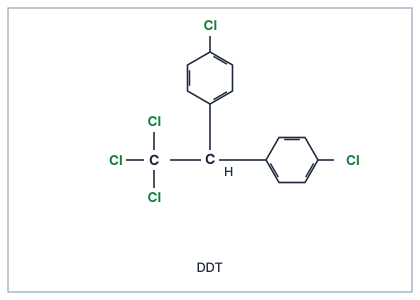
The key to answering such questions in exams is to recall the specific, well-known uses of each compound — not just general properties. Let's go through them one by one, with the reasoning behind each use.
1. Freon 12 (Dichlorodifluoromethane, )
Freon 12 is a chlorofluorocarbon (CFC). Its uses stem from its unique physical properties: it is a gas at room temperature but easily liquefies under pressure, it is non-toxic, non-flammable, and chemically stable.
- Refrigerant in air conditioners and refrigerators: Because it can absorb heat when it evaporates and release it when compressed, it was widely used in cooling systems.
- Propellant in aerosol sprays: Its low boiling point and inertness made it ideal for dispensing products like deodorants and paints.
- Foam-blowing agent: Used in manufacturing insulating foams.
Freon 12 is now banned under the Montreal Protocol because it depletes the ozone layer. In modern exams, you may be asked about its environmental impact alongside its uses.
2. DDT (Dichlorodiphenyltrichloroethane, )
DDT is an organochlorine compound. Its primary use is as an insecticide, but its story is complex.
- Insecticide in agriculture: It was massively used after World War II to control crop pests like mosquitoes, beetles, and moths.
- Disease vector control: It was sprayed to kill mosquitoes that transmit malaria and typhus, saving millions of lives.
- Household pest control: Used in powders and sprays for flies, cockroaches, and lice.
DDT is persistent in the environment and accumulates in food chains, causing harm to wildlife (especially birds). It is now banned in most countries, but is still used in some regions for malaria control under strict guidelines.
3. Carbon Tetrachloride ()
Carbon tetrachloride is a dense, non-flammable liquid. Its uses are based on its ability to dissolve oils and fats, and its fire-suppressing property.
- Solvent for oils, fats, and greases: Used in dry cleaning and as a degreasing agent in industries.
- Fire extinguisher (under the name Pyrene): Its non-flammable nature and ability to form a heavy vapour that smothers flames made it a common fire extinguisher for electrical fires. …
Unlock everything free for 14 days
- Full step-by-step solutions
- Concept-first explanations
- Methods, shortcuts & mistakes
- PYQ mapping + timed mock tests
Full access for 14 days. No credit card required.