Q.(a) In the following pairs of halogen compounds, which compound undergoes faster reaction? tert-butyl chloride (a central carbon bonded to three groups and , drawn skeletally) and a Cl-substituted skeletal alkyl chain (a secondary carbon bearing within a short branched chain) (1 mark)
You're viewing a preview — the full solution, concept, methods & PYQ mapping are locked.
Start your 14-day free trial to unlock the full solution →
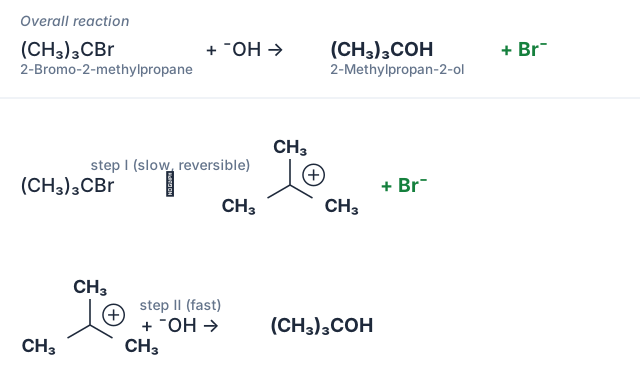
tert-Butyl chloride reacts faster by because its carbocation intermediate is tertiary and more stable; alkyl halides stay immiscible with water because they cannot hydrogen-bond with it, and Grignard reagents must be made moisture-free because water instantly destroys them.
(a) Comparing reactivity
reactions proceed through a carbocation intermediate, so their rate depends heavily on the stability of that carbocation — the more stable the carbocation, the faster the reaction (rate order: ).
- tert-Butyl chloride, , ionizes to give a tertiary carbocation, , stabilized by the (electron-donating inductive) effect and hyperconjugation from three attached methyl groups.
- The secondary chloride shown ionizes to give a secondary carbocation, stabilized by only two alkyl groups — less stabilization than the tertiary case.
Since the tertiary carbocation is significantly more stable (lower energy transition state to form it), tert-butyl chloride undergoes the faster reaction.
(b)(i) Why alkyl halides are immiscible with water despite being polar
Alkyl halides have a polar bond and so exhibit a net dipole moment, giving weak dipole–dipole (or dipole–induced-dipole) interactions with water. However, they cannot form hydrogen bonds with water molecules (they have no or group to donate a hydrogen bond, and the halogen is a poor hydrogen-bond acceptor compared to the strength of water's own network). Mixing an alkyl halide with water would require breaking many strong water–water hydrogen bonds, and the weak dipolar interactions the alkyl halide can offer in return are not energetically sufficient to compensate for this — so the two liquids do not mix and remain as separate immiscible layers.
(b)(ii) Why Grignard reagents need anhydrous conditions
Grignard reagents () are extremely reactive towards any source of active/acidic hydrogen, especially water, reacting instantaneously and irreversibly:
Even a trace of moisture would immediately protonate/quench the highly nucleophilic and basic carbanion-like carbon of the Grignard reagent, converting it uselessly into the simple alkane and destroying the reagent before it can perform the desired addition to a carbonyl compound (or other reaction). Hence, Grignard reagents must always be prepared and handled under strictly anhydrous conditions (dry ether solvent, moisture-free glassware and reagents).
…
Unlock everything free for 14 days
- Full step-by-step solutions
- Concept-first explanations
- Methods, shortcuts & mistakes
- PYQ mapping + timed mock tests
Full access for 14 days. No credit card required.