Q.Account for the following :
You're viewing a preview — the full solution, concept, methods & PYQ mapping are locked.
Start your 14-day free trial to unlock the full solution →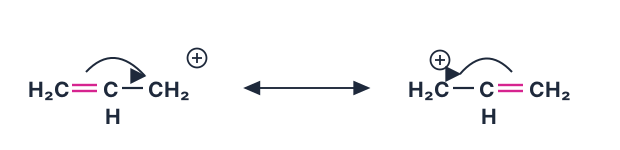
The three observations are explained by resonance shortening the C–Cl bond in chlorobenzene, the extreme moisture sensitivity of Grignard reagents, and the planar carbocation intermediate in reactions leading to racemisation.
Let’s take each part separately, because each one tests a different core concept from organic chemistry.
(a) The C–Cl bond length in chlorobenzene is shorter than that in methyl chloride.
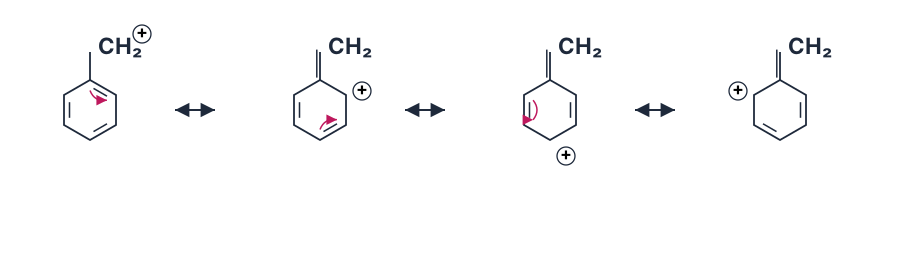
Why this happens: In chlorobenzene, the chlorine atom is directly attached to an aromatic ring. The lone pairs on chlorine can participate in resonance with the benzene ring, giving the C–Cl bond partial double-bond character. A double bond is shorter and stronger than a single bond. In methyl chloride (), no such resonance is possible — the C–Cl bond is a pure single bond.
Resonance structures of chlorobenzene show a contribution, which increases the bond order between carbon and chlorine from 1 to something greater than 1. This pulls the atoms closer together.
A common mistake is to think that the larger size of the benzene ring somehow lengthens the bond. In fact, it’s the electronic effect (resonance) that dominates, not the steric bulk.
Result: The C–Cl bond in chlorobenzene is shorter than in methyl chloride.
(b) Grignard reagents should be prepared under anhydrous conditions.
The core reason: Grignard reagents () are extremely strong bases and nucleophiles. They react violently with water — even with moisture in the air — to form the corresponding alkane () and magnesium hydroxide halide.
If water is present during preparation, the Grignard reagent gets destroyed as soon as it forms. You end up with no useful reagent, just the hydrocarbon and a magnesium salt.
This is why Grignard reactions are always carried out in absolutely dry ether (like diethyl ether or THF), which also helps stabilise the reagent by coordinating to the magnesium.
Result: Anhydrous conditions are essential to prevent the Grignard reagent from reacting with water and decomposing.
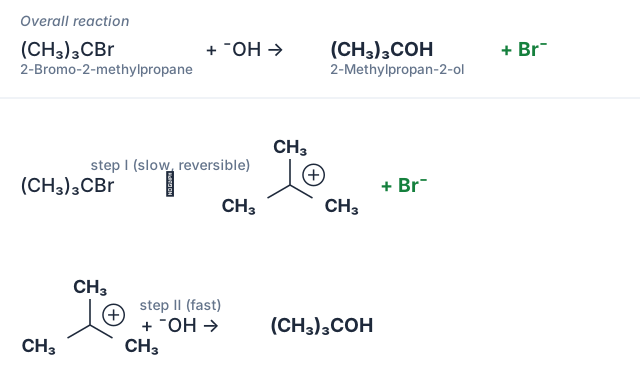
(c) In case of optically active alkyl halides, reactions are accompanied by racemisation.
The mechanism: reactions proceed via a two-step mechanism. First, the leaving group departs, forming a planar carbocation intermediate. This carbocation is hybridised and has a trigonal planar geometry — the three bonds lie in a plane, and the empty p-orbital is perpendicular to it. …
Unlock everything free for 14 days
- Full step-by-step solutions
- Concept-first explanations
- Methods, shortcuts & mistakes
- PYQ mapping + timed mock tests
Full access for 14 days. No credit card required.