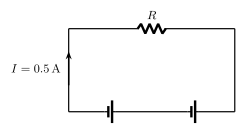
Q.In the circuit shown above, each cell has an e.m.f. of 2 V and an internal resistance of 1Ω. The current flowing through the circuit is 0.5 A. The resistance of the resistor R is
🔒You're viewing a preview — the full solution, concept, methods & PYQ mapping are locked.
🔒 Start your 14-day free trial to unlock the full solution →Concept understanding — Cells in Series and Parallel
Cells in series. Several identical cells (each emf ε, internal resistance r) can be chained together, negative terminal to positive terminal, so that n cells in series present a combined emf of nε and a combined internal resistance of nr (since the internal resistances, like ordinary series resistors, simply add). Connected to an external resistance R, the current is I=nε/(nr+R). If r≪R, this current approaches n times what a single cell alone would supply -- a genuine, worthwhile gain from wiring cells in series. But if r≫R, the current instead approaches just ε/r, essentially the SAME as a single cell alone would supply, meaning there is no real benefit to adding more cells in series in that regime. Series wiring is therefore advantageous specifically when the cells' combined internal resistance is small compared with the external load R. …
Two cells of e.m.f. 2 V each (internal resistance 1Ω each) are in series, so total e.m.f. =4 V and total internal resistance =2Ω. Using ε=I(R+r) …
The two cells are in series, so their e.m.f.s and internal resistances add; applying εtotal=I(R+rtotal) gives R=6Ω.
Setting up the circuit equation
From the figure, the two cells (each e.m.f. ε=2 V, internal resistance r=1Ω) are connected in series with each other and with the external resistor R, all in one loop carrying current I=0.5 A.
Since the cells are in series and aiding each other, the total e.m.f. of the combination is
εtotal=2+2=4 V …
- CBSE 2026Set ANNUAL1 markMCQQ.Five cells, each of e.m.f. 0.2 volt and internal resistance 1 Ω, are connected in series to an external resistance of 10 Ω. The current through the 10 Ω resistor is(a) 1/2.5 A(b) 1/10 A(c) 1/15 A(d) 1/2 A
›Reveal solutionSolution
Total emf of the 5 cells in series is 1 V and total internal resistance is 5 Ω; with the 10 Ω external resistor, current = 1/15 A.
For n identical cells (emf ε, internal resistance r) connected in series with an external resistance R:
I=nr+Rnε
…
- CBSE 2025Set ANNUAL1 markMCQQ.In the circuit shown above, each cell has an e.m.f. of 2 V and an internal resistance of 1Ω. The current flowing through the circuit is 0.5 A. The resistance of the resistor R is(a) 6Ω(b) 4Ω(c) 8Ω(d) 2Ω
›Reveal solutionSolution
The two cells are in series, so their e.m.f.s and internal resistances add; applying εtotal=I(R+rtotal) gives R=6Ω.
Setting up the circuit equation
From the figure, the two cells (each e.m.f. ε=2 V, internal resistance r=1Ω) are connected in series with each other and with the external resistor R, all in one loop carrying current I=0.5 A.
Since the cells are in series and aiding each other, the total e.m.f. of the combination is
εtotal=2+2=4 V …
- CBSE 2025Set ANNUAL1 markMCQQ.Two batteries, one of emf 18 volts and internal resistance 2Ω and the other of emf 12 volts and internal resistance 1Ω, are connected as shown : What will be the potential difference across the points A and B ?(a) 30 volt(b) 18 volt(c) 15 volt(d) 14 volt
›Reveal solutionSolution
With no external load connected, the potential difference across A-B is simply the effective (Millman) EMF of the two parallel cells, which works out to 14 V.
The two branches (each an EMF in series with its internal resistance) are connected in parallel between the same two terminals A and B, with no external resistor drawing current from those terminals.
For two cells of EMF ε1,ε2 and internal resistances r1,r2 connected in parallel (same polarity), the equivalent EMF between the terminals is
εeq=r1+r2ε1r2+ε2r1
Substituting ε1=18 V,r1=2Ω,ε2=12 V,r2=1Ω: …
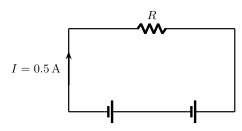
- CBSE 2023Set ANNUAL1 markMCQQ.In the circuit shown above, each cell has an e.m.f. 2 V and an internal resistance of 1Ω. The current flowing through the circuit is 0.5 A. The resistance of the resistor R is(a) 6Ω(b) 4Ω(c) 8Ω(d) 2Ω
›Reveal solutionSolution
Applying Kirchhoff's voltage law to the single loop (two cells in series aiding, in series with R) gives R=6Ω.
Solution:
From the figure: the loop contains a resistor R on the top arm and two cells, each of e.m.f. 2 V and internal resistance 1Ω, connected in series (one after another, same polarity) along the bottom arm, with plain connecting wire on the other side. The whole loop carries a single current I=0.5 A.
Total e.m.f. of the two series cells:
ε=2 V+2 V=4 V
…
- CBSE 2022Set GC1 markMCQQ.Three cells each of 6 V e.m.f. are connected in parallel. E.M.F. of the combination will be (internal resistances of the cells are negligible):i) 3 voltii) 2 voltiii) 4 voltiv) 6 volt
›Reveal solutionSolution
Cells of equal EMF in parallel keep the EMF unchanged (only current capacity/effective internal resistance changes). So EMF =6 V.
When n identical cells each of EMF E are joined in parallel, the combined EMF is still E (they behave like one cell that can supply more current). The in …
- CBSE 2022Set ANNUAL1 markQ.If two cells of e.m.f. epsilon_1, epsilon_2 and internal resistance r_1, r_2 are connected in parallel combination, then write the equivalent e.m.f. of this combination.
›Reveal solutionSolution
For two cells connected in parallel, the combination behaves like a single cell whose emf is a resistance-weighted average of the two individual emfs, and whose internal resistance is the parallel combination of the two internal resistances.
For two cells of emf ε1,ε2 and internal resistances r1,r2 connected in parallel (like terminals joined together) and delivering current I to an external circuit, applying Kirchhoff's laws to the two branches and equating terminal voltages gives th …
- CBSE 2020Set ANNUAL1 markMCQQ.Two cells of emf 6V and 3V of internal resistances 1Ω and 2Ω respectively are connected in parallel with their positive terminals together and similarly the negative terminals together. The equivalent emf of the combination would be A. 8V B. 4V C. 5V D. 10V
›Reveal solutionSolution
Equivalent emf of two parallel cells: Eeq=1/r1+1/r2E1/r1+E2/r2=5V, option C..
For two cells of emf E1,E2 and internal resistances r1,r2 connected in parallel with like terminals together, the combination is equivalent to a single cell of emf Eeq and internal resistance req, where
req1=r11+r21,reqEeq=r1E1+r2E2
Given E1=6V, r1=1Ω; E2=3V, r2=2Ω:
req=r1+r2r1r2=1+21×2=32Ω
Eeq=req(r1E1+r2E2)=32(6+1.5)=32×7.5=5V
…
🎓Unlock everything free for 14 days
- ✓Full step-by-step solutions
- ✓Concept-first explanations
- ✓Methods, shortcuts & mistakes
- ✓PYQ mapping + timed mock tests
Full access for 14 days. No credit card required.