Q.What is Cell? Obtain the condition for maximum current through a resistor, when a number of cells are connected in series.
You're viewing a preview — the full solution, concept, methods & PYQ mapping are locked.
Start your 14-day free trial to unlock the full solution →A series combination of cells gives near-maximum current whenever the external resistance is much larger than the cells' total internal resistance.
Cell: An electric cell is a source of emf that converts chemical energy stored in it into electrical energy, maintaining a potential difference between its two terminals which drives current through an external circuit. It has an emf and an internal resistance .
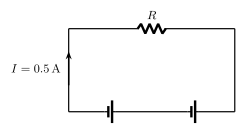
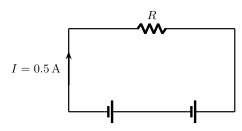
n cells in series: When identical cells, each of emf and internal resistance , are connected in series (positive terminal of one to negative of the next) to an external resistance , the equivalent emf is and the equivalent internal resistance is . By Ohm's law, the current in the circuit is
Condition for maximum current: Rewriting,
For fixed R and r, as n increases, I approaches its largest possible value only when the term becomes negligible compared to , i.e.
…
Unlock everything free for 14 days
- Full step-by-step solutions
- Concept-first explanations
- Methods, shortcuts & mistakes
- PYQ mapping + timed mock tests
Full access for 14 days. No credit card required.