Question of 73
Q.Draw a ray diagram of an astronomical telescope showing the final image at infinity and write the expression of its magnifying power. OR With the help of a ray diagram, show that the total deviation of a ray of light passing through a glass prism is given by , where the symbols used carry usual meanings.
Meghalaya MboseMBOSE Meghalaya Intermediate Board 2024Subjective· 3mImportance★★★★★
0% · 0/73 Questions
You're viewing a preview — the full solution, concept, methods & PYQ mapping are locked.
Start your 14-day free trial to unlock the full solution →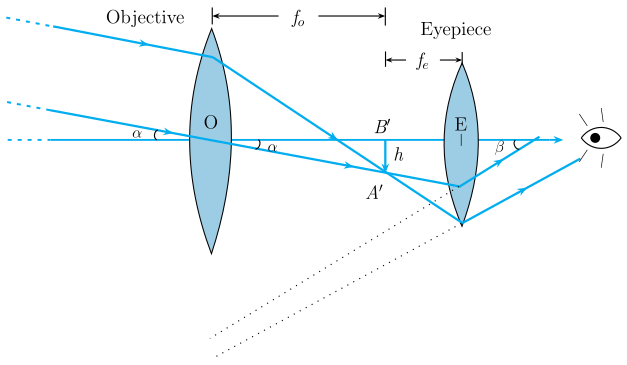
An astronomical telescope in normal adjustment places the objective's focal point coincident with the eyepiece's focal point, so parallel rays from a distant object emerge as parallel rays, giving a final image at infinity and magnifying power .
Ray diagram (described)
- Parallel rays from a very distant object are incident on the objective lens (large aperture, large focal length ).
- The objective converges these rays to form a small, real, inverted image at its focal plane, at a distance from the objective.
- The eyepiece (focal length , much smaller) is positioned so that this intermediate image lies exactly at its focal point too — i.e. the objective's focus and the eyepiece's focus coincide (tube length ).
- Rays from each point of the intermediate image, after passing through the eyepiece, therefore emerge as a parallel beam (since the object for the eyepiece is at its focal point) — so the final image is formed at infinity, and can be viewed by a relaxed (unaccommodated) eye.
Magnifying power
The magnifying power is defined as the ratio of the angle subtended at the eye by the final image () to the angle subtended by the object at the unaided eye (). For normal adjustment this works out to:
To get high magnification, the objective should have a large focal length and the eyepiece a small focal length.
…
Unlock everything free for 14 days
- Full step-by-step solutions
- Concept-first explanations
- Methods, shortcuts & mistakes
- PYQ mapping + timed mock tests
Full access for 14 days. No credit card required.