Q.What is an unpolarized light? Explain with the help of a suitable diagram how an unpolarized light can be polarized by reflection from a transparent medium. Write the expression for Brewster's angle in terms of refractive index of denser medium. OR Draw a ray diagram to show the refraction of light through a glass prism. Hence, obtain the relation for angle of deviation in terms of angle of incidence, angle of emergence and angle of prism. What is the refractive index of the material of the prism?
You're viewing a preview — the full solution, concept, methods & PYQ mapping are locked.
Start your 14-day free trial to unlock the full solution →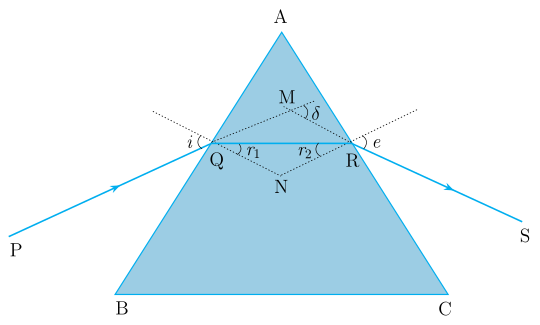
Primary: unpolarized light has randomly oriented field vibrations; reflection at exactly Brewster's angle filters out one polarization component entirely, leaving fully polarized reflected light. Alternative: track a ray's bending at each prism face and combine the geometry to relate deviation, incidence/emergence angles, and the prism's refractive index.
Primary — Unpolarized light and polarization by reflection
Unpolarized light: ordinary light (e.g. from the sun or a bulb) in which the electric field vector vibrates randomly and rapidly in every direction perpendicular to the direction of propagation, with no preferred orientation.
Polarization by reflection: when unpolarized light strikes the surface of a transparent medium (e.g. glass), the reflected and refracted rays are, in general, partially polarized. At one particular angle of incidence — the Brewster's angle — the reflected ray becomes completely plane-polarized (with its electric vector perpendicular to the plane of incidence), while the refracted ray remains partially polarized. This happens because, at this specific angle, the reflected and refracted rays are perpendicular to each other, and the component of the dipole re-radiation along the reflected direction (which would need to point in the direction of the refracted ray's propagation) vanishes.
Brewster's angle formula: where is the refractive index of the (denser) medium relative to the medium of incidence.
…
Unlock everything free for 14 days
- Full step-by-step solutions
- Concept-first explanations
- Methods, shortcuts & mistakes
- PYQ mapping + timed mock tests
Full access for 14 days. No credit card required.