Chemistry · Ch 9 — Hydrocarbons
Properties
Properties
Physical Properties
Alkanes are almost non-polar molecules. The C–C and C–H bonds are covalent, and the electronegativity difference between carbon and hydrogen is very small. As a result, the only intermolecular forces present are weak van der Waals forces.
Because these forces are weak, the physical state at 298 K depends on molecular size. The first four members (methane, ethane, propane, butane, with 1–4 carbon atoms) are gases. Alkanes with 5–17 carbon atoms are liquids. Those with 18 or more carbon atoms are solids. All alkanes are colourless and odourless.
Solubility. Since alkanes are non-polar, they do not dissolve in water, which is a polar solvent. The general rule is "like dissolves like": polar substances dissolve in polar solvents, and non-polar substances dissolve in non-polar solvents. Petrol, a mixture of hydrocarbons, is used as a fuel and also for dry cleaning to remove grease stains. Grease itself is a mixture of higher alkanes — it is non-polar and hydrophobic, which is why it dissolves in petrol but not in water.
Boiling point. Table 9.2 shows that boiling point increases steadily with molecular mass. The reason is that van der Waals forces increase as molecular size (or surface area) increases.
The three isomeric pentanes — pentane, 2-methylbutane, and 2,2-dimethylpropane — have the same molecular formula () but different boiling points. Pentane (a straight chain) boils at 309.1 K, 2-methylbutane at 300.9 K, and 2,2-dimethylpropane at 282.5 K. As branching increases, the molecule becomes more spherical. This reduces the surface area of contact, weakening the intermolecular forces, so less thermal energy is needed to overcome them.
Melting point. Melting points also generally increase with molecular mass, but the pattern is less regular than for boiling points. The data for selected alkanes, exactly as the textbook prints them, are collected in Table 9.2.
| Molecular formula | Name | Molecular mass/u | b.p./(K) | m.p./(K) |
|---|---|---|---|---|
| Methane | 16 | 111.0 | 90.5 | |
| Ethane | 30 | 184.4 | 101.0 | |
| Propane | 44 | 230.9 | 85.3 | |
| Butane | 58 | 272.4 | 134.6 | |
| 2-Methylpropane | 58 | 261.0 | 114.7 | |
| Pentane | 72 | 309.1 | 143.3 | |
| 2-Methylbutane | 72 | 300.9 | 113.1 | |
| 2,2-Dimethylpropane | 72 | 282.5 | 256.4 | |
| Hexane | 86 | 341.9 | 178.5 | |
| Heptane | 100 | 371.4 | 182.4 | |
| Octane | 114 | 398.7 | 216.2 |
Chemical Properties
Alkanes are generally inert towards acids, bases, oxidising agents, and reducing agents under ordinary conditions. However, they undergo several reactions under specific conditions.
1. Substitution Reactions
One or more hydrogen atoms of an alkane can be replaced by halogens, a nitro group (), or a sulphonic acid group (). These are called substitution reactions. Lower alkanes do not undergo nitration or sulphonation.
Halogenation. This takes place at higher temperatures (520–670 K) or in the presence of diffused sunlight or ultraviolet light. The chlorination of methane proceeds stepwise:
Similarly, ethane gives chloroethane:
Reactivity of halogens. The rate of reaction with alkanes follows the order:
Fluorination is too violent to be controlled. Iodination is very slow and reversible. It can be carried out in the presence of an oxidising agent such as or , which removes the formed:
Rate of replacement of hydrogen atoms. The order of reactivity of hydrogen atoms in alkanes is:
Tertiary hydrogens are replaced most readily, then secondary, then primary.
Mechanism of halogenation. Halogenation proceeds via a free radical chain mechanism with three steps: initiation, propagation, and termination.
›Proof
Mechanism of chlorination of methane
- Initiation. The reaction is initiated by homolysis of the chlorine molecule in the presence of light or heat. The bond is weaker than and bonds, so it breaks most easily:
- Propagation. The chlorine free radical attacks methane, breaking a bond and forming a methyl radical: The methyl radical then attacks a second chlorine molecule, forming chloromethane and liberating another chlorine free radical: Steps (a) and (b) repeat, setting up a chain reaction. Many other propagation steps are possible, leading to more highly halogenated products. For example:
- Termination. The reaction stops when reactants are consumed or when free radicals combine. Possible termination steps are: The formation of ethane () as a byproduct during chlorination of methane is explained by the second termination step.
2. Combustion
Alkanes burn in the presence of air or dioxygen to give carbon dioxide and water, releasing a large amount of heat.
The general combustion equation for any alkane is:
Because of the large amount of heat evolved, alkanes are used as fuels.
Incomplete combustion. With an insufficient supply of air or dioxygen, incomplete combustion occurs, producing carbon black:
Carbon black is used in the manufacture of ink, printer ink, black pigments, and as filters.
3. Controlled Oxidation
Alkanes, when heated with a regulated supply of dioxygen or air at high pressure in the presence of suitable catalysts, give a variety of oxidation products.
- Methanol from methane:
- Methanal from methane:
- Ethanoic acid from ethane:
- Alkanes ordinarily resist oxidation, but those having a tertiary hydrogen atom can be oxidised to the corresponding alcohol by potassium permanganate:
2-Methylpropane gives 2-methylpropan-2-ol.
4. Isomerisation
-Alkanes, on heating in the presence of anhydrous aluminium chloride and hydrogen chloride gas, isomerise to branched-chain alkanes. The major products are given below; minor products are also possible but are not usually reported.
-Hexane gives 2-methylpentane and 3-methylpentane as major products.
5. Aromatisation (Reforming)
-Alkanes having six or more carbon atoms, on heating to 773 K at 10–20 atmospheric pressure in the presence of oxides of vanadium, molybdenum, or chromium supported on alumina, get dehydrogenated and cyclised to benzene and its homologues. This reaction is called aromatisation or reforming.
For example, -hexane gives benzene: …
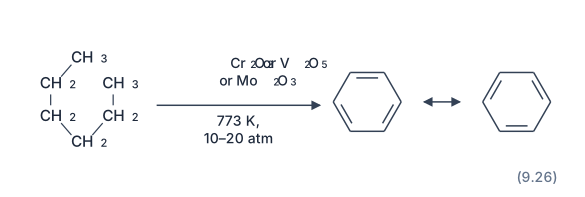
Equation 9.26, drawn out the way the textbook prints it: the chain form of -hexane written as a bent chain of / units cyclises over (or /) supported on alumina at 773 K and 10–20 atm, losing to give benzene — shown as the two resonance forms of the aromatic ring. This d …