Q.Find the maximum and the minimum values, if any, of the function given by .
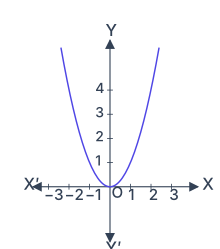
The function on has a minimum value of at , but no maximum value because it grows without bound as .
The Mean Value Theorem (MVT) is a powerful tool for analyzing function behaviour, but here it’s not needed — the shape of is simpler. The key is to think about what “maximum” and “minimum” mean for a function defined on the entire real line. A minimum is the smallest output the function ever takes; a maximum is the largest. For , the graph is a parabola opening upward, with its vertex at the origin. That vertex is clearly the lowest point. But does the parabola have a highest point? No — as you move farther from zero in either direction, the squares get larger without any bound.
Let’s walk through the reasoning step by step.
-
Understand the domain and range.
The domain is all real numbers . The output is always non-negative: for every . So the range is .
-
Check for a minimum.
Since , the smallest possible value is . Does the function actually achieve ? Yes — at , we have . So is the global minimum of on .
-
Check for a maximum.
Is there a largest value? Suppose someone claims is the maximum. Then for any , we must have . But pick ; then , contradicting the claim. No matter how large is, you can always find an whose square exceeds it. Hence, no maximum exists.
A common mistake is to say the maximum is “infinity.” Infinity is not a real number — the function simply has no maximum value on . If the domain were a closed interval like , then a maximum would exist (at the endpoints), but on the whole real line, it doesn’t.
- Formal justification using limits. We can also argue: , so the function is unbounded above. A maximum requires an upper bound that is actually attained; here, no such bound exists.
For any quadratic with , the minimum occurs at the vertex , and there is no maximum on . If , the situation reverses: a maximum at the vertex, no minimum.
The function has a minimum value of at , and no maximum value.
Unlock everything free for 14 days
- Full step-by-step solutions
- Concept-first explanations
- Methods, shortcuts & mistakes
- PYQ mapping + timed mock tests
Full access for 14 days. No credit card required.