Question of 41
Q.a. Mention the catalytic cycle of an enzymatic action. Draw the structure of a purine and a pyrimidine. OR b. Define Karyokinesis. Explain briefly the prophase-I stage of meiosis.
Nagaland NbseNagaland Board of School Education (Class XI) 2022Subjective· 5mImportance★★★★★
0% · 0/41 Questions
You're viewing a preview — the full solution, concept, methods & PYQ mapping are locked.
Start your 14-day free trial to unlock the full solution →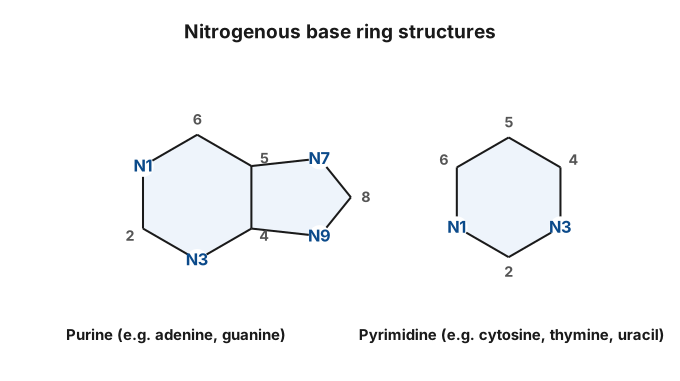
An enzyme binds substrate, converts it to product, releases it, and is regenerated unchanged to repeat the cycle; purines are double-ring bases and pyrimidines are single-ring bases.
Catalytic cycle of enzymatic action:
- The substrate binds to the enzyme's specific active site, forming an enzyme-substrate (ES) complex.
- The substrate is converted into an unstable transition state within the active site.
- The enzyme catalyses the transformation of the substrate into the product(s).
- The product(s) is/are released from the active site, and the enzyme is regenerated in its original, unchanged form.
- The free enzyme is now available to bind another substrate molecule, and the cycle repeats — this is why very small amounts of enzyme can catalyse the transformation of large amounts of substrate.
Structure of a purine and a pyrimidine (nitrogenous bases of nucleic acids):
- A purine (e.g., adenine, guanine) has a double-ring structure: a six-membered ring fused to a five-membered imidazole ring, both containing nitrogen atoms. …
Unlock everything free for 14 days
- Full step-by-step solutions
- Concept-first explanations
- Methods, shortcuts & mistakes
- PYQ mapping + timed mock tests
Full access for 14 days. No credit card required.