Chemistry · Ch 4 — Chemical Bonding and Molecular Structure
Types of Hybridisation
Types of Hybridisation
Types of Hybridisation
Hybridisation is the mixing of atomic orbitals of the same atom (with comparable energies) to form a new set of equivalent orbitals called hybrid orbitals. The number of hybrid orbitals formed equals the number of atomic orbitals that mix. The type of hybridisation depends on which orbitals (s, p, or d) participate in the mixing.
(i) sp Hybridisation
This involves the mixing of one s orbital and one p orbital from the same valence shell. The result is two equivalent sp hybrid orbitals.
For the hybrid orbitals to lie along the z-axis, the mixing occurs between the s orbital and the orbital. Each sp hybrid orbital has exactly 50% s-character and 50% p-character.
The two sp hybrid orbitals point in opposite directions along the z-axis. Each orbital has a large positive lobe and a very small negative lobe. This shape allows for more effective overlapping with other atomic orbitals, leading to the formation of stronger sigma bonds.
A molecule where the central atom is sp-hybridised and directly bonded to two other atoms has a linear geometry. This type of hybridisation is also called diagonal hybridisation.
Do not confuse "diagonal" with "linear" — they mean the same thing here. The term "diagonal" is historical and refers to the 180° angle between the two bonds.
Example: BeCl
The ground state electronic configuration of beryllium (Be) is . To account for its bivalency (ability to form two bonds), one of the 2s electrons is promoted to a vacant 2p orbital in the excited state.
- Ground state:
- Excited state:
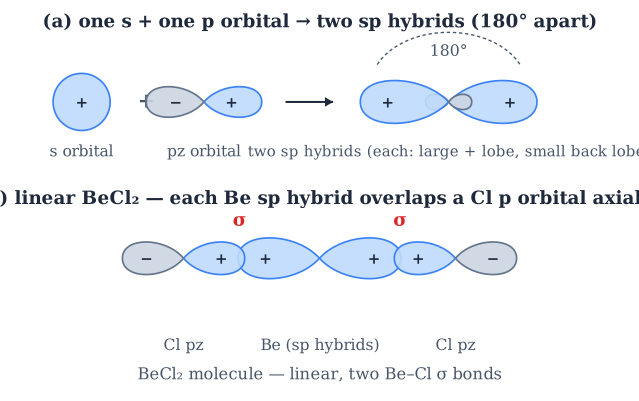
Now, one 2s orbital and one 2p orbital (say ) hybridise to form two sp hybrid orbitals. These two orbitals are oriented 180° apart. Each sp hybrid orbital overlaps axially (end-to-end) with the 2p orbital of a chlorine atom, forming two Be–Cl sigma () bonds.
The promotion of an electron from the 2s to the 2p orbital requires energy, but this energy is more than compensated by the energy released during the formation of two strong Be–Cl bonds. This is why BeCl is stable.
Drawn by us to help you understand the concept clearly, and verified to make sure it's accurate. For exams, practice from your textbook's own diagram.
Figure 4.10 is the visual anchor for the concept of sp hybridisation — the simplest kind of orbital mixing. The figure has two parts, (a) and (b), and each teaches a different layer of the same idea.
Part (a): The formation of two sp hybrid orbitals
This panel shows the before and after of orbital mixing. On the left, you see two separate atomic orbitals: one s orbital (spherical) and one p orbital (dumbbell-shaped, specifically the orbital, which points along the z-axis). The s orbital has no directional preference; the p orbital has a positive lobe (say, along ) and a negative lobe (along ).
The arrow or process symbol between them indicates that these two orbitals combine mathematically — they are not physically glued together but rather their wavefunctions are added and subtracted. The result, shown on the right, is a pair of equivalent sp hybrid orbitals. Each hybrid looks like a lopsided dumbbell: one large lobe (the positive lobe) and a very small back lobe (the negative lobe). Crucially, the two hybrids point in exactly opposite directions, apart, along the z-axis.
Each sp hybrid orbital has 50% s-character and 50% p-character. This equal mixing is what gives the hybrids their directional strength — the large lobe is concentrated along one axis, allowing for much better overlap with another atom’s orbital than either a pure s or pure p orbital could achieve alone.
The small negative lobes are usually drawn but are often omitted in simplified diagrams; they are a consequence of the subtraction step in the hybridisation process. The key takeaway: one s + one p → two sp hybrids, linear, opposite.
Part (b): The linear BeCl₂ molecule
Here the figure shows how those two sp hybrids on the central beryllium atom actually form bonds. Beryllium in its ground state has the configuration — no unpaired electrons. To form two bonds, one of the electrons is promoted to an empty orbital (the ), giving the configuration . These two half-filled orbitals (one s, one p) then hybridise into the two sp hybrids from part (a).
Each sp hybrid on Be now overlaps end-on (axially) with a chlorine 3p orbital (specifically, the orbital of each Cl atom). This head-on overlap creates a sigma () bond. Because the two sp hybrids point in opposite directions, the two Cl atoms end up on opposite sides of Be, giving the linear geometry Cl–Be–Cl with a bond angle of exactly .
The figure does not show the chlorine atoms’ other orbitals (their lone pairs, for instance) — it focuses only on the bonding orbitals to keep the hybridisation idea clear. In reality, each Cl also has three lone pairs, but those do not affect the linear shape.
The physical idea this figure teaches
Hybridisation is a mathematical model that explains why certain molecules have the shapes they do. Without hybridisation, you would expect Be to form bonds using its orbital (which is spherical) and its orbital (which is directional but at to each other in a pure p set). That would predict a bent molecule — which is wrong. By mixing the s and p orbitals, you get two equivalent orbitals that are optimally directed for bonding: apart. This is why BeCl₂ is linear, not bent.
The figure also teaches that the number of hybrid orbitals equals the number of atomic orbitals mixed (here, 1 s + 1 p = 2 sp hybrids), and that the geometry is determined by the repulsion between these hybrid orbitals (they point as far apart as possible — for two).
The key formula the textbook develops with this figure
The central quantitative idea is the percentage s-character in each hybrid. For sp hybridisation:
More generally, for any hybridisation involving s orbitals and p orbitals (and possibly d orbitals), the s-character of each equivalent hybrid is:
For sp: , → 50% s, 50% p. …
(ii) sp² Hybridisation
This type involves the mixing of one s orbital and two p orbitals from the same valence shell. The result is three equivalent sp² hybrid orbitals.
Each sp² hybrid orbital has 33.33% s-character and 66.67% p-character (since one s mixes with two p orbitals, the s-character is and p-character is ).
The three sp² hybrid orbitals are oriented in a trigonal planar arrangement. They lie in the same plane, pointing towards the three corners of an equilateral triangle. The angle between any two sp² hybrid orbitals is 120°.
Example: BCl
The ground state electronic configuration of boron (B) is . In the excited state, one of the 2s electrons is promoted to a vacant 2p orbital.
- Ground state:
- Excited state:
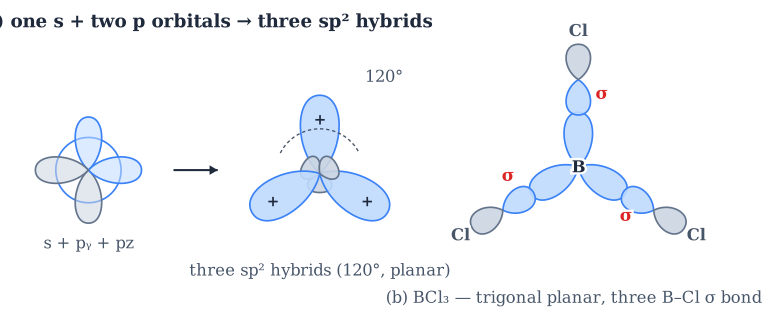
Now, one 2s orbital and two 2p orbitals ( and ) hybridise to form three sp² hybrid orbitals. These three orbitals are arranged in a trigonal planar geometry. Each sp² hybrid orbital overlaps axially with the 2p orbital of a chlorine atom, forming three B–Cl sigma bonds. The molecule BCl has a trigonal planar geometry with a Cl–B–Cl bond angle of 120°.
When you see a molecule with three bonds and no lone pairs on the central atom (like BCl, BF, or AlCl), think sp² hybridisation and trigonal planar geometry.
Drawn by us to help you understand the concept clearly, and verified to make sure it's accurate. For exams, practice from your textbook's own diagram.
Fig. 4.11 is a two-part schematic that shows how atomic orbitals on a boron atom reorganise to form three equivalent hybrid orbitals, and how those hybrids then bond with chlorine atoms to give the BCl₃ molecule.
The left panel depicts the mixing process. Three atomic orbitals from boron’s valence shell — one 2s orbital (spherical) and two 2p orbitals (dumbbell-shaped, lying in the same plane) — are shown combining. The result is three identical sp² hybrid orbitals, each drawn as a lopsided lobe: a large positive lobe and a much smaller negative lobe. The three hybrids are arranged in a plane, pointing toward the corners of an equilateral triangle, with 120° angles between them. The right panel shows the complete BCl₃ molecule. Each sp² hybrid on boron overlaps end‑to‑end (axially) with a 2p orbital from a chlorine atom, forming a sigma bond. The three chlorine atoms sit at the vertices of the triangle, and the entire molecule is flat — trigonal planar — with all Cl–B–Cl bond angles equal to 120°.
The physical idea is that mixing one s and two p orbitals produces three equivalent orbitals that are more directional than the original s orbital and more concentrated along the bonding directions than the original p orbitals. This directional character allows stronger overlap with the chlorine orbitals, giving a stable, symmetric molecule. The 120° angle is a direct consequence of the three hybrids repelling each other equally in a plane — the geometry that minimises electron‑pair repulsion for three equivalent bonds.
The textbook uses this figure to introduce the concept that hybridisation determines molecular shape. For sp² hybridisation, the key result is that the three hybrid orbitals lie in a plane at 120° to each other, and the molecule formed (like BCl₃) is trigonal planar. There is no separate formula beyond the geometric fact that the bond angle is fixed at 120° for a perfect sp²‑hybridised centre with no lone pairs. …
(iii) sp³ Hybridisation
This type involves the mixing of one s orbital and three p orbitals from the same valence shell. The result is four equivalent sp³ hybrid orbitals.
Each sp³ hybrid orbital has 25% s-character and 75% p-character (since one s mixes with three p orbitals, the s-character is and p-character is ).
The four sp³ hybrid orbitals are directed towards the four corners of a tetrahedron. The angle between any two sp³ hybrid orbitals is 109.5°.
Example: CH (Methane)
The ground state electronic configuration of carbon (C) is . In the excited state, one of the 2s electrons is promoted to the vacant orbital.
- Ground state:
- Excited state:
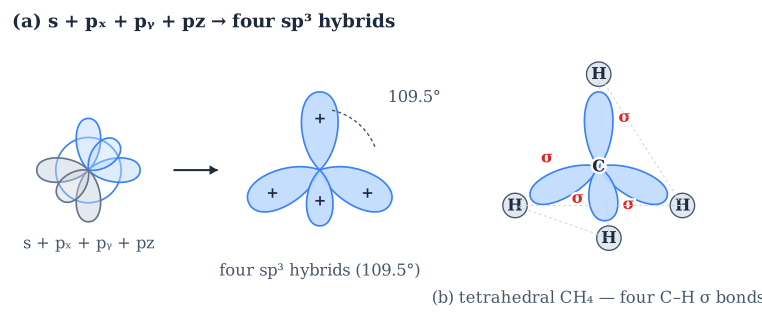
Now, one 2s orbital and three 2p orbitals (, , ) hybridise to form four sp³ hybrid orbitals. These four orbitals are directed towards the four corners of a tetrahedron. Each sp³ hybrid orbital overlaps axially with the 1s orbital of a hydrogen atom, forming four C–H sigma bonds. The molecule CH has a tetrahedral geometry with a H–C–H bond angle of 109.5°.
The promotion of an electron from 2s to 2p in carbon is essential. Without it, carbon would have only two unpaired electrons (2p 2p) and would form only two bonds. The promotion gives four unpaired electrons, allowing carbon to form four equivalent bonds.
Drawn by us to help you understand the concept clearly, and verified to make sure it's accurate. For exams, practice from your textbook's own diagram.
Fig. 4.12 is a two-part diagram that shows the entire journey from atomic orbitals to a finished methane molecule. The left side illustrates the mixing process — how one s orbital and three p orbitals (pₓ, p_y, p_z) of carbon combine to form four identical sp³ hybrid orbitals. The right side shows the final molecule: these four hybrids overlapping with the 1s orbitals of four hydrogen atoms to give tetrahedral CH₄.
The left panel is essentially a "before and after" of the carbon atom's valence orbitals. Before hybridisation, you see four separate orbitals: a spherical 2s orbital and three dumbbell-shaped 2p orbitals oriented along the x, y, and z axes. The figure then shows these four orbitals merging into four equivalent sp³ hybrids. Each hybrid has a large lobe (the part that points outward) and a much smaller lobe on the opposite side. The four large lobes are directed toward the four corners of a regular tetrahedron, with the carbon nucleus at the centre. The angle between any two hybrid orbitals is exactly 109.5°.
The right panel of Fig. 4.12 shows the complete CH₄ molecule. Each sp³ hybrid orbital on carbon overlaps end‑to‑end (axially) with the 1s orbital of a hydrogen atom, forming a sigma (σ) bond. Because all four hybrids are identical and point to tetrahedral corners, all four C–H bonds are equivalent in length and strength, and the molecule has a perfect tetrahedral shape with H–C–H bond angles of 109.5°.
The central physical idea is that hybridisation is not a real physical process — it is a mathematical model that explains observed molecular geometry. By mixing one s and three p orbitals, we get four equivalent orbitals that point as far apart as possible, minimising electron‑pair repulsion and giving the tetrahedral shape.
The figure anchors the concept of sp³ hybridisation; its quantitative companion is the s/p composition of each hybrid:
Here, the 1 comes from the single s orbital and the 3 from the three p orbitals that participate in mixing. Each of the four sp³ hybrids therefore has 25% s‑character and 75% p‑character. This ratio directly influences bond properties: greater s‑character makes a bond shorter and stronger (as in sp hybrids with 50% s‑character), while greater p‑character makes bonds longer and weaker.
The figure also implicitly teaches the relationship between hybridisation and geometry. For a central atom with four electron domains (bond pairs or lone pairs), the domains arrange tetrahedrally. When all four domains are bond pairs, as in CH₄, the molecule is tetrahedral with 109.5° angles. When one domain is a lone pair (NH₃) or two are lone pairs (H₂O), the geometry distorts — the bond angles shrink to 107° and 104.5° respectively — but the underlying hybridisation remains sp³. …
sp³ Hybridisation in NH and HO
The concept of sp³ hybridisation also explains the structures of ammonia (NH) and water (HO), but with a twist — the presence of lone pairs of electrons.
NH (Ammonia)
The valence shell electronic configuration of nitrogen (N) in the ground state is . In NH, the four orbitals (one 2s and three 2p) undergo sp³ hybridisation, forming four sp³ hybrid orbitals. However, nitrogen already has five valence electrons. Three of these sp³ hybrid orbitals contain one electron each (unpaired), while the fourth hybrid orbital contains a pair of electrons (a lone pair).
The three singly-occupied sp³ hybrid orbitals overlap with the 1s orbitals of three hydrogen atoms, forming three N–H sigma bonds. The fourth hybrid orbital, containing the lone pair, does not participate in bonding.
A common mistake is to think that the lone pair occupies a pure p orbital. In NH, the lone pair occupies an sp³ hybrid orbital, not a pure p orbital.
The geometry of the four sp³ hybrid orbitals is tetrahedral. However, the molecular geometry (considering only the positions of atoms) is pyramidal. Why? Because the lone pair exerts a stronger repulsive force than a bond pair.
Lone pair–bond pair repulsion > Bond pair–bond pair repulsion
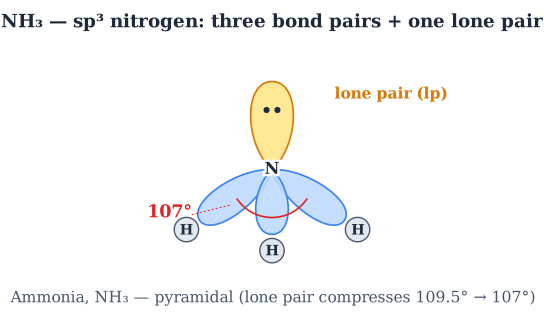
This greater repulsion from the lone pair pushes the three N–H bonds closer together. As a result, the H–N–H bond angle is reduced from the ideal tetrahedral angle of 109.5° to 107°.
Drawn by us to help you understand the concept clearly, and verified to make sure it's accurate. For exams, practice from your textbook's own diagram.
Fig. 4.13 is a schematic diagram of the ammonia molecule, NH₃, built from the idea of sp³ hybridisation. The figure does not show a graph or plot; it is a structural drawing that illustrates how the atomic orbitals of nitrogen mix and then overlap with hydrogen 1s orbitals to form the molecule.
The central nitrogen atom is shown at the apex of a trigonal pyramid. Three sp³ hybrid orbitals, each containing one electron, point toward the three corners of the base of the pyramid. Each of these three hybrids overlaps end‑to‑end (sigma overlap) with the 1s orbital of a hydrogen atom, forming three N–H sigma bonds. The fourth sp³ hybrid orbital, which contains a lone pair of electrons, points toward the fourth corner of a tetrahedron — but since no hydrogen is attached there, that corner is empty. The lone pair occupies more space than a bonding pair, so it pushes the three N–H bonds closer together. The result is a bond angle of 107° instead of the full tetrahedral angle of 109.5°, and the overall shape is pyramidal, not tetrahedral.
The physical idea the figure teaches is that the geometry of a molecule is determined not only by the number of sigma bonds but also by the number of lone pairs on the central atom. The lone pair repels the bonding pairs more strongly, distorting the ideal tetrahedral angle. This is the core of the VSEPR (Valence Shell Electron Pair Repulsion) theory, which the textbook uses alongside hybridisation to explain molecular shapes.
The key formula that emerges from this figure is the relationship between the number of hybrid orbitals and the number of atoms plus lone pairs. For NH₃:
Here, the central nitrogen atom has 5 valence electrons. In its ground state, the configuration is . Under sp³ hybridisation, one 2s orbital and three 2p orbitals mix to form four equivalent sp³ hybrid orbitals. Three of these hybrids each contain one electron and form sigma bonds with hydrogen. The fourth hybrid contains two electrons — the lone pair. The bond angle is given by:
This is less than the ideal tetrahedral angle of because the lone pair exerts a stronger repulsive force on the bonding pairs than the bonding pairs exert on each other. …
HO (Water) …
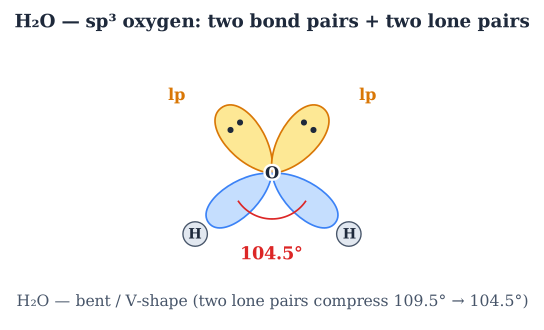
Drawn by us to help you understand the concept clearly, and verified to make sure it's accurate. For exams, practice from your textbook's own diagram.
The figure shows the central oxygen atom surrounded by four hybrid orbitals arranged tetrahedrally. Two of these orbitals, each containing one unpaired electron, overlap with the orbitals of two hydrogen atoms to form two O–H sigma bonds. The other two orbitals each contain a lone pair of electrons and point toward the remaining two corners of the tetrahedron. Because lone pairs exert stronger repulsion than bond pairs, the ideal tetrahedral angle of is compressed to . The resulting molecular shape is bent or V-shaped, not linear.
The physical idea the figure teaches is that the geometry of a molecule is determined not only by the number of bonded atoms but also by the number of lone pairs on the central atom. In , oxygen has six valence electrons. After hybridisation, four equivalent hybrid orbitals are produced. Two of these are half-filled (one electron each) and form bonds; the other two are completely filled (two electrons each) and remain as lone pairs. The repulsion hierarchy — lone pair–lone pair > lone pair–bond pair > bond pair–bond pair — explains why the bond angle shrinks from to .
This is the experimentally observed angle, reduced from the ideal angle of due to lone pair repulsion.
The relationship the figure supports is between hybridisation and molecular shape. For a central atom with hybridisation, the ideal bond angle is . The actual angle in is given by:
where the correction arises from the VSEPR (Valence Shell Electron Pair Repulsion) theory. The lone pairs occupy more space than bonding pairs, pushing the O–H bonds closer together. The figure visually demonstrates this by showing the two lone pairs occupying two tetrahedral positions, forcing the hydrogen atoms into the remaining two positions with a smaller angle between them. …