Physics · Ch 7 — System of Particles and Rotational Motion
Moment of Force (torque)
Moment of Force (torque)
The Turning Effect of a Force
When you push a door, where you push matters just as much as how hard you push. Push near the hinges — the door opens slowly, with effort. Push at the far edge — it swings open easily. This everyday experience captures the essence of torque: the rotational analogue of force.
A force can cause a body to translate (move in a straight line) or to rotate about some axis. The measure of a force's ability to produce rotation is called the moment of force, or torque. It depends not only on the magnitude of the force, but also on where the force is applied relative to the axis of rotation.
Torque is to rotation what force is to translation. Just as a net force causes linear acceleration, a net torque causes angular acceleration.
Defining Torque
Consider a rigid body that can rotate about a fixed axis through point , perpendicular to the plane of the page. A force acts at point , whose position vector from is . The torque about due to is defined as the vector cross product:
The magnitude of the torque is:
where is the angle between and when they are placed tail-to-tail. The direction of is given by the right-hand rule: curl the fingers of your right hand from to , and your thumb points in the direction of .
The quantity is the perpendicular distance from the axis of rotation to the line of action of the force. This distance is called the lever arm or moment arm. So torque = force × lever arm.
The Perpendicular Component Matters
Only the component of force perpendicular to the position vector contributes to torque. If you resolve into components parallel and perpendicular to :
- The parallel component () passes through the axis — it can only pull or push the body, not rotate it.
- The perpendicular component () is the one that actually produces rotation.
This is why pushing a door at the edge (large ) with a force perpendicular to the door (large ) gives maximum torque.
A common mistake is to think that a larger force always produces a larger torque. If the force is applied at the axis itself () or directly along the line from the axis ( or ), the torque is zero regardless of how large the force is.
Properties of Torque
The textbook lists three important properties of torque. Each one follows directly from the properties of the cross product.
›Proof
Property 1: Torque is zero if and are parallel or antiparallel
If and are parallel () or antiparallel (), then .
Therefore .
Physically: the force acts along the line joining the point of application to the axis — it can only cause translation, not rotation.
›Proof
Property 2: Torque is zero if
If the force is applied at the axis itself, the position vector has zero magnitude.
Then .
Physically: you cannot rotate a body by pushing at its axis.
›Proof
Property 3: Torque depends on the choice of origin
Unlike force, which is the same regardless of where you measure it, torque depends on the point about which it is calculated.
If you shift the origin from to , the position vector changes from to , where is the vector from to .
The new torque is .
So the torque changes by , which is generally non-zero.
This is why we must always specify the point about which torque is calculated.
Torque as a Vector
Torque is a vector quantity. Its direction is perpendicular to the plane containing and . For a body rotating about a fixed axis, the torque vector lies along the axis of rotation. The sense of rotation (clockwise or anticlockwise) is determined by the direction of the torque vector. …
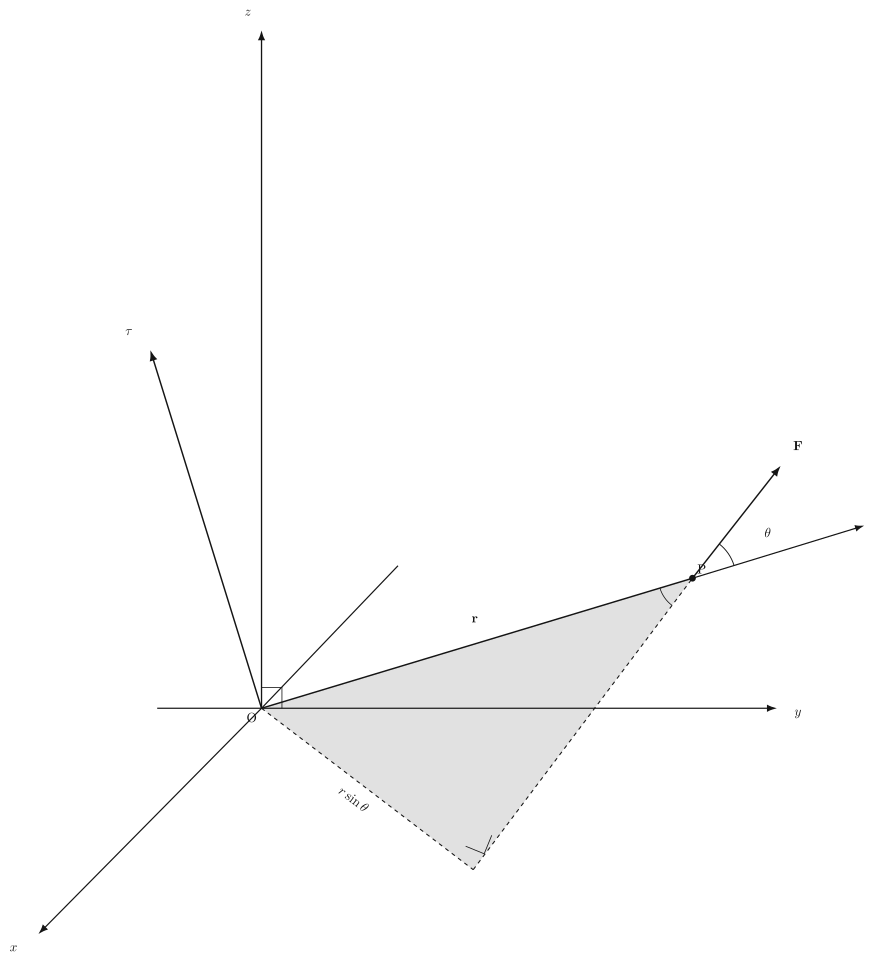
Drawn by us to help you understand the concept clearly, and verified to make sure it's accurate. For exams, practice from your textbook's own diagram.
The figure shows a three-dimensional coordinate system with the origin labelled O. The x-axis runs lower-left, the y-axis runs to the right, and the z-axis points straight up. A point P is located somewhere in the x-y plane, and a position vector r is drawn from O to P. At P, a force vector F is applied at an angle θ to the direction of r. A dashed line marks the perpendicular distance from O to the line of action of F — that is, the length — and a small right-angle symbol sits where this perpendicular meets the line of action. The torque vector τ is shown along the positive z-axis, with a curved arrow around it to indicate the sense of rotation given by the right-handed screw rule.
The physical idea is straightforward: when a force acts at a point that is not on the line through the axis of rotation, it produces a turning effect. That turning effect depends not just on how hard you push, but on where and in what direction you push. The figure makes this geometric dependence explicit. The perpendicular distance is the lever arm — the shortest distance from the axis (through O) to the line along which the force acts. If you push directly toward O (θ = 0), the lever arm is zero and there is no rotation. If you push perpendicular to r (θ = 90°), the lever arm is maximum and the torque is largest.
The magnitude of the torque is , where is the magnitude of the position vector (the distance from O to the point of application), is the magnitude of the force, and is the angle between r and F when they are placed tail-to-tail. The direction of τ is perpendicular to the plane containing r and F, given by the right-handed screw rule: if you curl the fingers of your right hand from r toward F, your thumb points along τ. In the figure, that direction is the positive z-axis.
The angle θ in the formula is always the smaller angle between the two vectors when they are drawn from a common origin. If you use the supplementary angle, the sine changes sign — and so does the direction of the torque. Stick to the standard convention: measure θ from r to F in the sense of the right-hand rule.
The dashed perpendicular and the right-angle mark are not decorative. They visually confirm that the lever arm is , which is the side opposite θ in the right-angled triangle formed by r, the perpendicular, and the line of action of F. This is the same geometry you use for the moment of a force in statics — the torque is the product of the force and the perpendicular distance from the axis to its line of action. …