Q.What is transcription? Describe the different regions of the transcriptional unit with a schematic representation. OR Describe transforming principle experiment performed by Frederick Griffith.
🔒You're viewing a preview — the full solution, concept, methods & PYQ mapping are locked.
🔒 Start your 14-day free trial to unlock the full solution →Concept understanding — Template Strand Transcription
Template Strand Transcription: A First Look
Imagine you have a master recipe book written in a language only the head chef can read. To share a recipe with the kitchen staff, you don't hand them the original book — you make a working copy on a separate sheet, using the original as your guide. That original page you read from is the template. The copy you produce is the transcript.
In a cell, the master recipe book is DNA. It holds all the instructions for making proteins, which do almost everything in your body. But DNA never leaves the nucleus — it's too precious and too large. So the cell makes a temporary, portable copy of a specific instruction. That copy is called messenger RNA (mRNA).
The process of making this mRNA copy is transcription. And the strand of DNA that is actually read to make the copy is called the template strand.
The Precise Meaning
DNA is a double helix — two strands twisted together. During transcription, the cell unzips a small section of this helix. Only one of the two strands serves as the blueprint. That strand is the template strand. The other strand, called the coding strand (or non-template strand), is not read — it just sits there, matching the sequence of the mRNA that gets made (with one chemical difference: DNA uses T, RNA uses U).
So the template strand is the actual DNA sequence that RNA polymerase (the enzyme that does the copying) reads and uses to build a complementary mRNA molecule.
Think of the template strand as the negative of a photograph. The mRNA is the print made from that negative. The coding strand is like a second print that happens to look almost identical to the final photo — but it wasn't used to make it.
Why It Matters
- Accuracy: The cell must read the correct strand. If it read the wrong one, the mRNA would be nonsense and the protein would be wrong or non-functional.
- Direction: RNA polymerase reads the template strand in the 3' to 5' direction, and builds mRNA in the 5' to 3' direction. This is a fixed rule — like reading a sentence left to right.
- Gene regulation: Which strand is the template for a given gene is fixed. But different genes on the same DNA molecule may use different strands as their template. So a single stretch of DNA can contain genes pointing in opposite directions.
A Simple Example
Suppose a short stretch of DNA has these two strands:
- Strand A:
ATGCGT - Strand B:
TACGCA
If Strand A is the template, the mRNA made will be complementary to it: UACGCA (remember, U replaces T in RNA).
If Strand B is the template, the mRNA will be complementary to B: AUGCGU.
The two mRNAs are completely different. So the cell must know, for each gene, which strand is the template. That information is encoded in the DNA sequence itself — in the promoter region that tells RNA polymerase where to start and which way to go.
The template strand is not the same as the coding strand. The mRNA sequence is identical to the coding strand (with U instead of T), but it is complementary to the template strand. This is a common confusion — the mRNA looks like the coding strand, but it was built from the template strand.
What NCERT Says …
Transcription is the synthesis of an RNA copy from a DNA template. A transcription unit has three regions: a promoter (upstream, where RNA polymerase binds), the structural gene (transcribed region, defined by a start and stop point), and a terminator (downstream, where transcription ends) …
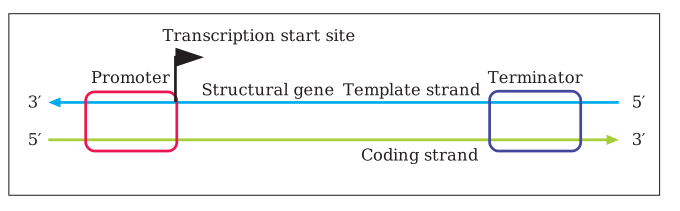
Transcription copies one DNA strand into RNA; the transcription unit has a promoter, structural gene, and terminator.
Transcription is the process by which a single-stranded RNA molecule is synthesised using one strand of DNA as a template, catalysed by RNA polymerase.
A transcription unit in DNA has three components:
- Promoter — a DNA sequence located towards the 5' end (upstream) of the structural gene, which provides the binding site for RNA polymerase, and thereby determines the template strand and the direction of transcription.
- Structural gene — the region actually transcribed into RNA; it always has a template strand (3'→5', copied to make RNA) and a coding strand (5'→3', with the same sequence as the RNA except T is replaced by U).
- Terminator — located towards the 3' end (downstream) of the coding strand, it defines the point where transcription stops (termination).
Schematically: …
Showing the 12 most recent of 22 on this concept.
- CBSE 2026Set 57/3/11 markMCQQ.Four different transcription units are shown below. Choose the option with the correct image. (A) Terminator on the left, Promoter on the right; template strand 3'←…5' above (Structural gene: TACGACTACGCT), coding strand 5'…→3' below (ATGCTGATGCGA). (B) Promoter on the left, Terminator on the right; 5'…→3' above (Structural gene: TACGACTACGCT), coding strand 3'←…5' below (ATGCTGATGCGA). (C) Promoter on the left, Terminator on the right; template strand 3'←…5' above (Structural gene: TACGACTACGCT), coding strand 5'…→3' below (ATGCTGATGCGA). (D) Promoter on the left, Terminator on the right; coding strand 3'←…5' above (Structural gene: TACGACTACGCT), template strand 5'…→3' below (ATGCTGATGCGA). [Figure required: four labelled DNA transcription-unit diagrams as options A–D.]
›Reveal solutionSolution
A transcription unit consists of a promoter, structural gene, and terminator. The promoter is upstream (left), the terminator is downstream (right). The template strand has 3' to 5' polarity and is read by RNA polymerase, while the coding strand has 5' to 3' polarity and its sequence matches the mRNA (with T instead of U).
Transcription is the process of copying genetic information from one strand of the DNA into RNA. The segment of DNA that is transcribed into an RNA molecule is called a transcription unit. Understanding its components and their arrangement is crucial for comprehending how genes are expressed.
A typical transcription unit in DNA is fundamentally defined by three regions: a promoter, the structural gene, and a terminator. These regions are arranged sequentially on the DNA molecule.
-
Promoter: This is the binding site for RNA polymerase, the enzyme responsible for transcription. It is located upstream (towards the 5' end of the coding strand) of the structural gene. Its presence dictates which strand will act as the template and in which direction transcription will proceed. In diagrams, if transcription is depicted from left to right, the promoter is typically shown on the left.
-
Terminator: Located downstream (towards the 3' end of the coding strand) of the structural gene, the terminator sequence signals the end of the transcription process. When RNA polymerase reaches this region, transcription ceases, and the newly synthesized RNA molecule is released. In diagrams, if transcription is depicted from left to right, the terminator is typically shown on the right.
-
Structural Gene: This is the segment of DNA that actually codes for the RNA molecule. Within the structural gene, there are two distinct strands, each with a specific role and polarity:
-
Template Strand: This is the DNA strand that has the polarity 3' to 5'. It serves as the template for RNA synthesis. RNA polymerase moves along this strand in the 3' to 5' direction, synthesizing RNA in the complementary 5' to 3' direction. The sequence of the RNA molecule is complementary to this template strand.
-
Coding Strand: This is the DNA strand that has the polarity 5' to 3'. It is called the coding strand because its sequence is identical to the RNA molecule that will be transcribed (with thymine 'T' in DNA replaced by uracil 'U' in RNA). Although it is called the coding strand, it does not directly participate in transcription as a template. Its sequence is used as a reference to define the gene sequence.
-
ImportantRNA polymerase always catalyzes the polymerization in the 5' to 3' direction. This means it reads the template strand in the 3' to 5' direction.
Let's analyze the given options based on these principles:
- Option A is incorrect because the terminator is shown on the left and the promoter on the right. The promoter should be upstream (left) and the terminator downstream (right). …
-
- CBSE 2026Set A1 markMCQQ.What is the process of removal of introns and mutual joining of exons called?(a) Splicing(b) Tailing(c) Capping(d) Transcription
›Reveal solutionSolution
During RNA processing, non-coding introns are removed and coding exons are joined; this is splicing.
In eukaryotes the primary transcript (hnRNA) contains both coding exons and non-coding introns. In the process of splicing, the introns are excised and the exons are joined together in the correct order to form the mature mRNA. Capping (adding methyl guanosine at the 5' …
- CBSE 2026Set ANNUAL1 markMCQQ.In split genes, the exons are displayed as(a) Introns(b) Non-coding sequences(c) Coding sequences(d) Operons
›Reveal solutionSolution
In a split (eukaryotic) gene, exons are the sequences that are retained in mature mRNA and translated, while introns are the intervening non-coding sequences removed during splicing.
Most eukaryotic genes are 'split genes' — their coding sequence is interrupted by non-coding stretches:
- Exons — the expressed sequences that appear in the mature, processed mRNA and are ultimately translated into protein. Hence exons represent the coding sequences. …
- CBSE 2025Set 57/4/11 markMCQQ.Use the given information to select the amino acid attached to the 3′ end of tRNA during the process of translation, if the coding strand of the structural gene being transcribed has the nucleotide sequence TAC. Codons for the amino acids : AUC – Isoleucine AUG – Methionine UAC – Tyrosine GUA – Valine Options : (A) Isoleucine (B) Methionine (C) Tyrosine (D) Valine
›Reveal solutionSolution
The coding strand sequence TAC directly translates to the mRNA codon UAC (with T replaced by U), which codes for Tyrosine.
Understanding how genetic information flows from DNA to proteins is fundamental to molecular biology. This process, known as the Central Dogma, involves two main stages: transcription and translation.
Transcription is the process where the genetic information from a DNA segment, called a gene, is copied into an RNA molecule. In the context of a structural gene, one of the two DNA strands acts as the template strand, guiding the synthesis of messenger RNA (mRNA). The other strand is called the coding strand. The key distinction is that the template strand has the polarity 3' to 5' and serves as the actual template for RNA synthesis, meaning the mRNA sequence will be complementary to it. The coding strand, on the other hand, has the polarity 5' to 3' and its sequence is identical to the mRNA sequence, except that thymine (T) in DNA is replaced by uracil (U) in RNA.
ImportantThe mRNA sequence is essentially a copy of the coding strand, with all thymine (T) bases replaced by uracil (U) bases.
Once the mRNA is synthesized, it moves out of the nucleus (in eukaryotes) and into the cytoplasm, where translation occurs. Translation is the process by which the genetic code carried by mRNA is decoded to produce a specific sequence of amino acids, forming a polypeptide chain (protein). This process involves ribosomes and transfer RNA (tRNA) molecules.
Each tRNA molecule has two crucial sites:
- An anticodon loop: This region contains three nucleotides that are complementary to a specific codon on the mRNA.
- An amino acid attachment site: Located at the 3' end of the tRNA, this site binds to a specific amino acid. …
- CBSE 2025Set F1 markMCQQ.Which of the following is related to the formation of RNA by DNA?(a) Translation(b) Transcription(c) Replication(d) Transduction
›Reveal solutionSolution
Formation of RNA from a DNA template is called transcription.
Transcription is the process in which the genetic information of one DNA strand (the template strand) is copied into a complementary RNA molecule by the enzyme RNA polymerase. Replication is the copying of DNA into DNA, translation is the synthesis of protein from mRNA, and …
- CBSE 2025Set A1 markMCQQ.How many parts of the transcription unit in DNA?(a) The two region(b) The three region(c) The four region(d) The five region
›Reveal solutionSolution
A transcription unit in DNA has three functional regions: promoter, structural gene, and terminator.
A transcription unit is the segment of DNA that is transcribed into RNA. It is organised into three regions: (1) the Promoter — located upstream (towards the 5' end of the coding strand), it is where RNA polymerase binds to initiate transcription and it determines the template and coding strands; (2) the Structural gene — the region actually transcribed into RNA, present as a single stretch …
- CBSE 2025Set ANNUAL1 markMCQQ.The type of RNA which provides template during transcription in Bacteria -(a) tRNA(b) rRNA(c) mRNA(d) hnRNA
›Reveal solutionSolution
The RNA that carries the genetic message forward from the gene, and directly serves as the template for translation in bacteria, is mRNA.
During transcription, DNA is the actual template strand; the RNA polymerase copies it to produce a transcript. In bacteria, since there is no nuclear membrane separating transcription from translation, and because the primary transcript needs no splicing/capping/tailing (unlike eukaryotic hnRNA), the transcript itself is directly functional as messenger RNA (mRNA) — the molecule that goes on to act as the template for polyp …
- CBSE 2025Set ANNUAL1 markQ.The non-coding sequences are called ............ .
›Reveal solutionSolution
Introns are the intervening, non-coding sequences interrupting the coding exons of a split (eukaryotic) gene.
In eukaryotes, most genes are 'split genes' — their coding sequence is interrupted by non-coding stretches. The coding sequences that are expressed (and retained in the mature mRNA) are called exons, while the intervening non-coding sequence …
- CBSE 2025Set ANNUAL1 markMCQQ.The process of copying genetic information from one strand of DNA into RNA is termed as :(a) Replication(b) Transcription(c) Translation(d) Reverse transcription
›Reveal solutionSolution
Transcription is the DNA-to-RNA copying step of gene expression, carried out by RNA polymerase using one DNA strand as template.
Key processes involving nucleic acids, for comparison:
- Replication: DNA → DNA (copying DNA to make more DNA, during cell division).
- Transcription: DNA → RNA (copying the genetic message of one strand of DNA — the template strand — into a complementary RNA molecule, catalysed by RNA polymerase). This is exactly what the question describes.
- Translation: RNA → protein (mRNA codons are read by ribosomes/tRNA to synthesise a polypeptide). …
- CBSE 2024Set 57/2/11 markMCQQ.In a 'transcription unit', the 'terminator' is located towards the : (A) 3' end of the template strand (B) 5' end of the template strand (C) 5' end of the coding strand (D) 3' end of the coding strand
›Reveal solutionSolution
A transcription unit is defined by a promoter, the structural gene and a terminator. These positions are conventionally described relative to the coding strand, so the terminator lies towards the 3' end of the coding strand — option (D).
The transcription unit
A transcription unit is the stretch of DNA copied into a single RNA molecule. It has three components: a promoter at the start, the structural gene in the middle, and a terminator at the end.
Why the coding strand is the reference
The two DNA strands run antiparallel. One is the template strand, read by RNA polymerase in the 3'→5' direction; the other is the coding (sense) strand, which carries the same base sequence and the same 5'→3' polarity as the RNA that is synthesised. By convention, the promoter and terminator are located with reference to the coding strand, because that matches the direction in which transcription and the transcript run.
- The promoter lies upstream, towards the 5' end of the coding strand — where RNA polymerase binds and transcription begins. …
- CBSE 2024Set ANNUAL1 markMCQQ.The sequence of nucleotide in the template strand of a DNA is 3' ATGCATGCATGC 5'. What will be the sequence of nucleotide in the messenger RNA?(a) 5' ATGCATGCATGC 3'(b) 5' AUGCAUGCAUGC 3'(c) 5' TUCGTUCGUACG 3'(d) 5' UACGUACGUACG 3'
›Reveal solutionSolution
mRNA is synthesised complementary and antiparallel to the DNA template strand, using the base-pairing rule A-U, T-A, G-C, C-G (uracil replaces thymine in RNA).
Template strand given (3' to 5'): A T G C A T G C A T G C
RNA polymerase synthesises mRNA 5' to 3', reading the template 3' to 5' and pairing each base:
- Template A (3' end) pairs with mRNA U
- Template T pairs with mRNA A
- Template G pairs with mRNA C
- Template C pairs with mRNA G …
- CBSE 2024Set ANNUAL1 markQ.The process of copying genetic information from one strand of the DNA into RNA.
›Reveal solutionSolution
Transcription is the synthesis of an RNA copy from a DNA template strand.
In transcription, the enzyme RNA polymerase uses only one strand of the DNA double helix as a template — this is called the template strand, while the other, non-transcribed strand (which has the same sequence as the RNA produced, except T is replaced by U) is called the coding strand. RNA polymerase moves along the template strand in the 3'→5' direction, synthesising a complementary RNA strand in the 5'→3' direction. This RNA (mRNA, tRNA or rRNA depending on the gene) then car …
🎓Unlock everything free for 14 days
- ✓Full step-by-step solutions
- ✓Concept-first explanations
- ✓Methods, shortcuts & mistakes
- ✓PYQ mapping + timed mock tests
Full access for 14 days. No credit card required.