Q.Consider the following reaction (species labelled (a)–(e) as printed in the Exemplar):
In the printed diagram
Which of the following statements are correct about this reaction? (Two or more than two options may be correct.)
You're viewing a preview — the full solution, concept, methods & PYQ mapping are locked.
Start your 14-day free trial to unlock the full solution →
This is an reaction where the nucleophile attacks from the back, causing inversion of configuration at the chiral carbon. The correct statements are (i) and (ii).
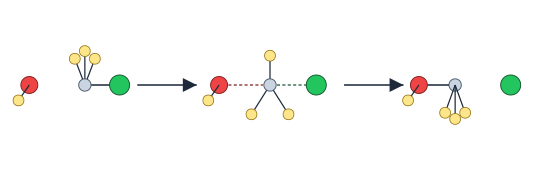
Let’s understand why this reaction behaves the way it does. The key is the mechanism — the step-by-step path from reactants to products. The diagram shows a single step where the incoming approaches the carbon from the side opposite the leaving , passing through a high-energy transition state, and then forming with expelled. This is the classic signature of an (substitution, nucleophilic, bimolecular) reaction.
In , the nucleophile attacks the electrophilic carbon from the back side (the side opposite the leaving group). This forces the three other groups attached to that carbon to “umbrella” or invert — like an umbrella turning inside out in a strong wind. That inversion changes the spatial arrangement of the substituents, so if the starting carbon is chiral, the product has the opposite configuration.
Now, let’s examine each statement carefully.
-
Statement (i): The given reaction follows mechanism.
Look at the species: (b) is with tetrahedral geometry. (c) is the transition state — a trigonal bipyramidal arrangement where both the incoming and the leaving are partially bonded to the carbon. This is a single, concerted step with no intermediate. That is exactly what means: substitution, nucleophilic, bimolecular (both reactants are involved in the rate-determining step). So statement (i) is correct.
-
Statement (ii): (b) and (d) have opposite configuration.
The diagram explicitly shows that the three H atoms in (b) are arranged tetrahedrally (one wedge, one dash, one in plane), and in the product (d) the “umbrella” of H atoms is drawn inverted. This inversion is a direct consequence of back-side attack. If the carbon were chiral (which it isn’t here because it has three identical H atoms, but the principle holds), the configuration would be reversed. For any reaction at a stereogenic centre, the product has the opposite configuration relative to the starting material. So statement (ii) is correct.
-
Statement (iii): (b) and (d) have same configuration.
This directly contradicts the inversion shown in the diagram and the known mechanism of . If the configuration were retained, that would suggest an mechanism (which proceeds through a planar carbocation intermediate and gives racemisation, not retention). But here, the product is clearly inverted. So statement (iii) is incorrect. …
Unlock everything free for 14 days
- Full step-by-step solutions
- Concept-first explanations
- Methods, shortcuts & mistakes
- PYQ mapping + timed mock tests
Full access for 14 days. No credit card required.