Physical Education · Ch 3 — Yoga
Relaxation Technique – Yoga Nidra
Relaxation Technique – Yoga Nidra
The Sanskrit word "yoga" means union or perfect awareness, and "nidra" means sleep. Yoga Nidra is therefore a state in which the body appears to be asleep but the consciousness is functioning at a deeper level of awareness. It is an effective technique for relaxation, and it helps towards stress-management and wellness.
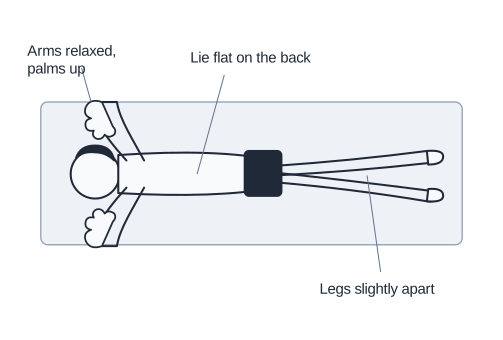
Drawn by us to help you understand the concept clearly, and verified to make sure it's accurate. For exams, practice from your textbook's own diagram.
A person lies flat on the back on the floor in Shavasana: the legs are extended and slightly apart, the arms rest a little away from the body with the palms turned up, the head rests on the ground and the eyes are closed. This fully relaxed supine pos …
Technique
- Lie down straight on the back in Shavasana (corpse pose). Close the eyes and relax; take a few slow, deep breaths.
- Gently take your attention to the right foot, hold it there a few seconds while relaxing the foot, then move up to the right knee, thigh and hip, becoming aware of the whole right leg.
- Repeat the same process for the left leg.
- Take the attention to the stomach, navel region and chest.
- Take the attention to the right shoulder, arm, palm and fingers, then repeat on the left, and finally the throat, face and top of the head.
- Take a deep breath in and observe the sensations in the body; relax in this state for a few minutes.
- Slowly become aware of the body and surroundings and roll onto the right side (this lets the breath flow through the left nostril, which cools the body); stay lying down a little longer.
- Taking your own time, sit up slowly and, when comfortable, gradually open the eyes.
Things to remember
- Yoga Nidra is best done on an empty stomach.
- Practise in a comfortable, clutter-free space.
- Keep a blanket handy, as some people feel cold afterwards.
Contraindications
- Practise at your discretion if you face severe clinical depression or other challenging mental-health conditions (it may still help mild conditions).
- Never practise Yoga Nidra while driving or operating machinery, as you may fall asleep.