Biology · Ch 16 — Excretory Products and their Elimination
Mechanism of Concentration of the Filtrate
Mechanism of Concentration of the Filtrate
One of the defining abilities of mammals is that they can produce a urine much more concentrated than their body fluids. In the human kidney two structures make this possible — Henle's loop and the vasa recta — working together through what is called the counter current mechanism.
Counter current flow
The key feature is the direction of flow. In the two limbs of Henle's loop the filtrate flows in opposite directions, forming a counter current. Similarly, blood flows through the two limbs of the vasa recta in a counter current pattern. Because Henle's loop and the vasa recta lie close together and both carry fluid in opposing directions, they can build and hold a steadily rising osmolarity as one moves deeper into the medulla.
The osmolarity climbs from about 300 milliosmoles per litre in the cortex to roughly 1200 milliosmoles per litre in the inner medulla. This gradient is produced mainly by two substances: sodium chloride and urea.
How the gradient is maintained
The substances are shuffled between the tubule and the blood vessel in a coordinated way:
- Sodium chloride is transported out by the ascending limb of Henle's loop and is exchanged with the descending limb of the vasa recta.
- Sodium chloride is then returned to the interstitium by the ascending portion of the vasa recta.
- In much the same way, small amounts of urea enter the thin segment of the ascending limb of Henle's loop and are carried back to the interstitium by the collecting tubule.
This movement of substances, made possible by the special side-by-side arrangement of Henle's loop and the vasa recta, is the counter current mechanism. Its overall effect is to keep a strong concentration gradient in the medullary interstitium.
The result …
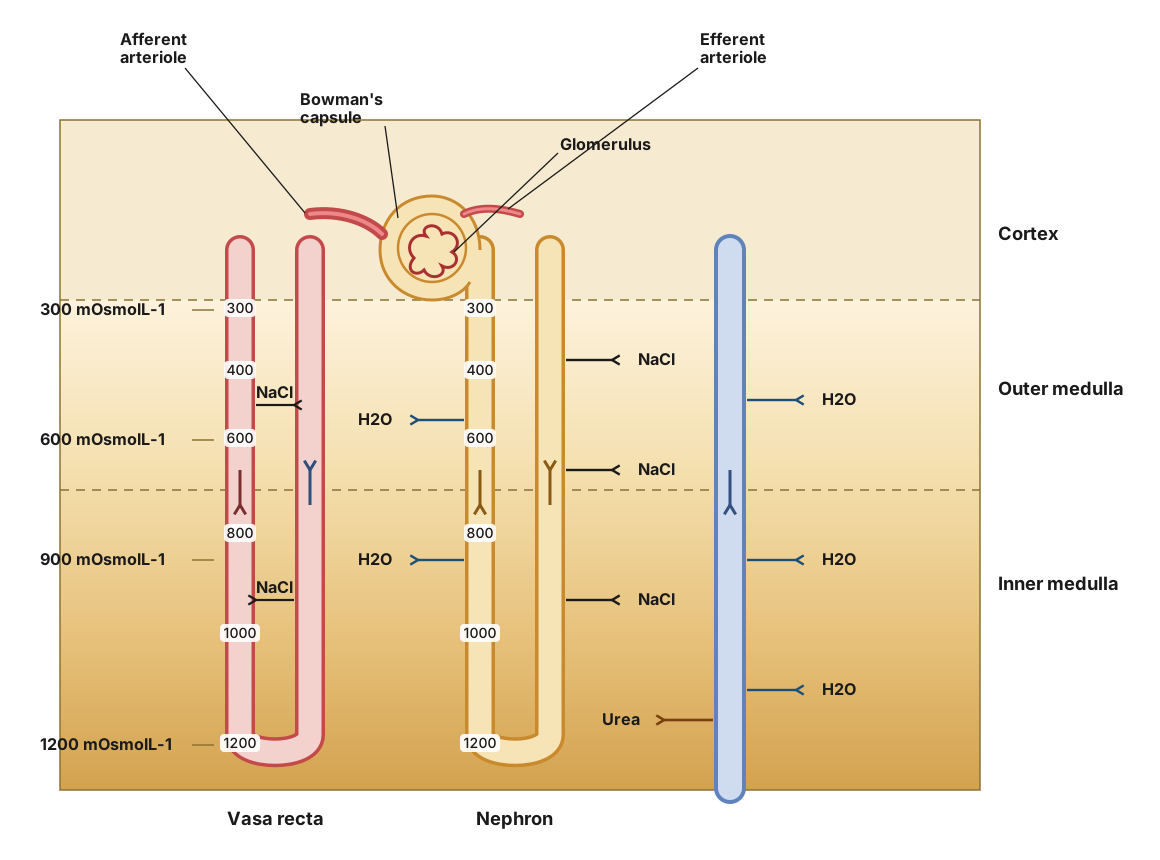
Drawn by us to help you understand the concept clearly, and verified to make sure it's accurate. For exams, practice from your textbook's own diagram.
This figure shows why the human kidney can make urine far more concentrated than the body's own fluids, by placing Henle's loop side by side with the vasa recta blood vessel. Notice that in the two limbs of the loop the filtrate flows in opposite directions, and blood in the two limbs of the vasa recta does the same, and this opposing flow is what is meant by a counter current. Because the loop and the vessel lie close together and both carry fluid in opposite directions, they build and hold a concentration that rises steadily as you move deeper, shown climbing from the outer cortex toward the inner medulla. The figure also …