Chemistry · Ch 1 — Some Basic Concepts of Chemistry
Avogadro's Law
Avogadro's Law
Avogadro's Law
In 1811, Amedeo Avogadro put forward a bold idea that would eventually become one of the cornerstones of chemical science. He proposed that equal volumes of all gases, measured at the same temperature and pressure, contain the same number of molecules. This was a radical departure from the thinking of his time, because it linked the volume of a gas directly to the number of particles it contains, not to the mass or type of those particles.
Avogadro made a crucial distinction that many before him had missed: the difference between an atom and a molecule. In the early 1800s, scientists like Dalton believed that the smallest particles of elements were single atoms, and that these atoms combined in simple whole-number ratios. But this view could not explain certain experimental results, especially those involving gases.
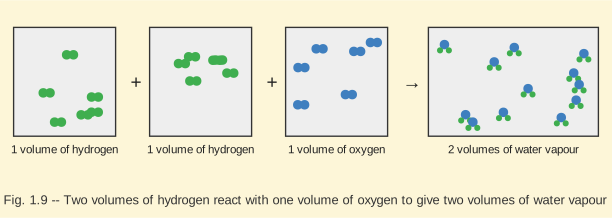
Consider the reaction between hydrogen and oxygen to form water. Experimentally, two volumes of hydrogen combine with exactly one volume of oxygen to produce two volumes of water vapour, with no leftover oxygen. If you picture each volume as a box containing the same number of particles, the result makes sense only if the reacting particles are not single atoms but molecules containing two atoms each. Two molecules of hydrogen (each ) react with one molecule of oxygen () to form two molecules of water (). The volume ratio of 2:1:2 matches the molecular ratio perfectly.
Drawn by us to help you understand the concept clearly, and verified to make sure it's accurate. For exams, practice from your textbook's own diagram.
Fig. 1.9 shows the reaction described in the text as four boxes of equal size, each representing one volume of gas and containing the same number of molecules. One box of hydrogen plus another box of hydrogen plus one box of oxygen react completely to give two boxes of water vapour -- with nothing left over. Because each box holds the same number of molecules (Avogadro's hypothesis), the 2:1:2 ratio of boxe …
Avogadro published his proposal in the French Journal de Physique, but in spite of being correct it did not gain much support during his lifetime. Only after about 50 years — at the first international conference on chemistry held in Karlsruhe, Germany in 1860, where Stanislao Cannizzaro presented a sketch of a course of chemical philosophy emphasising the importance of Avogadro's work — was the idea recognised as a fundamental law of chemistry.
The Statement of Avogadro's Law
Avogadro's Law states: Equal volumes of all gases under the same conditions of temperature and pressure contain an equal number of molecules.
This means that the volume of a gas is directly proportional to the number of moles (or molecules) of that gas, provided the temperature and pressure are held constant. Mathematically, we write:
where is the volume of the gas and is the number of moles. This proportionality can be turned into an equation by introducing a constant:
where is a proportionality constant that depends on the temperature and pressure.
The Molar Volume Concept
A direct consequence of Avogadro's Law is the idea of molar volume. If one mole of any gas contains the same number of molecules (Avogadro's number, ), then at a given temperature and pressure, one mole of any gas must occupy the same volume.
At Standard Temperature and Pressure (STP) — defined as (273.15 K) and 1 atm pressure — experiments show that one mole of any ideal gas occupies 22.4 litres. This is known as the standard molar volume.
The molar volume of 22.4 L at STP applies only to ideal gases. Real gases deviate slightly from this value, especially at high pressures or low temperatures, but for most calculations in basic chemistry, the approximation is excellent.
Quantitative Relationships from Avogadro's Law
From the direct proportionality , we can derive several useful relationships.
Relationship 1: Volume and number of moles
If we have two samples of gas at the same temperature and pressure, the ratio of their volumes equals the ratio of their number of moles:
This is the most common form used in calculations. If you know the volume of a known number of moles, you can find the volume for any other number of moles, or vice versa.
Relationship 2: Volume and number of molecules
Since the number of molecules is related to the number of moles by (where is Avogadro's number), and is proportional to , it follows that is also proportional to :
This is the direct statement of Avogadro's original hypothesis: equal volumes contain equal numbers of molecules.
Deriving the Combined Gas Law
Avogadro's Law completes the set of gas laws. When combined with Boyle's Law ( at constant and ) and Charles's Law ( at constant and ), we can write a single proportionality that incorporates all three:
Introducing a universal proportionality constant , we get the Ideal Gas Equation:
…