Mathematics · Ch 9 — Straight Lines
Slope of a Line When Coordinates of Any Two Points on the Line Are Given
Slope of a Line When Coordinates of Any Two Points on the Line Are Given
Concept: Slope from Two Points
A line is completely determined by any two points on it. Given two points, we can find the line's slope — the measure of its steepness — without needing a diagram. The slope is simply the ratio of the vertical change to the horizontal change between the two points.
Consider a non-vertical line passing through two distinct points and . Because the line is non-vertical, ; if , the line would be vertical and its slope would be undefined. Let the inclination of the line be . The inclination may be acute () or obtuse (). We treat both cases separately to derive a single, unified formula.
Derivation for Acute Inclination ( acute)
Draw perpendiculars from and to the axes as shown in the textbook figure. From , draw a horizontal line to meet the vertical line through at point . In the right triangle , the angle at equals (corresponding angles with the transversal).
In :
- The vertical side
- The horizontal side
By definition of slope:
From the triangle:
Therefore:
Derivation for Obtuse Inclination ( obtuse)
When is obtuse, the acute angle inside is . In this case, .
Now, .
Using the tangent identity for supplementary angles:
So:
In , .
Thus:
But (multiplying numerator and denominator by ).
Hence, the same formula holds:
The slope formula is identical for both acute and obtuse inclinations. The sign of the slope automatically accounts for the direction of the line.
The Unified Formula
For any two points and on a non-vertical line, the slope is:
This is the fundamental result of this section. The order of subtraction does not matter as long as it is consistent: .
This formula fails for vertical lines (). For vertical lines, slope is undefined. Also, if , the slope is , indicating a horizontal line.
Key Observations
-
Consistency: The slope is independent of which point is labelled and which is , as long as the subtraction is consistent in numerator and denominator.
-
Sign of slope: …
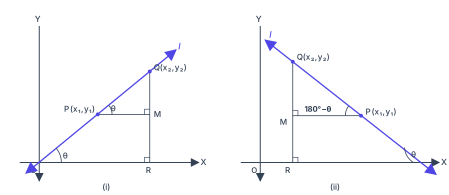
Drawn by us to help you understand the concept clearly, and verified to make sure it's accurate. For exams, practice from your textbook's own diagram.
The figure shows a single non-vertical line in two different orientations, drawn on a standard -coordinate plane. In both panels, two fixed points and lie on the line. The key construction is the same in both cases: from , a vertical line is dropped straight down to meet the -axis at point (so is perpendicular to the -axis). From , a horizontal line is drawn to meet at point (so is perpendicular to ). This creates a right-angled triangle , with the right angle at .
The difference between the two panels is the sign of the line's slope. In panel (i), the line runs upward as we move from left to right — the inclination (the angle the line makes with the positive -axis, measured anticlockwise) is acute, less than . Here, the angle at inside the triangle, , is exactly equal to . In panel (ii), the line runs downward as we move left to right — the inclination is obtuse, greater than . In this case, the interior angle at in the triangle is the supplement of : .
The physical idea is simple: the slope of a line is the ratio of the vertical change to the horizontal change between any two points on it. The figure shows that this ratio can be read directly from the right triangle formed by the two points and the coordinate axes. The vertical leg has length , and the horizontal leg has length . The sign of the slope is determined by whether increases or decreases as increases — that is, whether the line is rising or falling.
This single formula works for both acute and obtuse inclinations. In the acute case, directly. In the obtuse case, , but careful: because in that panel, the denominator is negative, and the negative signs cancel to give exactly the same expression . …