Trigonometric Functions of Sum and Difference of Two Angles
This section develops the core identities that let you express trigonometric functions of sums and differences in terms of functions of the individual angles. These are the building blocks for everything that follows — double-angle formulas, triple-angle formulas, sum-to-product transformations, and more.
Foundational Results Already Known
Before we begin, recall two basic identities that hold for any angle x:
- sin(−x)=−sinx
- cos(−x)=cosx
These will be used repeatedly in the derivations that follow.
Identity 3: cos(x+y)=cosxcosy−sinxsiny
This is the most fundamental addition formula. Everything else in this section flows from it.
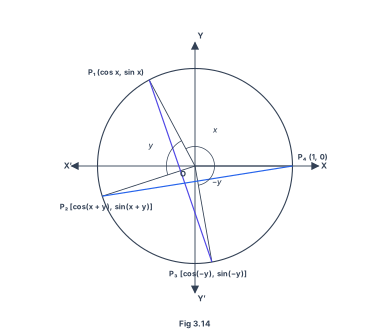
Proof using the unit circle:
Consider a unit circle centred at the origin. Let angle x be ∠P4OP1 and angle y be ∠P1OP2. Then (x+y) is ∠P4OP2. Also let (−y) be ∠P4OP3.
The coordinates of the four points are:
- P1(cosx,sinx)
- P2[cos(x+y),sin(x+y)]
- P3[cos(−y),sin(−y)] — which equals (cosy,−siny)
- P4(1,0)
Now consider triangles P1OP3 and P2OP4. These triangles are congruent (they have two sides equal — the radii — and the included angle equal). Therefore P1P3=P2P4, and consequently P1P32=P2P42.
Compute P1P32 using the distance formula:
P1P32=[cosx−cos(−y)]2+[sinx−sin(−y)]2=(cosx−cosy)2+(sinx+siny)2=cos2x+cos2y−2cosxcosy+sin2x+sin2y+2sinxsiny=(cos2x+sin2x)+(cos2y+sin2y)−2(cosxcosy−sinxsiny)=2−2(cosxcosy−sinxsiny)
Now compute P2P42:
P2P42=[1−cos(x+y)]2+[0−sin(x+y)]2=1−2cos(x+y)+cos2(x+y)+sin2(x+y)=2−2cos(x+y)
Since P1P32=P2P42, we equate:
2−2(cosxcosy−sinxsiny)=2−2cos(x+y)
Cancelling 2 and dividing by −2 gives:
cos(x+y)=cosxcosy−sinxsiny
Identity 4: cos(x−y)=cosxcosy+sinxsiny
Replace y by −y in Identity 3:
cos(x+(−y))=cosxcos(−y)−sinxsin(−y)
Using cos(−y)=cosy and sin(−y)=−siny:
cos(x−y)=cosxcosy−sinx(−siny)=cosxcosy+sinxsiny
cos(x−y)=cosxcosy+sinxsiny
Identity 5: cos(2π−x)=sinx
Take Identity 4 with x=2π and y=x:
cos(2π−x)=cos2πcosx+sin2πsinx=0⋅cosx+1⋅sinx=sinx
cos(2π−x)=sinx
Identity 6: sin(2π−x)=cosx
Apply Identity 5 to the angle (2π−x):
sin(2π−x)=cos[2π−(2π−x)]=cosx
sin(2π−x)=cosx
Identity 7: sin(x+y)=sinxcosy+cosxsiny
Use the cofunction relationship from Identity 5:
sin(x+y)=cos[2π−(x+y)]=cos[(2π−x)−y]
Now apply Identity 4 with x replaced by (2π−x) and y replaced by y:
cos[(2π−x)−y]=cos(2π−x)cosy+sin(2π−x)siny
Using Identities 5 and 6:
=sinxcosy+cosxsiny
sin(x+y)=sinxcosy+cosxsiny
Identity 8: sin(x−y)=sinxcosy−cosxsiny
Replace y by −y in Identity 7:
sin(x+(−y))=sinxcos(−y)+cosxsin(−y)
Using cos(−y)=cosy and sin(−y)=−siny:
sin(x−y)=sinxcosy−cosxsiny
sin(x−y)=sinxcosy−cosxsiny
Identity 9: Results for Specific Angle Combinations
By substituting suitable values of x and y into Identities 3, 4, 7, and 8, we obtain the following standard results:
| Expression | Result |
|---|
| cos(2π+x) | −sinx |
| sin(2π+x) | cosx |
| cos(π−x) | −cosx |
| sin(π−x) | sinx |
| cos(π+x) | −cosx |
| sin(π+x) | −sinx |
| cos(2π−x) | cosx |
| sin(2π−x) | −sinx |
Similar results for tanx, cotx, secx, and cscx can be derived from these sine and cosine results. For example, tan(π−x)=cos(π−x)sin(π−x)=−cosxsinx=−tanx.
Identity 10: tan(x+y)=1−tanxtanytanx+tany
This identity holds provided none of x, y, and (x+y) is an odd multiple of 2π (so that cosx, cosy, and cos(x+y) are all non-zero).
Start with the definition:
tan(x+y)=cos(x+y)sin(x+y)=cosxcosy−sinxsinysinxcosy+cosxsiny
Divide numerator and denominator by cosxcosy:
tan(x+y)=cosxcosycosxcosy−cosxcosysinxsinycosxcosysinxcosy+cosxcosycosxsiny=1−tanxtanytanx+tany
tan(x+y)=1−tanxtanytanx+tany
Identity 11: tan(x−y)=1+tanxtanytanx−tany
Replace y by −y in Identity 10:
tan(x−y)=tan[x+(−y)]=1−tanxtan(−y)tanx+tan(−y)
Since tan(−y)=−tany:
tan(x−y)=1+tanxtanytanx−tany
tan(x−y)=1+tanxtanytanx−tany
Identity 12: cot(x+y)=coty+cotxcotxcoty−1
This holds provided none of x, y, and (x+y) is a multiple of π (so that sinx, siny, and sin(x+y) are non-zero).
Start with the definition:
cot(x+y)=sin(x+y)cos(x+y)=sinxcosy+cosxsinycosxcosy−sinxsiny
Divide numerator and denominator by sinxsiny:
cot(x+y)=sinxsinysinxcosy+sinxsinycosxsinysinxsinycosxcosy−sinxsinysinxsiny=coty+cotxcotxcoty−1
cot(x+y)=coty+cotxcotxcoty−1
Identity 13: cot(x−y)=coty−cotxcotxcoty+1
Replace y by −y in Identity 12. Since cot(−y)=−coty:
cot(x−y)=cot(−y)+cotxcotxcot(−y)−1=−coty+cotx−cotxcoty−1
Multiply numerator and denominator by −1:
cot(x−y)=coty−cotxcotxcoty+1
cot(x−y)=coty−cotxcotxcoty+1
Double-Angle Formulas
Identity 14: cos2x=cos2x−sin2x=2cos2x−1=1−2sin2x=1+tan2x1−tan2x
Start with cos(x+y) and set y=x:
cos2x=cos(x+x)=cosxcosx−sinxsinx=cos2x−sin2x
Using sin2x=1−cos2x:
cos2x=cos2x−(1−cos2x)=2cos2x−1
Using cos2x=1−sin2x:
cos2x=(1−sin2x)−sin2x=1−2sin2x
For the tangent form, write cos2x=cos2x−sin2x=cos2x+sin2xcos2x−sin2x and divide numerator and denominator by cos2x:
cos2x=1+tan2x1−tan2x
cos2x=cos2x−sin2x=2cos2x−1=1−2sin2x=1+tan2x1−tan2x
Identity 15: sin2x=2sinxcosx=1+tan2x2tanx
Set y=x in sin(x+y):
sin2x=sin(x+x)=sinxcosx+cosxsinx=2sinxcosx
For the tangent form, write sin2x=sin2x+cos2x2sinxcosx and divide numerator and denominator by cos2x:
sin2x=1+tan2x2tanx
sin2x=2sinxcosx=1+tan2x2tanx
Identity 16: tan2x=1−tan2x2tanx
Set y=x in tan(x+y):
tan2x=1−tanxtanxtanx+tanx=1−tan2x2tanx
tan2x=1−tan2x2tanx
Triple-Angle Formulas
Identity 17: sin3x=3sinx−4sin3x
Write 3x=2x+x and use the addition formula:
sin3x=sin(2x+x)=sin2xcosx+cos2xsinx=(2sinxcosx)cosx+(1−2sin2x)sinx=2sinxcos2x+sinx−2sin3x=2sinx(1−sin2x)+sinx−2sin3x=2sinx−2sin3x+sinx−2sin3x=3sinx−4sin3x
sin3x=3sinx−4sin3x
Identity 18: cos3x=4cos3x−3cosx
Again write 3x=2x+x:
cos3x=cos(2x+x)=cos2xcosx−sin2xsinx=(2cos2x−1)cosx−(2sinxcosx)sinx=2cos3x−cosx−2sin2xcosx=2cos3x−cosx−2(1−cos2x)cosx=2cos3x−cosx−2cosx+2cos3x=4cos3x−3cosx
cos3x=4cos3x−3cosx
Identity 19: tan3x=1−3tan2x3tanx−tan3x
Write 3x=2x+x:
tan3x=tan(2x+x)=1−tan2xtanxtan2x+tanx
Substitute tan2x=1−tan2x2tanx:
tan3x=1−1−tan2x2tanx⋅tanx1−tan2x2tanx+tanx
Multiply numerator and denominator by (1−tan2x):
tan3x=(1−tan2x)−2tan2x2tanx+tanx(1−tan2x)=1−3tan2x2tanx+tanx−tan3x=1−3tan2x3tanx−tan3x
tan3x=1−3tan2x3tanx−tan3x
Sum-to-Product Identities (Identity 20)
These identities transform sums of trigonometric functions into products — extremely useful for solving equations and simplifying expressions.
Derivation of the Four Core Identities
Start with the addition and subtraction formulas for cosine:
cos(x+y)cos(x−y)=cosxcosy−sinxsiny(1)=cosxcosy+sinxsiny(2)
Adding (1) and (2):
cos(x+y)+cos(x−y)=2cosxcosy(3)
Subtracting (2) - (1):
cos(x−y)−cos(x+y)=2sinxsiny
Multiplying by −1:
cos(x+y)−cos(x−y)=−2sinxsiny(4)
Now for sine:
sin(x+y)sin(x−y)=sinxcosy+cosxsiny(5)=sinxcosy−cosxsiny(6)
Adding (5) and (6): …